Credit: ©Science China Press
With the quick development of industrial technology, the energy crisis caused by the shortage of fossil energy has been a growing headache. The renewable and green energy source systems such as fuel cell and metal-air batteries are regarded as the reliable alternatives to fossil fuels. Oxygen reduction reaction (ORR) and oxygen evolution reaction (OER) are paramount semi-reactions in these applications. The noble metal catalysts are widely used for both ORR and OER. However, their scarcity, high cost, and poor durability strongly impede the large-scale application. Therefore, a rational design of bifunctional non-expensive oxygen electrocatalysts is highly desired.
Metal-organic frameworks (MOFs), a new class material with special chemical and physical properties, have attracted tremendous attention in recent years for their versatile potential applications. Recently, applying MOFs in electrochemical reactions has been an emerging research field because the high surface area of MOFs can maximize active site density, and the special chemical structures of MOFs provide a tailored microenvironment for controllable reaction within the pores. However, it is rarely reported to use MOFs directly in the electrocatalysis field due to their low ion transport and unfavourable electrical conductivity.
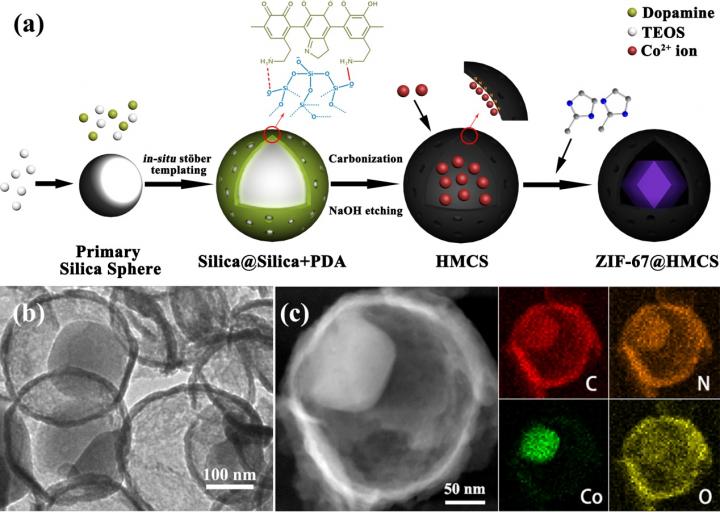
Encapsulating nanoparticles into hollow mesoporous carbon sphere (HMCS) is a classical design. This design is helpful to stabilize catalytic active sites, increase electrical conductivity and reduce mass transport lengths. The yolk-shell structure design such as metallic nanoparticles@carbon, metal oxide@carbon has been widely used in lithium batteries, catalysis and other flieds. However, the design of MOFs@HMCS yolk-shell structured hybrid material has not been reported yet. Therefore, it is believed that the elaborate combination of MOFs with HMCS to construct a yolk-shell structured hybrid material will effectively overcome the aforementioned shortcoming of MOFs materials in electrocatalysis field.
In response to this challenge, recently, the research team led by Prof. Cao Rong from Fujian Institute of Research on the Structure of Matter of the Chinese Academy of Sciences designed a yolk-shell structured ZIF-67@HMCS hybrid material by using ZIF-67 as core and hollow mesoporous carbon spheres (HMCS) as shell innovatively. The particle size of ZIF-67 is well controlled by utilizing the spatial confinement effect from HMCS, which shortens the diffusion paths and enhances the ion transportation. Encapsulating ZIF-67 in HMCS also increase its conductivity prominently. Moreover, the typical hierarchical pore structures of HMCS guarantee the diffusion of reactive species to the exposed active sites of ZIF-67 quickly and efficiently, and thus improve the electrochemical activity. The ZIF-67@HMCS hybrid material exhibits superior bifunctional electrocatalytic activity towards both ORR and OER. What’s more, the assembled Zn-air battery by ZIF-67@HMCS as air-cathode also presents impressive performance and long-term stability.
This bifunctional yolk-shell structured hybrid material could be a promising candidate as electrocatalyst in fuel cells and electrolysers for renewable energy applications. This work also paves a new way toward designing stable MOFs used directly as high efficiency electrochemical catalysts in promising energy storage devices to meet the growing demand of stable energy supply.
###
This research received funding from the the Ministry of Science and Technology of China, the National Natural Science Foundation of China, and the Chinese Academy of Sciences.
See the article:
Wanfeng Xiong, Hongfang Li,* Hanhui You, Minna Cao, Rong Cao*
Encapsulating metal organic framework into hollow mesoporous carbon sphere as efficient oxygen bifunctional electrocatalyst
Natl Sci Rev, doi: 10.1093/nsr/nwz166
https:/
The National Science Review is the first comprehensive scholarly journal released in English in China that is aimed at linking the country’s rapidly advancing community of scientists with the global frontiers of science and technology. The journal also aims to shine a worldwide spotlight on scientific research advances across China.
Media Contact
Rong Cao
[email protected]
Related Journal Article
http://dx.