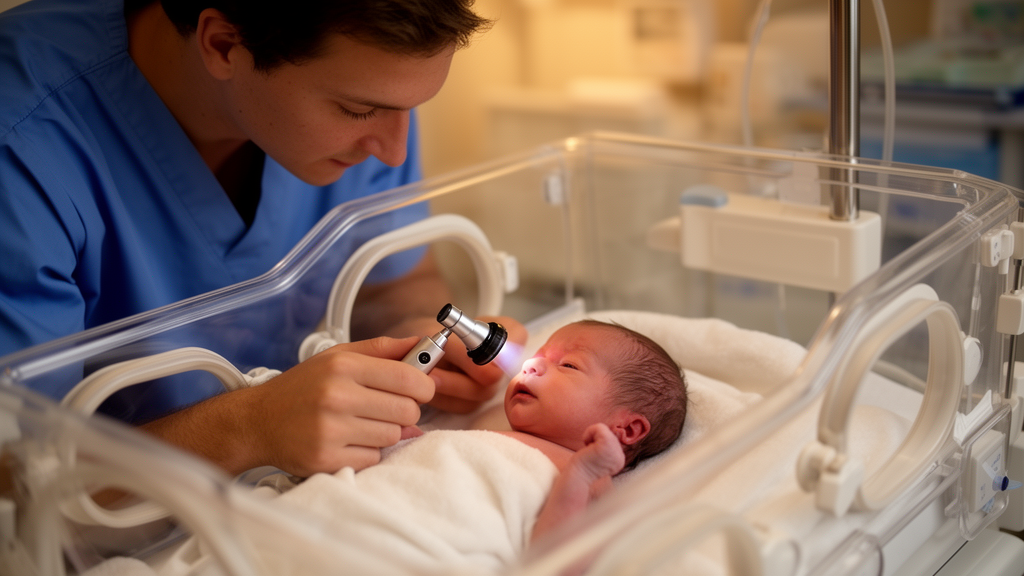
A prospective multicenter study has demonstrated that an early risk prediction model can help identify the likelihood of severe retinopathy of prematurity among very preterm infants surviving to eye evaluation. Conducted across twenty-eight hospitals in Shenzhen, China, the investigation focused on infants born at less than thirty-two weeks of gestation to evaluate whether routinely recorded clinical variables could provide investigational risk stratification shortly after birth.
Severe retinopathy of prematurity represents a major vision-threatening condition among infants born before thirty-two weeks of gestation. To address this risk, researchers aimed to construct and internally validate a mathematical prediction model utilizing clinical data that are routinely collected during standard hospital care, seeking an objective approach to assess conditional risk before conventional screening takes place.
The prospective cohort study enrolled eligible infants admitted between January 2022 and December 2023 across the participating hospital network. Investigators set the primary prediction target as the conditional risk of developing severe retinopathy of prematurity specifically among infants who survived long enough to undergo formal ophthalmic assessment. Severe disease was defined as reaching stage 3 or higher based on the International Classification of Retinopathy of Prematurity, Third Edition.
To build the prediction tool, researchers evaluated candidate predictors spanning maternal, perinatal, and early neonatal variables that were readily available at delivery or within the first twenty-four hours of life. Using these parameters, the team trained a ridge logistic regression model and designed an extensive statistical evaluation framework to measure model discrimination, calibration accuracy, overall error, and potential net clinical benefit through decision curve analysis.
From an initial cohort of 1,453 identified infants, investigators excluded 112 individuals who died prior to eye examination and removed 5 duplicate hospital records. This left 1,336 infants for final prediction modeling. Within this analyzed population, severe retinopathy of prematurity occurred in 179 infants, establishing an overall observed incidence rate of 13.4 percent among surviving patients.
The developed ridge regression model achieved an apparent area under the receiver operating characteristic curve of 0.844, with a 95 percent confidence interval spanning from 0.812 to 0.876. To address potential statistical overfitting, the authors conducted internal validation using 500 bootstrap resamples. This optimism correction resulted in an adjusted area under the curve of 0.831, accompanied by an optimism-corrected Brier score of 0.089 and an estimated calibration slope of 1.192.
The researchers also performed internal-external validation using a leave-one-center-out procedure to test generalizability across participating centers. In this analysis, the pooled area under the curve was 0.789, with a 95 percent confidence interval of 0.749 to 0.827. The pooled evaluation also demonstrated a Brier score of 0.094 and an observed calibration slope of 1.031 across the individual hospital sites.
The authors emphasized that the predictive tool provides investigational risk stratification and must complement, rather than replace, established guideline-recommended screening protocols. The research team noted that prospective clinical-impact evaluations and independent external validations across diverse populations remain necessary before considering real-world clinical implementation, with the underlying trial retrospectively registered under the Chinese Clinical Trial Registry as ChiCTR2400090262.
Subject of Research: Early prediction modeling for severe retinopathy of prematurity in preterm infants
Article Title: Early prediction of severe retinopathy of prematurity in infants born at < 32 weeks’ gestation: a multicenter prediction model study
Article References: Guo, Y., Su, R., Chen, J., Zhang, H., Lu, G., Yan, X., Yu, Z., Liu, Y., & Chen, G. (2026). Early prediction of severe retinopathy of prematurity in infants born at < 32 weeks’ gestation: a multicenter prediction model study. BMC Pediatrics. https://doi.org/10.1186/s12887-026-08061-1
Image Credits: AI Generated
DOI: 10.1186/s12887-026-08061-1
Keywords: retinopathy of prematurity, preterm infants, prediction model, ridge logistic regression, neonatal intensive care, Shenzhen, gestational age, area under the curve, internal-external validation, Brier score, calibration slope, bootstrap optimism correction, prospective cohort study, perinatal variables, ophthalmology screening, clinical risk stratification
News Source: Harold Sullivan. (November 20, 2026). Model Predicts Severe Eye Disease Risk in Very Preterm Infants. Scienmag.