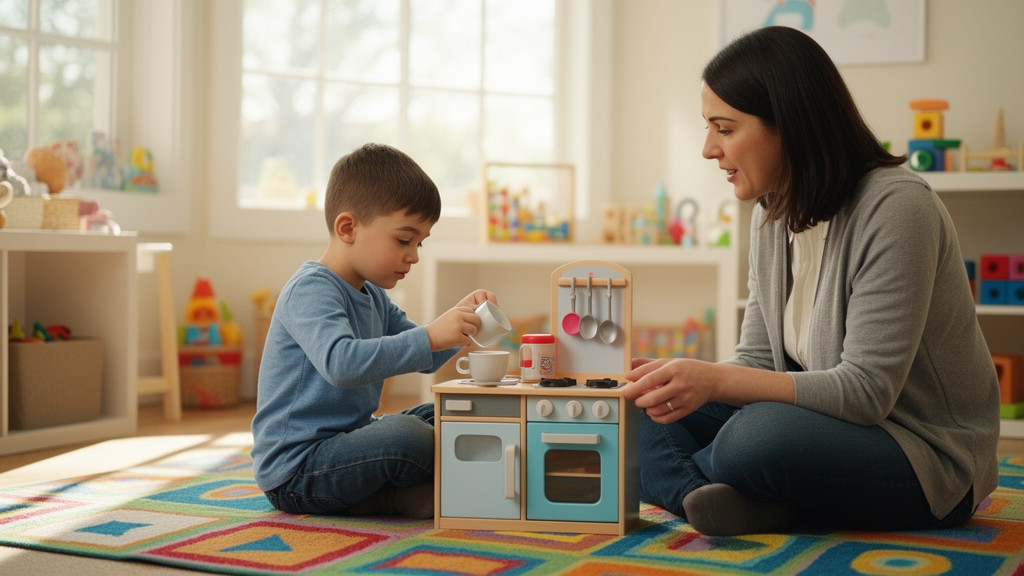
Language development across the autism spectrum is recognized for its extraordinary variability, presenting developmental trajectories that range from early fluent speech to minimally verbal profiles. Addressing this heterogeneity, a new hypothesis and theory article published in Frontiers in Psychiatry by lead author Alessandro Frolli and colleagues proposes a formal longitudinal model in which functional object use acts as a developmental bridge to later verbal communication. Rather than treating early vocabulary as an isolated skill, the researchers situate conventional object interaction within an integrated developmental framework linking nonverbal visual cognition, caregiver input, joint attention, and imitation. Functional object use is strictly defined as intentional, conventional, and goal-directed manipulation according to culturally recognizable functions, such as lifting a cup to drink, rolling a toy car on a flat surface, or stirring a bowl with a spoon. By establishing structured, predictable object-action-goal routines, these conventional actions offer an organized triadic platform where children, caregivers, and physical objects coordinate, establishing shared referential foundations that facilitate lexical acquisition.
To establish rigorous empirical boundaries, the theoretical framework distinguishes functional object use from four adjacent forms of object engagement frequently observed during early childhood. The first category, sensorimotor exploration, encompasses actions such as mouthing, banging, shaking, rubbing, and tactile inspection that lack conventional object-action-goal structures. The second category captures repetitive or sensory-focused manipulation, including spinning toy wheels, lining up blocks, perseverative opening and closing of containers, or prolonged visual inspection without adherence to culturally established utility. The authors emphasize that sensorimotor and sensory-focused actions are descriptive rather than evaluative classifications, highlighting that these behaviors can provide genuine utility, self-regulation, or enjoyment for the child without being inherently inadequate or requiring replacement. The third boundary construct involves mechanical means-end problem solving, such as pressing buttons, sliding latches, or fitting puzzle pieces to reveal affordances through visual analysis. Finally, symbolic or pretend play involves representational transformations where an object or agent assumes an imagined identity, such as substituting a wooden block for a telephone or pretending an empty plastic cup contains warm tea.
The developmental distinction between functional object use and symbolic pretense holds central importance within the proposed architecture. Drawing on established developmental play assessment frameworks, conventional action forms and representational contents are separated into distinct measurement tracks rather than combined into a single composite score. For example, feeding a doll with a spoon incorporates a conventional motor action while simultaneously depicting an imagined recipient, requiring separate descriptive codes so that pretense is not prematurely embedded into baseline functional object scores. In typical development, early functional actions and symbolic sequences predict concurrent and longitudinal language growth by supplying segmentable, repeatable events that adult partners can easily label with words like cup, hot, open, feed, or car. In autistic children, prior investigations reveal that global frequencies of functional play can obscure substantial differences in action variety, structural flexibility, and social embedding. By isolating nonpretend functional object use at baseline, the framework allows researchers to test whether conventional action supports communication directly or functions in parallel with emergent symbolic capacities.
Within the primary confirmatory architecture, the authors specify a longitudinal parallel mediation design operating across three discrete measurement waves. In this model, baseline functional object use measured at Time 1 predicts language outcomes at Time 3 indirectly through two correlated mediators evaluated at Time 2: sustained joint engagement and spontaneous immediate object imitation. The framework emphasizes that observational mediation models establish prospective indirect associations rather than confirmed causal mechanisms, requiring rigorous statistical adjustment for baseline language, baseline mediator levels, chronological age, fine motor ability, autism symptom severity, repetitive object manipulation, and intervention exposure. To validate the proposed directional hypothesis, the focal formulation must be systematically contrasted against competing models evaluated on the identical longitudinal sample. These competing models include an additive account predicting independent direct influences, a common-cause model attributing longitudinal associations to general cognitive or motor development, and reciprocal models testing whether early language or imitation acts as an antecedent predicting subsequent object use.
Joint attention constitutes the first focal mediator, conceptualized as a triadic social-cognitive capacity that coordinates attention between the child, an adult partner, and an object or event. The theoretical model differentiates three distinct dimensions of this construct: responding to joint attention, initiating joint attention, and sustained joint engagement. Responding to joint attention involves following an interaction partner’s gaze shift or pointing gesture, a skill hypothesized to support receptive language development by directing the child’s focus toward adult-identified referents. Initiating joint attention encompasses spontaneous bids to share interest through alternating eye contact, pointing, showing, or offering objects, predicted to relate closely to expressive and pragmatic vocabulary growth. Sustained joint engagement represents the broader state where dyadic interaction remains continuously coordinated around a shared object activity over time. The authors argue that joint engagement transforms solitary object play into a communicative event, creating extended interactive episodes where responsive caregiver language can be synchronized directly with the child’s immediate attentional focus.
The second focal mediator is spontaneous immediate object imitation, precisely defined as the unprompted reproduction of a demonstrated object-action variation without adult instruction or physical guidance. This construct is explicitly differentiated from structured elicited object imitation, deferred imitation involving memory retrieval over delays, and manual or body imitation. By isolating spontaneous immediate imitation with objects, the model measures a child’s active uptake of newly observed action variations within an existing behavioral repertoire. Elicited imitation tasks, which assess motor reproduction following direct verbal commands, remain separate competing mediators in secondary analyses. The authors emphasize that spontaneous object imitation must not be operationalized using social gaze or shared smiling as mandatory criteria, because confounding imitation coding with social affect would introduce circular measurement overlap with joint engagement. Measuring these subdomains on separate scales allows researchers to evaluate whether imitation provides an independent developmental pathway toward expressive language or acts as a correlated facet of shared attention.
A critical theoretical contribution of the framework is the inclusion of nonverbal visual problem solving as both an essential developmental covariate and a prospective moderator. Toddler assessments of nonverbal visual cognition typically measure visual reception, pattern matching, means-end reasoning, spatial problem solving, and object permanence rather than fluid reasoning in an abstract psychometric sense. The authors outline two partially distinct developmental pathways leading to functional object proficiency: a socially embedded route and a visual-problem-solving route. In the socially embedded route, a child acquires conventional object use through interactive observation, modeled demonstrations, shared routines, and caregiver verbal labeling, establishing direct functional ties between object manipulation and communication. Conversely, in the visual-problem-solving route, a child discovers object functions through autonomous affordance detection, mechanical causal inference, and visual analysis. While both developmental routes yield skilled object use, solitary or repetitive visual problem solving may produce competent mechanical actions without providing shared referential contexts, potentially explaining why some autistic toddlers demonstrate high object proficiency alongside minimal spoken language.
The framework incorporates communicative functions as proximal developmental outcomes rather than treating communicative acts as identical to structural language competence. Grounded in developmental pragmatics, communicative function describes the behavioral purpose of an act directed toward another individual, categorized into behavioral regulation, social interaction, and sharing attention or information. Behavioral regulation encompasses acts designed to request objects, demand actions, obtain assistance, or protest unwanted events. Social interaction includes communicative bids that initiate or sustain relational connection, such as greeting an adult or maintaining a physical game. Sharing attention or information involves directing a partner toward an object or event purely to share interest. The model dictates that communicative functions must be coded independently of the expressive modality utilized, whether the child communicates using spoken words, nonverbal gestures, manual signs, vocalizations, or augmentative and alternative communication devices. In extended four-wave longitudinal models, early joint engagement and spontaneous imitation are hypothesized to predict increases in specific communicative functions, which subsequently predict distal expressive vocabulary.
To evaluate these theoretical proposals, the authors outline strict methodological guidelines for future empirical testing across prospective toddler cohorts. Confirmatory longitudinal designs require at least three time points spaced approximately six to nine months apart, typically initiating data collection between 18 and 30 months of age. Researchers must evaluate measurement invariance across developmental waves and examine discriminant validity among observational codes, ensuring that identical behavioral items are never scored simultaneously as predictors and mediators. Furthermore, intervention histories must be comprehensively recorded as structured sources of developmental heterogeneity rather than treated as unmeasured confounding noise. Because early intervention programs frequently target joint attention, imitation, functional play, and parent responsiveness simultaneously, studies must document intervention approach, total weekly hours, delivery setting, and specific curriculum targets. Statistical models must account for missing observations using full-information maximum likelihood or multiple imputation, using sensitivity analyses to evaluate the robustness of indirect associations against unmeasured confounding.
These theoretical distinctions offer practical guidance for individualized clinical assessment and early intervention design. Standardized assessments should describe conventional object competence, symbolic elaboration, imitation forms, engagement duration, and communicative intent along separate diagnostic axes, acknowledging that comparable functional toy manipulation can serve entirely different goals across children. In therapeutic settings, interventions should leverage shared object routines to support communication without establishing rigid developmental prerequisites. The authors emphasize that conventional functional play does not represent a mandatory milestone that must precede communicative support, and access to multimodal communication supports—including signs, pictures, and speech-generating devices—should never be postponed until a child masters conventional toy manipulation or symbolic pretense. By detailing the interacting perceptual, motor, social, and cognitive processes surrounding object actions, the framework establishes a verifiable roadmap for examining how shared play activities foster language growth across diverse autistic developmental trajectories.
Subject of Research: Theoretical mediation model linking functional object use to language development in autism
Article Title: Functional object use as a developmental bridge to language in autism: a mediation model of joint attention and imitation
Article References: Frolli, A., Chiarella, S. G., Presti, G., Di Salle, F., Sica, L. S., & Cavallaro, A. (2026). Functional object use as a developmental bridge to language in autism: a mediation model of joint attention and imitation. Frontiers in Psychiatry, 17, 1960489. https://doi.org/10.3389/fpsyt.2026.1960489
Image Credits: AI Generated
DOI: 10.3389/fpsyt.2026.1960489
Keywords: functional object use, autism spectrum disorder, joint attention, sustained joint engagement, spontaneous immediate object imitation, language development, parallel mediation model, symbolic play, nonverbal visual problem solving, communicative functions, caregiver linguistic input, developmental pragmatics, longitudinal study design, receptive vocabulary, expressive vocabulary, behavioral regulation, triadic interaction
News Source: Glenn Wilkins. (November 17, 2026). Model Links Functional Object Play to Language Growth in Autistic Children. Scienmag.