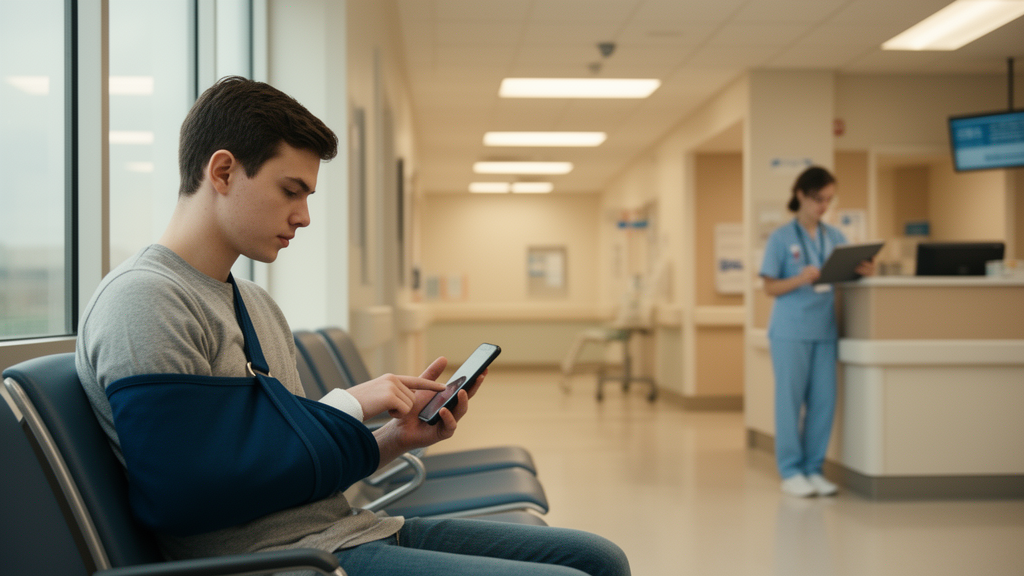
Injured patients arriving at a busy emergency department in Seoul were able to report their own injury histories through a simple link sent to their phones, with their answers flowing directly into the hospital’s electronic medical record, according to a retrospective observational study published in BMC Medical Informatics and Decision Making.
Communication errors and information loss during history-taking are common in emergency departments. Digital self-report systems could help close those gaps, but earlier approaches often required patients to use hospital-owned devices or install an app, which limited how widely such systems could spread. The new study evaluated a mobile web-based questionnaire delivered through a widely used messaging platform, with no app installation required and responses imported automatically into the EMR.
Researchers at a tertiary academic hospital in Seoul, South Korea, studied injury-related emergency department visits from June 7 to December 31, 2023. During waiting time, eligible patients received a structured injury history questionnaire link via the messaging platform. The primary outcome was questionnaire completion among message recipients, and the team used multivariable logistic regression to identify factors associated with completion. They also assessed how completely registry-mandated injury fields were documented and how well patient-entered responses agreed with the medical record.
Of 3,966 injury-related visits, 3,684 were eligible for the system. The questionnaire message reached 3,029 patients, or 82.2 percent of eligible visits, and 962 of those recipients—31.8 percent—completed it.
Completion was not evenly distributed across patient groups. In adjusted analyses among message recipients, younger age groups completed the questionnaire at higher rates than patients aged 75 or older, and completion rose with longer waiting times. Patients with lower-acuity visits completed more often than those with higher acuity, and completion was higher during daytime and evening visits than at night. Mode of arrival mattered as well: patients who came by other vehicle or by an ambulance other than the 119 service completed more frequently than those arriving by 119 ambulance. Sex was not associated with completion.
The study also looked at what happened to the medical record.
Agreement between what patients reported and what was documented was high. Patient-entered responses matched the documentation in 95.2 percent of general injuries and 91.7 percent of traffic injuries, indicating that patients could supply injury information that was consistent with what clinicians recorded.
The authors conclude that the EMR-integrated mobile web-based self-report system was implemented in a real-world emergency department setting, and that questionnaire completion was associated with greater documentation completeness while patient-reported responses showed high agreement with documentation. They note that the findings identify patient- and workflow-related considerations that may inform future implementation and optimization of mobile self-report systems in the emergency department.
As a single-center retrospective study conducted at one tertiary academic hospital, the analysis describes one institution’s implementation experience rather than a controlled evaluation of clinical effects, and the reported completion and agreement figures reflect that specific setting and study period.
Subject of Research: Implementation of an EMR-integrated mobile patient self-report system for injured patients in the emergency department
Article Title: Real-world implementation of an EMR-integrated mobile patient self-report system for injured patients in the emergency department: a retrospective observational study
Article References: Bae, J., Kim, M., Cha, W. C., Kim, T., Chang, H., Lee, S. U., Shin, T. G., Hwang, S. Y., Yoon, H., Park, J. E., Lee, G. T., Maeng, S. J., & Heo, S. (2026). Real-world implementation of an EMR-integrated mobile patient self-report system for injured patients in the emergency department: a retrospective observational study. BMC Medical Informatics and Decision Making. https://doi.org/10.1186/s12911-026-03928-w
Image Credits: AI Generated
DOI: 10.1186/s12911-026-03928-w
Keywords: emergency department, electronic medical record, patient self-report, mobile messaging, injury history, retrospective study, documentation completeness, health informatics, questionnaire completion, South Korea, Real-world, implementation
News Source: Ophelia Keating. (October 27, 2026). Mobile messaging questionnaire lets injured ED patients self-report histories into the EMR. Scienmag.