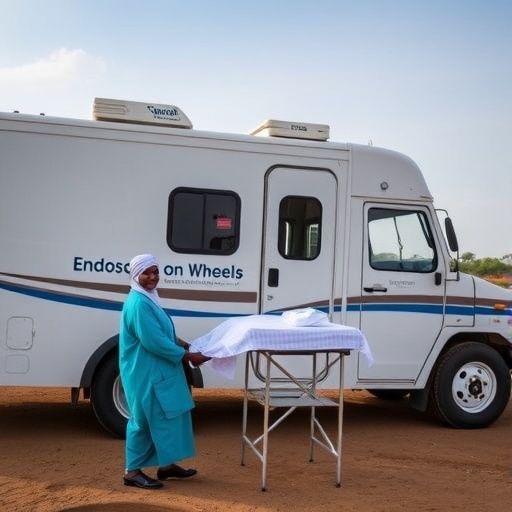
In the remote and underserved regions of South Africa’s Western Cape, access to advanced gastrointestinal diagnostics has long been a formidable challenge, hindered by scarce specialist manpower and vast geographical barriers. A recent groundbreaking study published in BMJ Open Gastroenterology sets a new precedent in tackling these challenges with an innovative mobile endoscopy outreach program. Spearheaded by the Medical University of South Carolina (MUSC) Global Surgery Program in collaboration with George Regional Hospital, this initiative took portable endoscopy directly to rural district hospitals, a move that has not only expanded access to crucial diagnostic care but significantly altered the clinical landscape for gastrointestinal health in these communities.
Between January and November 2024, a dedicated traveling endoscopy team performed over 500 procedures on nearly 500 unique adult patients across five rural hospitals. This program was deliberately executed in areas where conventional endoscopy services were virtually non-existent, demonstrating an effective decentralization of highly specialized medical interventions. The study highlights how mobile, specialist care provision can be scaled and integrated into low-resource settings, potentially reshaping the trajectory of gastrointestinal disease management in regions burdened by limited healthcare infrastructure.
The scarcity of gastroenterologists in South Africa is stark—only about 0.1 specialists per 100,000 population serve the entire country, creating an acute health divide, particularly in rural areas where patients routinely face waits of up to nine weeks for an endoscopy. Compounding this challenge is the high prevalence of Helicobacter pylori infection, a bacterial pathogen intricately linked to chronic gastritis, peptic ulcer disease, and gastric cancers. This combination of insufficient specialist availability and high disease burden inevitably results in delayed diagnosis and treatment, perpetuating advanced gastrointestinal disease and poor clinical outcomes.
To surmount these barriers, the outreach model leveraged the portability of endoscopy equipment and a small, agile clinical team. By transporting essential endoscopy devices in a vehicle, the team could perform procedures onsite at district hospitals without requiring patients to undertake prohibitive travel. Visit frequencies were tailored to referral volumes, with hospitals receiving two to four mobile service days each month. This model not only circumvented logistical challenges but also fostered robust patient-provider relationships by delivering care within patients’ own communities.
The clinical outcomes of the program are compelling. Out of 515 adult procedures done on 495 patients (predominantly women aged around 56 years), an overwhelming 94% were upper gastrointestinal endoscopies, with the remainder comprised largely of colonoscopies and a small minority of proctoscopies. The diagnostic yield was significant, revealing that a majority of patients suffered from treatable conditions such as gastritis (76%), esophagitis (69%), and hiatal hernia (70%). Other pathologies included duodenitis and gastric ulcers, with many patients exhibiting overlapping morbidities consistent with chronic reflux disease.
Alarmingly, the program also detected early-stage malignancies, diagnosing twelve cases of esophageal cancer and five of gastric cancer—a crucial finding that underscores the potential life-saving impact of timely endoscopic screening in such settings. Several patients with cancer were promptly referred for advanced care at the regional hospital, including interventions like stenting and surgery, bridging the gap between rural diagnostics and tertiary treatment. This early detection capacity marks a pivotal shift towards reducing morbidity and mortality from gastrointestinal cancers in a traditionally underserved population.
Beyond clinical findings, the outreach initiative dramatically diminished the travel burdens for patients. On average, individuals traveled just over eight miles to reach a mobile endoscopy site compared to approximately 63 miles required to access George Regional Hospital’s centralized care. The starkest travel reductions were seen in the most isolated communities, where some patients saved upwards of 130 miles per visit. This reduction in travel not only alleviates the financial and logistical strain on patients but also addresses indirect barriers such as time away from work or family, ultimately ensuring better access to consistent follow-up care.
Accessibility challenges in health care, particularly in rural areas, extend well beyond mere distance. Reliable transportation may be unavailable, and the socioeconomic realities of patients—ranging from employment constraints to familial responsibilities—can make traditional hospital visits untenable. By bringing diagnostics to patients rather than the reverse, the mobile endoscopy program effectively dismantled these obstacles, fostering improved compliance with medical recommendations and enhancing continuity of care.
This South African model echoes similar successful programs in rural India, where mobile endoscopy services have proven both feasible and sustainable, hinting at a broader applicability of the approach across diverse low-resource environments. Cost-conscious and portable specialist services represent a viable strategy to confront workforce shortages and healthcare disparities prevalent in many low- and middle-income countries. With strategic scaling, such initiatives could reshape global health paradigms for gastrointestinal disease management.
Nevertheless, the study authors candidly acknowledge certain limitations. The majority of upper endoscopies employed topical throat anesthesia—a cost-effective method that may compromise the detection of subtle mucosal abnormalities. The study’s scope was geographically limited, confined to a single region, precluding insights into varied health systems or demographic heterogeneity. Additionally, longitudinal patient outcomes post-procedure remain untracked, leaving long-term clinical effectiveness and survival benefits to be elucidated in future research.
Looking forward, the research team envisages expanding the program’s footprint, potentially incorporating more regions across South Africa. Analyzing the cost-effectiveness of the mobile model is a critical next step, alongside integrating more comprehensive clinical support structures. The broader vision articulated by Michael Deal, M.D.—the study’s lead author—encompasses expanding mobile outreach beyond diagnostics to include minimally invasive surgical procedures, offering a holistic approach to rural surgical care.
In conclusion, this mobile endoscopy outreach program has emerged as a transformative force in reducing healthcare inequities by bringing specialized gastrointestinal care to patients in their own communities. The initiative not only facilitates earlier disease detection and timely treatment but also saves patients countless miles of arduous travel, thereby improving access and adherence to care in a profoundly meaningful way. As healthcare systems worldwide grapple with disparities in specialist availability, such innovative, scalable models hold immense promise for improving population health outcomes across low-resource settings globally.
Subject of Research: People
Article Title: Mobile endoscopy in rural South Africa: outcomes of a decentralised outreach programme to improve gastrointestinal healthcare access
News Publication Date: 23-Dec-2025
Web References: http://dx.doi.org/10.1136/bmjgast-2025-002040
Image Credits: Medical University of South Carolina
Keywords: Medical diagnosis, Gastrointestinal disorders
Tags: access to diagnostic care in South Africachallenges in gastrointestinal diagnosticsdecentralization of medical servicesgastrointestinal health in rural areashealthcare for underserved populationsimproving healthcare infrastructure in rural communitiesinnovative healthcare solutionsMedical University of South Carolina initiativesmobile endoscopy programportable endoscopy technologyrural health outreach programsspecialist care in low-resource settings