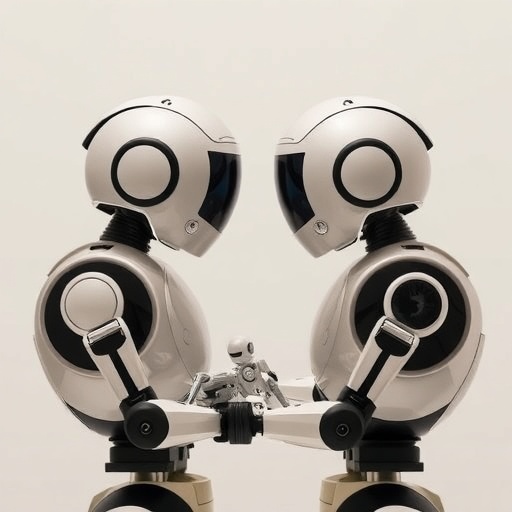
In the heart of Ithaca, New York, a groundbreaking innovation at Cornell University is redefining how strangers connect in shared spaces. The Architectural Robotics Lab, under the direction of Keith Evan Green, has developed an ingenious robot named MirrorBot, designed to foster human interaction through a novel application of mirrors. Standing at four feet tall, MirrorBot is equipped with dual mirrors that enable two strangers facing each other to simultaneously see their own reflection alongside the other person’s image. This setup effectively creates a shared visual space that encourages eye contact, a fundamental precursor to meaningful social connection.
Unlike many technological interventions that often alienate individuals despite physical proximity, MirrorBot’s design intentionally counters the pervasive social isolation amplified by digital devices. Keith Green expressed a conscious mission behind this invention, aiming to leverage computational tools not for distraction and withdrawal, but to promote togetherness and social bonding. The team’s conviction is grounded in the idea that modern computing trends, despite their ubiquity, have inadvertently distanced people from immediate communal interactions.
Serena Guo, the lead author of the study, outlined the impetus for this research as urgent and necessary. Observing everyday environments such as waiting rooms and public parks, she noted a striking paradox: although people occupy the same physical space, their attention is often fragmented and directed at personal devices rather than each other. In these scenarios, the opportunity for spontaneous, face-to-face human connection is remarkably diminished. MirrorBot’s function is to catalyze that initial moment of eye contact—an often elusive yet powerful social cue.
The experimental design involved 32 participants ranging in age from 18 to 50, paired off and placed in a controlled waiting-room environment measuring approximately 12 by 12 feet. Initially, participants were told they were part of a memory task experiment, a deliberate deception aimed at eliciting natural behavior. Subsequently, MirrorBot was introduced, its movements remotely controlled by Guo, who adjusted the angles of the mirrors until both participants could see themselves and each other reflected side-by-side. This configuration served as a subtle yet effective prompt to engage with one another.
MirrorBot’s presence, understated and non-threatening due to its modest size and soft materials, elicited a diverse range of social behaviors. Remarkably, in 12 out of 16 pairs, the first real social contact derived from observing reflections in the mirrors, rather than direct face-to-face interaction. This indirect mode of connection seemed to lower social barriers, allowing participants to cautiously explore each other’s reactions before moving to direct communication. Some pairs reacted with curiosity towards the robot itself, while others used it as a medium to gauge mutual openness.
To test its effectiveness beyond initial observations, Guo led follow-up studies comparing MirrorBot with other social catalysts including a bare robot without mirrors, a stationary wall-mounted mirror, and scenarios lacking any mediating object. Across a larger participant base of 40 pairs, results underscored MirrorBot’s distinctive advantage: its unique capacity to facilitate eye contact and initiate dialogues. This reinforced the team’s assertion that mere presence of an object is insufficient; it must steer focus towards the interpersonal dynamic rather than the object itself.
From a technical perspective, MirrorBot’s dual mirror system constitutes an inventive means of spatial mediation. By reflecting both individuals in a shared visual frame while retaining their line of sight through the mirrors, it creates a mediated environment where social apprehensions are mitigated. This encourages a conceptual “nudging” towards engagement, leveraging optical perception to reframe strangers’ relationships from isolated individuals to co-participants in a mutual experience.
The robot’s teleoperation components offer precise control over its positioning and mirror angles, enabling tailored interactions in real time. This adaptability is critical in accommodating varying social contexts and optimizing conditions for human connection. Furthermore, the decision to cover MirrorBot with soft materials addresses psychological factors, calming potential anxieties that could arise from encountering an unfamiliar mechanical presence.
Underlying the research is a profound reflection on the societal impact of technology. While digital platforms promise connectivity, their effect often paradoxically induces solitude by channeling attention inward. MirrorBot symbolizes a shift towards embedding technology in physical environments where it cultivates direct human engagement, rather than digital distraction. This paradigm offers promising implications for enhancing social well-being in shared public domains.
Looking ahead, Green and Guo plan to present their findings at the prestigious Association for Computing Machinery Conference on Human Factors in Computing Systems (CHI ’26) in Barcelona. Their work charts new territory in human-robot interaction, emphasizing robots as facilitators of human connection rather than isolated computational agents. The potential applications extend beyond waiting rooms to any spaces characterized by proximity coupled with social distance, such as transit hubs, public parks, and community centers.
MirrorBot’s approach raises compelling questions about the future of robotics in social environments. By positioning the robot as a subtle spatial mediator, it transcends traditional notions of robotic roles and highlights opportunities for designing technology that enhances our fundamental human need for connection. This innovative merging of robotics, psychology, and spatial design heralds a promising frontier at the intersection of technology and social interaction.
The Cornell team’s endeavor with MirrorBot signifies more than a study; it’s a conceptual and practical challenge to how computing technologies should evolve. Their research is a call to action for developers and designers to create digital and robotic experiences that prioritize meaningful interpersonal exchange and enrich the social fabric rather than fray it. Through this inward and outward reflection enabled by simple mirrors, MirrorBot embodies a hopeful vision for technology’s role in fostering empathy and understanding among strangers.
Subject of Research:
Human-robot interaction focused on fostering social connection through mediated eye contact using a mirror-equipped robot.
Article Title:
MirrorBot: Harnessing Robotic Mirrors to Foster Eye Contact and Social Connection Among Strangers
News Publication Date:
April 2026
Web References:
MirrorBot Fostering Human Connection – Cornell Chronicle
References:
Keith Evan Green, Serena Guo, et al. “MirrorBot: Designing a Mirror-Equipped Robot to Facilitate Human Eye Contact in Social Settings.” Published at the ACM CHI Conference on Human Factors in Computing Systems (CHI ’26), 2026. DOI: 10.1145/3757279.3785647
Keywords
Human-robot interaction, social robotics, eye contact facilitation, spatial mediation, interpersonal connection, mirror technology, teleoperation, social psychology, computational design, public spaces, behavioral studies, social engagement
Tags: architectural robotics lab researchcomputational tools for social interactionCornell University robotics projectfostering eye contact with technologyhuman-robot interaction technologyMirrorBot innovationpublic space social engagement toolsreducing social isolation with robotsrobotic mirrors for communicationshared visual space for strangerssocial connection through roboticstechnology enhancing human bonding