Supplementing whole milk with inactivated Saccharomyces cerevisiae fermentation products altered rumen fermentation patterns, changed microbial community structure, and altered circulating antibody concentrations in young dairy calves, according to a controlled trial published in Frontiers in Veterinary Science. Researchers evaluated thirty young Holstein calves from seven days of age through weaning at seventy days, administering postbiotic preparations daily in whole milk to observe how non-viable microbial components interact with early digestive and physiological development. Postbiotics, defined as preparations of inanimate microorganisms or their cellular components and metabolites that confer health benefits on the host, offer practical advantages in stability and handling compared to live probiotics because they do not require maintaining cell viability. The investigation documented significant shifts in short-chain fatty acid profiles and bacterial taxonomic abundances alongside higher weaning-age serum immunoglobulin concentrations, while overall body weight gain and average daily growth rates remained unchanged across all experimental groups.
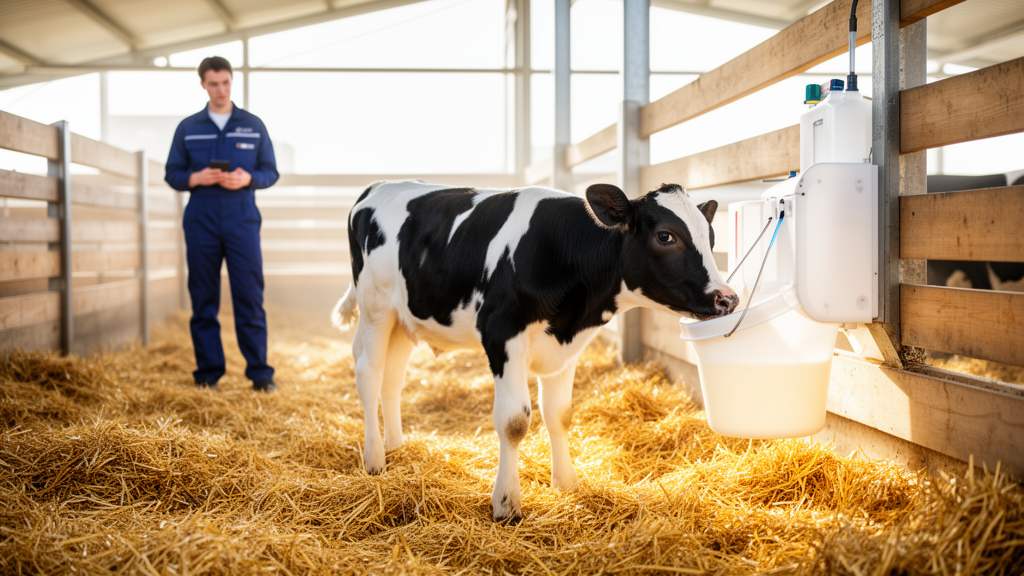
The experimental trial was conducted at a commercial dairy facility in Aksaray Province, Türkiye, under an approved protocol from the Erciyes University Local Ethics Committee for Animal Experiments. Thirty newborn Holstein calves were initially provided maternal colostrum equivalent to ten percent of their body weight within two hours after birth, with colostrum quality assessed using a Brix refractometer to verify adequate passive transfer of maternal immunoglobulins. From day two, the calves received five liters of whole milk per day split equally into two feedings, and calf starter feed was offered ad libitum starting on day three. At seven days of age, the animals were ranked by body weight and assigned to three balanced treatment groups consisting of equal numbers of male and female calves housed individually in ventilated hutches. Calves received zero grams per day in the control group, three point five grams per day in the moderate dose group, or five grams per day in the higher dose group of the commercial postbiotic formulation.
The postbiotic material evaluated in the trial was XPC LS, an inactivated yeast fermentation preparation derived from Saccharomyces cerevisiae cultured on a plant-based substrate composed of soybean meal, wheat bran, and sugarcane molasses. Calves consumed their assigned supplements mixed directly into their evening milk feeding bottles throughout the pre-weaning stage. A sensitivity power analysis indicated that the sample size of ten calves per group provided eighty percent statistical power to detect large treatment effects with an effect size of Cohen’s f equal to zero point six zero at an alpha level of zero point zero five, though smaller differences might escape detection. Solid feed intake was encouraged toward the end of the trial by reducing daily whole milk allowances to three liters per day between fifty-six and seventy days of age. By seventy days, dry matter consumption of starter feed and chopped alfalfa hay surpassed fifteen hundred grams per animal daily across all pens.
Growth performance monitoring revealed that milk-delivered postbiotics did not significantly alter body weight or average daily gain at thirty-five or seventy days of age. At weaning, control calves reached an average body weight of one hundred three point five zero kilograms, while calves receiving three point five grams per day weighed one hundred four point one zero kilograms and those receiving five grams per day averaged ninety-seven point eight zero kilograms. Similarly, average daily gain from days seven to thirty-five ranged from zero point five four to zero point six two kilograms per day, and gain from days thirty-six to seventy ranged from one point zero one to one point two seven kilograms per day without statistically significant divergence. Mean fecal consistency scores and chest circumference measurements also did not differ among treatments, although withers height was significantly greater in supplemented calves compared with controls, measuring one hundred eight point five zero centimeters in the three point five gram group and one hundred four point eight eight centimeters in the five gram group versus ninety-eight point zero zero centimeters in unsupplemented animals.
Rumen fermentation parameters measured via oral stomach tubes at thirty-five and seventy days showed pronounced treatment effects and highly significant treatment-by-age interactions for volatile fatty acids. Total short-chain fatty acid concentrations and straight-chain fatty acids were influenced by postbiotic administration, but the magnitude and direction of the response varied across development. At thirty-five days of age, calves receiving five grams per day produced the highest numerical concentrations of acetic acid at thirty-one point zero seven millimoles per liter, propionic acid at twenty-eight point seven nine millimoles per liter, and total short-chain fatty acids at sixty-six point seven six millimoles per liter, compared to twenty-four point five eight millimoles per liter in controls. By contrast, at seventy days of age, the highest numerical concentrations of propionic acid and total short-chain fatty acids occurred in the three point five gram group, reaching nineteen point four zero and forty-six point six five millimoles per liter, respectively, demonstrating that neither dose sustained uniformly elevated fermentation output across the pre-weaning timeline.
Rumen ammonia nitrogen and fluid acidity also exhibited divergent responses between the supplementation levels across the sampling time points. Postbiotic dosage exerted a significant quadratic effect on ammonia nitrogen concentrations, with the three point five gram daily dose yielding ammonia levels comparable to unsupplemented controls but significantly higher than the five gram daily group. Ruminal fluid acidity differed between treatments, as calves receiving five grams per day displayed a significantly higher ruminal pH than those receiving three point five grams per day, although neither supplemented cohort differed significantly from the control group. Multivariate principal component analysis performed on day seventy data separated the treatment groups into distinct clusters, mapping the control group to lower acetate and propionate production, the moderate dose group to higher short-chain fatty acids and butyrate concentrations, and the high-dose group to an independent profile defined by higher pH and lower ammonia nitrogen.
Bacterial community profiling of day seventy rumen fluid using high-throughput sequencing of the V3 to V4 hypervariable regions of the 16S rRNA gene revealed substantial structural rearrangements in calves receiving the highest postbiotic dosage. Alpha diversity metrics rarefied to an even sequencing depth of one thousand five hundred fifty-five sequences per sample demonstrated significantly reduced Shannon diversity and Pielou evenness in the five gram group compared to both the control and moderate groups, alongside a significant decrease in Chao1 richness relative to controls. Permutational multivariate analysis of variance confirmed significant differences in beta diversity based on Bray-Curtis dissimilarity distances across treatments. At the phylum level, calves receiving five grams per day displayed a marked decrease in Bacteroidota abundance to twelve point zero four percent compared to thirty-seven point four six percent in controls, accompanied by a dramatic increase in Patescibacteria abundance to twenty-three point four one percent compared to two point four six percent in the control cohort.
Taxonomic shifts extended into individual bacterial families and genera, establishing that distinct microbial assemblages developed under the two postbiotic dosing regimens. Calves in the three point five gram group exhibited greater relative abundances of the genus Prevotella, reaching thirty-four point four seven percent compared to twenty-eight point four six percent in controls, alongside elevated proportions of Selenomonadaceae, the Lachnospiraceae NK3A20 group, and Treponema. In contrast, the five gram daily group showed a sharp reduction in Prevotella to six point one five percent, accompanied by substantial increases in Shuttleworthia, which rose to thirty-six point three seven percent from zero point seven nine percent in controls, an uncultured Saccharimonadales genus rising to twenty point six four percent, and the Eubacterium ruminantium group increasing to five point zero three percent. These community shifts illustrate distinct microbial configurations, though the authors stressed that changes in relative taxonomic abundance cannot establish metabolic activity or functional cross-feeding without direct enzymatic and pathway quantification.
Evaluation of serum immune and inflammatory markers highlighted dose-dependent and age-dependent modulations of circulating immunoglobulins and inflammatory cytokines. Serum immunoglobulin G and immunoglobulin M concentrations were significantly affected by postbiotic dosage, sampling age, and their interaction, with calves receiving five grams per day reaching peak concentrations at weaning of sixty-eight point seven one milligrams per milliliter for IgG and three point four one milligrams per milliliter for IgM. In contrast, circulating concentrations of immunoglobulin A and immunoglobulin E showed no significant differences across treatments or time points. Serum interleukin-1 beta displayed a significant dose-by-time interaction, decreasing between days thirty-five and seventy in the three point five gram group but increasing over the same period in the five gram group, while interleukin-6 decreased from day thirty-five to day seventy in controls without showing comparable declines in supplemented animals, and systemic markers including tumor necrosis factor-alpha, interferon-gamma, and day thirty-five serum amyloid A remained unaffected.
The researchers cautioned that while milk-delivered Saccharomyces cerevisiae fermentation products altered ruminal fermentation, bacterial diversity, and circulating immunoglobulins, several biological and methodological limitations must be considered when interpreting these findings. Because milk typically bypasses the reticulorumen via closure of the esophageal groove in suckling calves, the degree to which supplemented materials entered the rumen directly rather than operating through indirect systemic or post-ruminal gastrointestinal interactions could not be determined. Furthermore, individual solid feed consumption was not measured, the rarefaction depth of 16S amplicon sequencing was relatively low, and no disease or inflammatory challenge was applied to evaluate clinical disease resistance. The authors concluded that while Saccharomyces cerevisiae postbiotics can actively modulate pre-weaning ruminal microbial profiles and circulating antibody concentrations, the isolated change in withers height did not reflect enhanced overall growth performance, underscoring the need for detailed metabolic and gastrointestinal investigations to define their practical nutritional role.
Subject of Research: Pre-weaning supplementation of Holstein calves with milk-delivered Saccharomyces cerevisiae fermentation products
Article Title: Effects of milk-delivered Saccharomyces cerevisiae fermentation products on growth, rumen fermentation, ruminal microbiota, and serum immune markers in pre-weaned Holstein calves
Article References: Öztaş, İ., & Kara, K. (2026). Effects of milk-delivered Saccharomyces cerevisiae fermentation products on growth, rumen fermentation, ruminal microbiota, and serum immune markers in pre-weaned Holstein calves. Frontiers in Veterinary Science, 13, 2009350. https://doi.org/10.3389/fvets.2026.2009350
Image Credits: AI Generated
DOI: 10.3389/fvets.2026.2009350
Keywords: Saccharomyces cerevisiae, postbiotics, Holstein calves, rumen fermentation, ruminal microbiota, short-chain fatty acids, immunoglobulin G, immunoglobulin M, withers height, pre-weaning nutrition, 16S rRNA sequencing, Shuttleworthia, Patescibacteria, Prevotella, interleukin-1 beta, esophageal groove, dairy calf management, ammonia nitrogen
News Source: Drew Townsend. (November 13, 2026). Milk Yeast Postbiotics Shift Calf Rumen Fermentation and Circulating Antibodies. Scienmag.