A prospective cohort study evaluating non-surgical interventions for nodular thyroid disease has demonstrated that percutaneous microwave thermal ablation provides a highly effective and minimally invasive alternative to conventional surgical resection. Conducted across sixty-six enrolled patients presenting with sixty-six distinct benign thyroid nodules, the trial directly compared the clinical efficacy, physiological stability, and complication profiles of ultrasound-guided microwave ablation against standard unilateral hemi-thyroidectomy. The cohort was evenly allocated into two cohorts of thirty-three individuals each, designated respectively as the microwave thermal ablation cohort and the conventional surgical resection cohort. Notably, due to the specialized nature of the hospital setting where the investigations took place, all participating individuals were diagnosed with metabolically associated liver disease with incidentally detected thyroid lesions, though the underlying hepatic conditions did not exert any direct bearing on the nodular treatment strategy or biological therapeutic outcomes. Across an active monitoring duration extending through twelve postoperative months, the collected findings revealed that thermal ablation delivered substantial volume shrinkage while significantly mitigating bodily trauma, eliminating surgical neck scarring, and avoiding the postoperative endocrine disruptions frequently encountered following open surgical intervention.
Nodular thyroid disorders represent an exceptionally widespread endocrine condition, ranking as the second most frequent endocrine presentation after diabetes mellitus and exhibiting an elevated prevalence among female patients with a documented four-to-one female-to-male ratio. Sonographic evaluations identify nodular lesions in twenty to seventy-six percent of the general population, with higher diagnostic rates observed in elderly demographics and geographic cohorts experiencing reduced dietary iodine intake. Although the vast majority of identified thyroid nodules remain pathologically benign and clinically silent, requiring only routine sonographic monitoring, a distinct subset of patients necessitates therapeutic interference due to physical indentation symptoms, airway compression, subjective sensations of a foreign body in the throat, or notable cosmetic concerns. Historically, open partial or total hemi-thyroidectomy has served as the established definitive standard of care, particularly in multi-nodular goiter presentations where the potential danger of future nodular relapse within residual thyroid tissue prompts surgical excision. Nevertheless, traditional cervical surgery entails inherent operative drawbacks, carrying an established complication rate spanning two to ten percent that encompasses iatrogenic hypothyroidism, irreversible or transient recurrent laryngeal nerve damage, hypoparathyroidism, mandatory inpatient hospitalization, risks related to general endotracheal anesthesia, and permanent postsurgical neck scars.
To circumvent the clinical morbidity associated with open surgery, investigators have progressively introduced non-surgical minimally invasive techniques over recent decades, beginning with percutaneous ethanol injection and developing through thermal modalities such as laser ablation, radiofrequency ablation, and microwave ablation. Microwave ablation induces focal tissue necrosis through localized electromagnetic heating, transferring targeted energy directly into the cellular matrix of the nodule to trigger coagulative necrosis, which subsequently prompts progressive tissue resorption and nodule shrinkage. While thermal ablation has been utilized for benign lesions with recognized safety profiles, previous clinical investigations have predominantly emphasized technical feasibility, nodule volume reduction rates, and comparisons among differing ablation devices. Comparative clinical research rigorously paralleling thyroid functional preservation, patient-reported psychological distress, and procedural complication rates between microwave ablation and formal surgical hemi-thyroidectomy has historically remained limited, establishing the empirical impetus for the prospective cohort comparison.
The demographic profile of the prospective investigation comprised thirty-three patients in the microwave ablation cohort, consisting of eleven male and twenty-two female participants with an average age of 39.88 plus or minus 12.20 years, alongside thirty-three patients in the surgical hemi-thyroidectomy cohort, comprising eight male and twenty-five female participants with an average age of 39.21 plus or minus 9.72 years. Baseline sonographic and clinical features revealed no statistically significant differences between the two study arms. Nodules were systematically classified into three structural categories based on their internal ultrasonic composition: solid nodules containing greater than seventy percent solid tissue, cystic nodules containing greater than seventy percent cystic fluid, and mixed lesions exhibiting intermediate proportions. In the microwave ablation group, the team documented twenty-six solid nodules, one cystic nodule, and six mixed nodules, yielding a median baseline nodule volume of 5.75 milliliters within an interquartile range of 2.93 to 9.65 milliliters. Correspondingly, the surgical cohort presented twenty-eight solid nodules, two cystic nodules, and three mixed nodules, demonstrating a median baseline volume of 4.60 milliliters within an interquartile range of 2.60 to 7.60 milliliters.
Participant eligibility was governed by stringent clinical inclusion and exclusion parameters designed to ensure participant safety and diagnostic precision. Eligible individuals presented with benign thyroid nodules exhibiting a maximum diameter exceeding one centimeter, accompanied by subjective local compressive complaints, neck embarrassment, foreign body sensations, or cosmetic worries. Confirmation of benign cytological status was established through at least one newly obtained fine needle aspiration biopsy prior to enrollment. Conversely, the researchers excluded any individuals exhibiting cytological evidence of non-benign pathology, underlying systemic blood coagulation disorders, severe cardio-pulmonary dysfunction, pre-existing contralateral vocal cord paralysis, a history of cervical radiation exposure, or a verified family history of thyroid malignancies. Patients presenting with small asymptomatic nodules measuring under one centimeter in longest dimension were directed to conservative surveillance rather than invasive interventions. Prior to therapeutic allocation, all patients received comprehensive, unbiased procedural counseling regarding operative workflows, anesthesia methods, anticipated volume reduction, potential hazards, financial costs, and required post-procedural surveillance protocols.
The microwave thermal ablation procedures were carried out under local anesthesia using a standardized ultrasound-guided approach. Total nodular volume was systematically calculated using the standard ellipsoid formula, multiplying the product of the longest longitudinal, anteroposterior, and transverse diameters by pi divided by six. Patients were placed in a comfortable supine posture with the cervical spine mildly extended. Following strict aseptic preparation, local analgesia was achieved via perithyroidal lidocaine injection through a minuscule one-to-two millimeter skin nick. To prevent unwanted thermal dissipation toward delicate adjacent anatomy, the practitioners delivered a hydro-dissection separation barrier consisting of ten milliliters of physiological saline, eight milliliters of xylocaine, one milliliter of sodium bicarbonate, and one milliliter of 0.1 percent adrenaline hydrochloride into the anatomical space separating the thyroid capsule from surrounding structures.
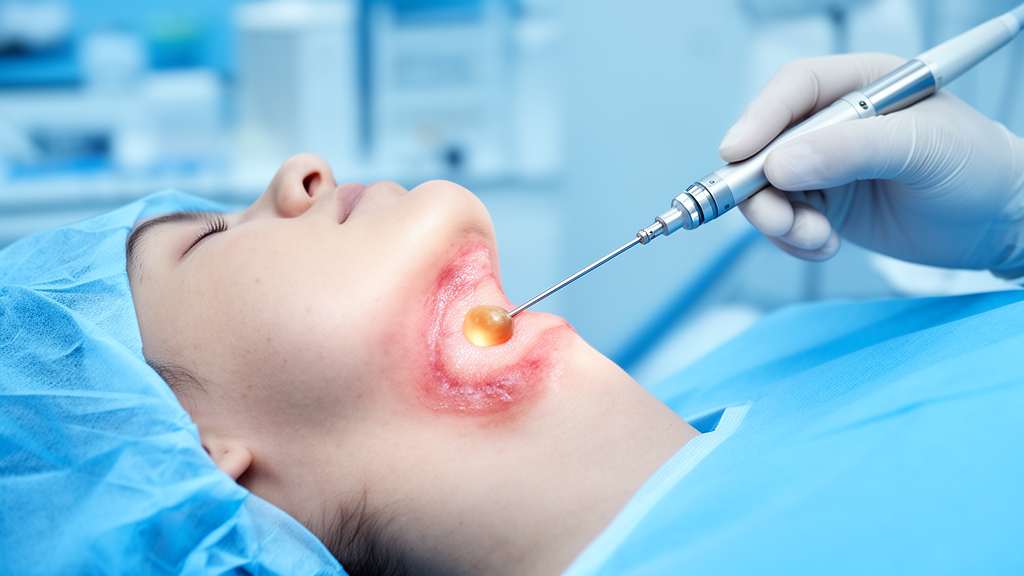
Energy delivery was conducted using a specialized internally cooled eighteen-gauge microwave antenna connected to a Canyon microwave generator, maintained at a uniform power setting of thirty watts irrespective of initial nodule volume. Operators implemented a real-time trans-isthmic moving-shot ablation technique, traversing the needle tip across successive internal compartments of the nodule to generate overlapping units of thermal coagulation. Continuous sonographic monitoring ensured unbroken visualization of the entire antenna shaft, enabling the team to vigilantly evade the anatomical danger triangle housing the recurrent laryngeal nerve, trachea, and esophagus. Thermal deposition proceeded until widespread hyperechoic microbubbles and an echogenic halo encompassed the entire nodular parenchyma, intentionally sparing thin margins immediately adjacent to the dangerous nerve zone to prevent thermal neural trauma. Immediately post-ablation, local ice packs were administered across the neck to counter soft tissue edema and relieve localized discomfort, followed by twenty minutes of vital sign monitoring before outpatient discharge.
In contrast, patients assigned to the surgical intervention group underwent formal ipsilateral hemi-thyroidectomy performed under conventional general endotracheal anesthesia by experienced surgical teams, culminating in total anatomical extirpation of the involved thyroid lobe. Follow-up clinical evaluations were conducted at one, two, three, six, and twelve months post-treatment to track anatomical, functional, and psychological recovery. Therapeutic success for thermal ablation was pre-defined as achieving a nodule volume reduction rate exceeding fifty percent of baseline measurements. While surgical resection naturally resulted in an immediate one hundred percent volume reduction across all follow-up intervals due to complete organ removal, microwave ablation induced steady, progressive tissue reabsorption. For predominantly solid nodules treated with ablation, the mean volume reduction rates reached 42.23 plus or minus 3.93 percent at one month, 71.33 plus or minus 3.84 percent at three months, 83.53 plus or minus 3.40 percent at six months, and 92.23 plus or minus 2.70 percent at twelve months post-ablation. Similarly, nodules exhibiting non-solid internal architectures demonstrated average volume reduction rates of 43.85 plus or minus 3.67 percent, 69.88 plus or minus 1.63 percent, 83.49 plus or minus 3.22 percent, and 92.18 plus or minus 1.67 percent across identical intervals, confirming that final therapeutic shrinkage was not constrained by baseline cystic proportions.
Assessment of acute postoperative pain using a ten-point visual analog scale recorded twenty-four hours after intervention revealed highly significant differences favoring microwave thermal ablation over surgical intervention. Patients in the ablation cohort reported exceptionally minimal discomfort, with only two out of thirty-three individuals experiencing minor pain that resolved spontaneously by the fifth post-procedural day without pharmaceutical analgesia. Conversely, thirty out of thirty-three surgically treated patients reported acute postsurgical pain, requiring oral analgesic prescriptions in ten cases before spontaneous resolution occurred within one week. Furthermore, procedural circumstances strongly favored microwave ablation in terms of overall hospital stay duration, total operative time, and avoidance of general anesthesia complications. All surgical patients sustained visible cervical incisions resulting in permanent surgical scars exceeding three centimeters in length, whereas microwave ablation left no discernible cutaneous scar tissues following the completion of healing.
Psychological distress and anxiety symptoms were measured utilizing the validated fourteen-item Hamilton Anxiety Rating Scale, which evaluates psychic agitation and somatic tension across scores ranging from zero to fifty-six. Prior to intervention, surgical patients exhibited elevated baseline anxiety compared to ablation candidates, reflecting heightened apprehension regarding major open surgery and general anesthesia. Following surgical intervention, average anxiety scores escalated sharply at the one-month evaluation before gradually receding toward baseline levels by three months, driven by early postoperative discomfort, visible neck wound healing, and concerns regarding hormonal replacement. In marked contrast, patients undergoing microwave ablation displayed progressive, uninterrupted declines in anxiety scores throughout the twelve-month surveillance timeline, reflecting rapid physical recuperation and consistent relief from compressive throat symptoms. Subjective cosmetic scores diminished across both treatment groups; although surgical resection achieved lower visual prominence scores during the initial three months due to immediate organ excision, cosmetic grading between the ablation and surgical cohorts exhibited no statistically significant difference at the six- and twelve-month follow-up milestones as the treated nodular scars contracted internally.
Longitudinal biochemical monitoring of endocrine parameters demonstrated marked preservation of endogenous thyroid function in the microwave ablation cohort compared to the open surgical group. Patients receiving microwave ablation showed minor, clinically insignificant fluctuations in thyroid stimulating hormone, free triiodothyronine, and free thyroxine levels across all scheduled observation points, with values remaining stable relative to baseline measurements. Conversely, patients who underwent hemi-thyroidectomy exhibited statistically significant elevations in thyroid stimulating hormone concentrations at one, three, and six months post-surgery, with ten individuals demonstrating substantial decreases in circulating free thyroid hormone concentrations that necessitated clinical management. Overall procedural safety was confirmed by the total absence of severe life-threatening adverse events in both treatment arms. However, minor complications were documented exclusively within the surgical cohort, including two patients who suffered temporary vocal hoarseness recovering within three to six months, one patient who developed transient loss of high-pitched phonation resolving within six months, and three individuals who experienced temporary dysphagia and laryngeal edema. No recurrent laryngeal nerve paralysis, voice alterations, or nodular recurrences were observed in the microwave ablation cohort.
Despite these encouraging comparative outcomes, the investigators emphasized several notable methodological limitations inherent to the trial design. The study was conducted at a single medical institution with a relatively compact sample size of sixty-six total participants, which restricts broad statistical generalization across diverse healthcare settings. Finally, the research protocol lacked extended systemic laboratory indices, such as detailed post-procedural inflammatory biomarkers, which could have provided deeper physiological insights into the localized wound-healing cascade distinguishing thermal coagulation from surgical tissue trauma. Nevertheless, the prospective evidence establishes microwave thermal ablation as a safe, tissue-preserving, and cosmetically superior therapeutic modality capable of achieving robust nodular shrinkage and psychological symptom relief without compromising endocrine thyroid function.
Subject of Research: Comparative clinical outcomes of microwave ablation versus hemi-thyroidectomy for benign thyroid nodules
Article Title: Comparison of the efficiency of microwave ablation and traditional thyroidectomy in the treatment of benign thyroid nodules in patients with metabolically associated liver disease
Article References: Medhat El-Geoushy Hassnien, E., Mohammed Korayem, E., Metwaly Omar, H., Saber Bayoumi Ahmed, S., Gamal El-Din Hagag, M., & Said Ellaban, H. (2026). Comparison of the efficiency of microwave ablation and traditional thyroidectomy in the treatment of benign thyroid nodules in patients with metabolically associated liver disease. Egyptian Journal of Radiology and Nuclear Medicine, 57(1), Article 251. https://doi.org/10.1186/s43055-026-01912-y
Image Credits: AI Generated
DOI: 10.1186/s43055-026-01912-y
Keywords: microwave ablation, hemi-thyroidectomy, benign thyroid nodules, volume reduction rate, thyroid stimulating hormone, recurrent laryngeal nerve, hydro-dissection, visual analog scale, Hamilton Anxiety Rating Scale, cosmetic score, ultrasound guidance, perithyroidal lidocaine, metabolically associated liver disease, internally cooled antenna, free thyroxine, postoperative pain, nodule shrinkage
News Source: Ophelia Keating. (November 23, 2026). Microwave Ablation Yields Fewer Complications Than Surgery for Benign Thyroid Nodules. Scienmag.