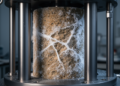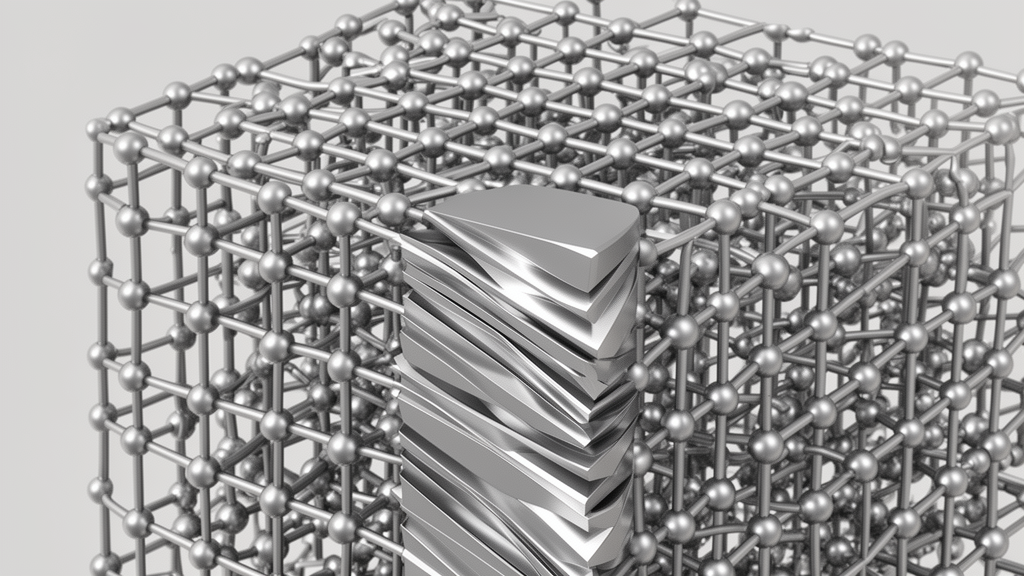
In microscopic metallic structures, decreasing physical dimensions fundamentally alters how crystalline lattices accommodate irreversible deformation under mechanical load, giving rise to pronounced temporal instabilities known as dislocation avalanches. While face-centered cubic crystals exhibit a well-established transition from smooth bulk yielding to intermittent slip bursts at micrometer dimensions, body-centered cubic metals such as molybdenum display a far more intricate response governed by coupled interactions between temperature, strain rate, and sample size. A comprehensive investigation published in the Journal of Materials Science: Materials Theory by Jérôme Weiss and colleagues demonstrates that pure molybdenum micropillars experience an unexpected resurgence of wild plastic fluctuations when sample diameters drop below approximately one micrometer, even at ambient temperatures far beneath the material athermal transition point. At these submicron dimensions, the strong lattice-controlled dampening that normally suppresses sudden slip events ceases to regulate deformation, demonstrating that physical miniaturization fundamentally modifies the operational dynamics of dislocation sources.
For decades, classical metallurgical engineering treated plastic flow as a steady, continuous progression because macroscopic measurements average out astronomical numbers of uncorrelated defect movements occurring throughout large crystal volumes. However, as modern technological devices shrink toward dimensions of a few micrometers or below, mechanical behavior becomes increasingly dominated by two emergent size effects colloquially summarized as “smaller is stronger” and “smaller is wilder.” The strengthening effect manifests as an empirical power-law increase in plastic yield shear stress with decreasing specimen diameter, an empirical relationship where the scaling exponent typically falls between zero point five and one. In nanoparticles spanning several hundred nanometers, this hardening effect can drive the measured yield stress toward the theoretical limit of approximately one-tenth the material shear modulus. Historically, researchers attributed this dramatic strengthening to free-surface interactions, specifically the truncation of internal dislocation sources and the exhaustion of mobile line defects through dislocation starvation.
Yet this elevated mechanical strength introduces severe complications because miniaturization concurrently intensifies plastic jerkiness. Under displacement-controlled loading, crystals exhibit sudden stress drops, whereas load-controlled tests reveal abrupt strain bursts. These localized deformations threaten microscale component integrity and complicate precision manufacturing. In face-centered cubic metals and basal-slip hexagonal close-packed crystals, plastic flow is obstacle-controlled and fundamentally athermal. In these materials, gliding dislocations traverse the lattice until encountering obstacles such as forest dislocation networks, solute atoms, or precipitates. Plastic deformation causes dislocations to spontaneously self-organize into patterned structures characterized by an internal length scale scaling with the effective pinning strength of obstacles. This pattern defines an effective mean free path for defect propagation. When specimen dimensions substantially exceed this internal pattern scale, dislocation avalanches remain confined within cell walls, generating a smooth macroscopic stress-strain curve. When system dimensions drop below this threshold, avalanches traverse the crystal unhindered, producing prominent jerkiness.
In body-centered cubic metals, plastic yielding follows a fundamentally different physical framework due to the non-degenerate atomic core structure of one-half bracket one-one-one screw dislocations. This core configuration produces an extraordinarily high Peierls stress at absolute zero, reaching approximately five thousandths to one hundredth of the elastic shear modulus, rendering screw dislocations completely stationary at low resolved shear stresses. Below a material-specific athermal transition temperature, designated as Ta, dislocations cannot glide freely and must instead advance via the thermally activated nucleation and subsequent lateral migration of kink pairs. Consequently, plastic flow becomes lattice-controlled and exhibits pronounced dependencies on both ambient temperature and deformation rate. Above this athermal transition threshold, lattice friction diminishes toward negligible levels relative to obstacle interactions, restoring obstacle-controlled behavior identical to face-centered cubic metals. Under these elevated thermal conditions, body-centered cubic crystals display negligible strain-rate sensitivity, form well-defined dislocation cell structures, and exhibit a pronounced size effect on yield strength with a classical scaling exponent near zero point seven.
To decipher how these combined mechanisms operate across varying physical scales, Weiss and his collaborators evaluated micropillar compression tests on pure molybdenum across systematically controlled environments. Their experimental design examined pillar diameters spanning five hundred nanometers to thirty-five hundred nanometers, tested across a broad thermal range from twenty-five degrees Celsius up to two hundred degrees Celsius, which approaches the molybdenum athermal transition temperature of approximately one hundred ninety to two hundred thirty degrees Celsius. The researchers also varied the applied strain rates between two times ten to the negative fourth inverse seconds and two times ten to the negative second inverse seconds. For rigorous cross-material comparison, these experiments evaluated pure aluminum micropillars at room temperature as a canonical obstacle-controlled face-centered cubic system, along with aluminum-scandium alloy micropillars. Instrument sensors operating at a sampling frequency of four hundred hertz captured fine displacement jumps, enabling detailed quantification of jump velocity, avalanche magnitude, and stress drops.
At two hundred degrees Celsius, compression data revealed that molybdenum micropillars behave in near-perfect agreement with pure aluminum. The cumulative probability distributions of plastic displacement jumps followed a mathematical model combining an initial exponential cut-off with an asymptotic power-law tail. In aluminum, this power-law tail dominated jump statistics for smaller samples, yielding a wildness metric close to zero point nine, representing the fraction of overall plastic strain accommodated through wild avalanches. Mildness only became significant in aluminum when sample dimensions reached six micrometers, consistent with an internal patterning scale of roughly ten micrometers. Similarly, molybdenum pillars tested at two hundred degrees Celsius exhibited wildness values near zero point nine at diameters of thirty-five hundred nanometers. Furthermore, submicron molybdenum pillars tested near this athermal threshold developed extreme outlier bursts termed dragon-kings, where individual system-spanning avalanches accounted for over ten percent of cumulative specimen strain, demonstrating super-critical dynamics analogous to catastrophic events previously documented during the plastic compression of face-centered cubic nanoparticles.
A starkly contrasting physical picture emerged when testing molybdenum micropillars at twenty-five degrees Celsius, well below the athermal transition temperature. For relatively large pillars exceeding one micrometer in diameter, such as specimens measuring fifteen hundred or thirty-five hundred nanometers, the recorded stress-strain curves became remarkably smooth. In thirty-five hundred nanometer pillars, the statistical jump distributions departed sharply from pure power laws, with the lower cut-off term dominating the distribution and driving the calculated wildness down to approximately one percent. This pronounced mildness did not stem from dislocation patterning, which remains suppressed in body-centered cubic crystals deformed at low temperatures due to the restricted cross-slip ability of screw dislocations. Instead, the authors established that sluggish, thermally activated screw dislocation motion acts as a powerful internal dampener. By restricting the propagation speed of dislocation cascades, lattice friction prevents the collective acceleration required to produce macroscopic strain bursts, enforcing an orderly, smooth plastic flow despite small specimen dimensions.
Multiple rigorous experimental diagnostics confirmed this thermally activated lattice-controlled mechanism in micrometer-scale molybdenum pillars at room temperature. First, measurements established a positive strain-rate sensitivity parameter of zero point zero five in fifteen hundred nanometer molybdenum pillars, closely matching bulk behavior and sharply exceeding the modest zero point zero two value measured in aluminum-scandium alloy pillars. Second, the scaling between average peak displacement velocity during an avalanche and average avalanche size yielded a power-law exponent of only zero point ten in thirty-five hundred nanometer molybdenum pillars at twenty-five degrees Celsius, indicating that peak propagation velocity remained largely insensitive to avalanche size due to screw dislocation drag. In contrast, pure aluminum and high-temperature molybdenum exhibited scaling exponents exceeding unity. Third, experimental recordings captured the spontaneous triggering of dislocation avalanches during the unloading stages that immediately followed prior instabilities in fifteen hundred nanometer pillars, a unique physical signature of thermally activated barrier crossing that never appeared in aluminum or high-temperature molybdenum.
However, this orderly lattice-controlled regime broke down completely when molybdenum pillar diameters were reduced to one micrometer or below. In these submicron specimens tested at room temperature, all classical hallmarks of lattice-controlled plasticity vanished. The strain-rate sensitivity parameter dropped to zero, matching the rate-insensitivity characteristic of obstacle-controlled crystals. Concurrently, compression trials revealed that the plastic yield stress measured at four percent strain became virtually independent of test temperature, displaying no variation between room temperature and two hundred degrees Celsius, in direct contrast to the strong thermal hardening observed in thirty-five hundred nanometer pillars. Concurrently, the stress-strain curves regained marked jerkiness, yielding critical power-law and super-critical dragon-king distributions of jump sizes. The velocity scaling exponent rebounded into the range between one point zero and one point three, mirroring the high avalanche propagation velocities typical of aluminum, while spontaneous avalanche triggering during unloading disappeared entirely. Despite ambient temperatures remaining far below Ta, submicron molybdenum pillars recovered wild plastic fluctuations.
To explain this transition, the researchers linked the loss of lattice control to single-arm source mechanics in submicron volumes. In pillars exceeding one micrometer, source operation requires a sluggish screw dislocation segment coupled to a fast non-screw segment, where the screw segment bottlenecks rotation and damps avalanches. Below one micrometer, surface proximity and image stresses cause these screw segments to vanish, leaving fast non-screw dislocations to dominate deformation and unleash wild plastic avalanches. Below one hundred nanometers, simulations indicate plasticity shifts toward surface nucleation and screw dislocation self-multiplication. The statistics of molybdenum fluctuations across all regimes remained consistent with universal scaling formulations. These findings carry practical significance for nanoscale engineering, including molybdenum gate structures in microelectronics, and suggest future investigations should explore whether alloying or prismatic slip in hexagonal metals can tame unpredictable deformation bursts.
Subject of Research: Dislocation avalanche dynamics and size effects in BCC and FCC micropillars
Article Title: Contrasting the nature of plastic fluctuations in small-sized systems of BCC and FCC materials
Article References: Weiss, J., Zhang, P., Cheng, P., & Liu, G. (2024). Contrasting the nature of plastic fluctuations in small-sized systems of BCC and FCC materials. Journal of Materials Science: Materials Theory, 8(1), Article 8. https://doi.org/10.1186/s41313-024-00061-x
Image Credits: AI Generated
DOI: 10.1186/s41313-024-00061-x
Keywords: crystal plasticity, dislocation avalanches, body-centered cubic metals, face-centered cubic metals, molybdenum micropillars, plastic intermittency, size effects, screw dislocations, lattice friction, obstacle-controlled plasticity, athermal transition temperature, strain rate sensitivity, single-arm sources, stress drops, strain bursts, power-law scaling, dragon-king events, dislocation patterning
News Source: Denise Maddox. (November 21, 2026). Microscopic Molybdenum Restores Wild Plastic Avalanches Below One Micrometer Dimensions. Scienmag.