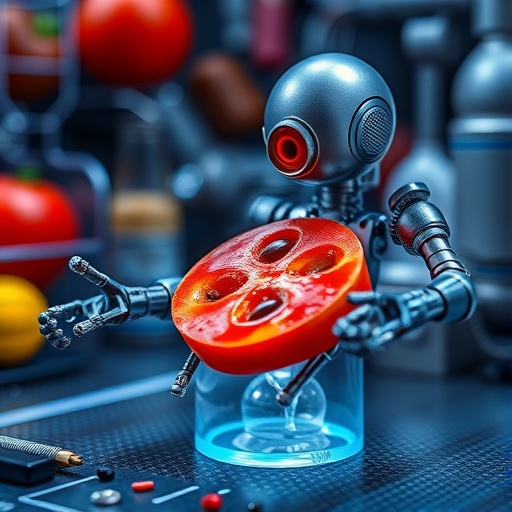
In an era defined by rapid technological advancement and growing concerns over food safety and sustainability, an intriguing frontier has emerged at the intersection of nanotechnology and food science: the application of functional microrobots. These tiny, autonomous devices, constructed from innovative materials, are showing exceptional promise in addressing long-standing challenges within the global food supply chain. The susceptibility of food to spoilage and contamination has significant implications for public health and economic stability, driving urgent demand for innovative methods that improve preservation, safety monitoring, and processing. Recent research highlights how nano- and microrobots, meticulously engineered in diverse shapes and sizes, could radically transform these aspects of food science, offering precision, efficiency, and scalability previously unattainable through conventional methods.
The food industry faces myriad threats related to microbial contamination, chemical spoilage, and oxidative degradation, all of which compromise product quality and safety. Traditional preservation methods, such as refrigeration, chemical additives, and packaging innovations, while helpful, often fall short in fully mitigating these risks. Enter microrobots, nanoscale devices powered by autonomous mechanisms capable of navigating complex environments within food matrices. By leveraging functional materials—such as catalytic nanoparticles, magnetic components, and bio-compatible polymers—scientists are designing microrobots with tailored responses to specific stimuli, enabling them to operate as active agents in quality control and contamination detection. Their autonomous nature allows continuous monitoring and real-time intervention, potentially revolutionizing the way food safety is managed from farm to fork.
Fundamentally, the concept of functional microrobots in food science hinges on their capacity for precise locomotion and targeted interaction with food components. Unlike passive sensors or external monitoring, these microrobots can infiltrate microenvironments within food products, actively seek out contaminants such as pathogenic bacteria or chemical residues, and either neutralize threats or provide diagnostic signals. Their programmability and responsiveness to stimuli—whether chemical gradients, light, magnetic fields, or temperature changes—grant unprecedented control over their activity. For example, in liquid food matrices such as milk or juices, microrobots can navigate autonomously to detect early signs of contamination, allowing for swift remediation that could prevent widespread outbreaks or spoilage.
Moreover, microrobotics technology is not solely limited to safety monitoring; it also harbors transformative potential in food preservation. Oxidative degradation and enzymatic activity are among the primary agents of food spoilage, and microrobots engineered with antioxidant or enzyme-inhibiting capabilities could mitigate these processes in situ. By releasing protective agents in a controlled manner or scavenging reactive oxygen species, these autonomous devices could extend shelf life significantly without the need for added preservatives, which consumers often seek to avoid. This aspect of microrobot application aligns with current trends emphasizing clean-label products and sustainability, as it reduces dependency on chemical additives and energy-intensive refrigeration.
Processing efficiency is a third frontier wherein microrobots show notable promise. From homogenization and emulsification to targeted delivery of nutrients and flavors, microrobots can introduce a level of precision in food manufacturing that surpasses traditional bulk processing techniques. Their small size enables them to manipulate food structures at the microscale, potentially enhancing texture, consistency, and nutritional profiles through active interventions. For instance, microrobots could facilitate the even distribution of bioactive compounds or vitamins within beverages or dairy products, ensuring optimal health benefits are retained throughout the product’s shelf life. The integration of such technology could redefine product formulation and manufacturing workflows, ushering in a new paradigm of personalized and functional foods.
Despite these exciting prospects, transitioning microrobotics from proof-of-concept experiments to real-world applications in the food industry entails overcoming significant hurdles. Biocompatibility and safety are paramount; the materials and propulsion mechanisms must be confirmed absolutely safe for human consumption, with transparent pathways for degradation or removal post-use. Additionally, the scalability of microrobot production remains a logistical challenge, requiring cost-effective manufacturing processes that can meet industrial volumes. Regulatory frameworks will need rapid adaptation to accommodate these novel entities, ensuring rigorous evaluation without stifling innovation. Furthermore, integration into existing food processing and handling systems demands interoperable designs that can withstand complex operational environments and deliver consistent performance.
From the perspective of functional material science, the development of microrobots involves intricate engineering at molecular and nanoscale levels. Catalytically active surfaces, responsive polymers, and magnetic or acoustic actuation systems form the backbone of these devices. Researchers are exploring diverse propulsion methods—chemical reactions such as hydrogen peroxide decomposition, magnetic field manipulation, or ultrasound-driven motion—each tailored to specific food matrices and operational contexts. Advanced fabrication techniques, including lithography and self-assembly, are enabling increasingly sophisticated structures capable of multifunctional tasks, such as simultaneous sensing and remediation. The integration of sensors and communication elements within these microrobots further enhances their autonomy and real-time data transmission capability, paving the way for smart, responsive food safety systems.
In terms of contamination control, microrobots present a dynamic alternative to conventional microbial detection and remediation measures. Traditional methods of microbial analysis are often time-consuming and measured post-facto, whereas microrobots can perform in situ sampling, detection, and even disinfection. For example, microrobots functionalized with antimicrobial agents or enzymes can actively neutralize pathogens like Salmonella, Listeria, or E. coli, reducing the need for broad-spectrum chemical sanitizers that can have environmental and health drawbacks. Their small size allows penetration into microstructures where microbes may hide, ensuring thorough decontamination. This capability not only enhances food safety but also offers potential to curb antimicrobial resistance by minimizing the use of conventional antibiotics and disinfectants.
Preservation efficiencies achieved through microrobotics could also impact cold chain logistics, currently a high-energy, costly requirement in food distribution. Autonomous microrobots with preservative functions may reduce reliance on refrigeration by maintaining food freshness and safety through active biochemical modulation. This could extend viable shelf life during transport and storage, particularly critical in regions with limited access to reliable refrigeration infrastructure. Moreover, the potential environmental benefits tied to reduced energy consumption align with increasing pressures for sustainability across the food industry, from production to retail and consumer domains.
In addition to microbial and biochemical applications, microrobots hold potential for detecting and mitigating chemical contaminants and residues, including pesticides, heavy metals, and allergens. Functional materials on microrobots can be engineered to bind or degrade specific harmful compounds, providing a means of active detoxification. Real-time monitoring of chemical hazards within food matrices and packaging could facilitate rapid responses to contamination events, reducing health risks and economic losses. Such proactive contamination control measures are critical in a global food supply chain facing increasing complexity and vulnerability to adulteration or accidental contamination.
Another transformative dimension of microrobotics is their role in enabling personalized nutrition and enhanced food functionality. By incorporating sensors and actuators that respond to individual health metrics, microrobots could someday modulate the release of nutrients or bioactive compounds tailored to consumer needs. This intersection of food technology and precision medicine represents a futuristic vision where foods become dynamic platforms capable of optimizing health on a personalized basis. Although still conceptual, early research in this area underscores the profound potential for microrobotics to enrich consumer experiences and outcomes through active, intelligent food systems.
Integration with digital and data technologies further augments the utility of microrobots in food science. Real-time data relay through embedded sensors opens pathways for predictive analytics and quality assurance, forming cyber-physical food systems that monitor safety and quality continuously along the supply chain. This convergence of robotics, nanotechnology, and data science could dramatically enhance traceability, transparency, and trust in food products, addressing growing consumer demand for information about food origins and safety. Such smart microrobotic systems would enable rapid responses to contamination or spoilage signals, minimizing losses and protecting public health globally.
Nevertheless, despite clear promise, the deployment of microrobots in food environments must contend with complex regulatory and societal challenges. Public acceptance hinges on clear communication regarding safety and benefits, as concerns around nanotechnology and robotics in food could fuel skepticism. Ensuring environmental sustainability in the production, use, and disposal phases of microrobots remains crucial, avoiding unintended ecological impacts. Furthermore, standardization of protocols for testing efficacy, safety, and performance is necessary to build broad confidence among industry stakeholders and regulators alike. Collaborative efforts across academia, industry, and policy arenas will be critical to navigate these multifaceted challenges.
Looking ahead, the future development of microrobotic technologies in food science will likely involve increasingly sophisticated multifunctional devices capable of integrated sensing, response, and remediation. Advances in material science, nanofabrication methods, and artificial intelligence could empower smart microrobots with adaptive behaviors tuned to the dynamic complexities of food systems. Their deployment could extend beyond safety and preservation into facilitating novel food processing techniques, environmental monitoring within food production, and enhancement of food nutritional profiles. The potential for these technologies to reshape our approach to food security, safety, and sustainability is unimpeachable, setting the stage for a new era in food technology.
In conclusion, functional microrobotics stands poised to revolutionize food science and technology by addressing critical challenges in safety, preservation, and processing. The precision, autonomy, and versatility intrinsic to nano- and microrobots could usher in innovative approaches that surpass the effectiveness of traditional methods. While significant scientific, technical, regulatory, and societal obstacles remain, ongoing research and development efforts are rapidly advancing toward tangible applications. As these devices transition from laboratory prototypes to industrial realities, they promise to enhance consumer health, reduce food waste, and promote sustainability, embodying a transformative shift in how humanity manages the food it produces and consumes.
Subject of Research:
Article Title:
Article References:
Maria-Hormigos, R., Mayorga-Martinez, C.C. & Pumera, M. Microrobots in food science and technology. Nat Food (2025). https://doi.org/10.1038/s43016-025-01261-5
Image Credits: AI Generated
DOI: https://doi.org/10.1038/s43016-025-01261-5
Keywords:
Tags: autonomous devices for food processingcombating food spoilage with technologyenhancing food quality with microrobotsfood preservation innovationsfunctional materials in food technologyinnovative food safety monitoringmicrorobots for contamination detectionmicrorobots in food safetynanoscale technology in food systemsnanotechnology in food sciencerevolutionizing food industry with roboticssustainable food supply solutions