• HOME
  • NEWS
  • EXPLORE
    • CAREER
      • Companies
      • Jobs
    • EVENTS
    • iGEM
      • News
      • Team
    • PHOTOS
    • VIDEO
    • WIKI
  • BLOG
  • COMMUNITY
    • FACEBOOK
    • INSTAGRAM
    • TWITTER
Tuesday, July 28, 2026
BIOENGINEER.ORG
No Result
View All Result
  • Login
  • HOME
  • NEWS
  • EXPLORE
    • CAREER
      • Companies
      • Jobs
        • Lecturer
        • PhD Studentship
        • Postdoc
        • Research Assistant
    • EVENTS
    • iGEM
      • News
      • Team
    • PHOTOS
    • VIDEO
    • WIKI
  • BLOG
  • COMMUNITY
    • FACEBOOK
    • INSTAGRAM
    • TWITTER
  • HOME
  • NEWS
  • EXPLORE
    • CAREER
      • Companies
      • Jobs
        • Lecturer
        • PhD Studentship
        • Postdoc
        • Research Assistant
    • EVENTS
    • iGEM
      • News
      • Team
    • PHOTOS
    • VIDEO
    • WIKI
  • BLOG
  • COMMUNITY
    • FACEBOOK
    • INSTAGRAM
    • TWITTER
No Result
View All Result
Bioengineer.org
No Result
View All Result
Home NEWS Science News Biology

Microplastics affect global nutrient cycle and oxygen levels in the ocean

Bioengineer by Bioengineer
April 21, 2021
in Biology
Reading Time: 3 mins read
0
IMAGE
Share on FacebookShare on TwitterShare on LinkedinShare on RedditShare on Telegram

GEOMAR study points to possible major changes in the marine ecosystem
IMAGE

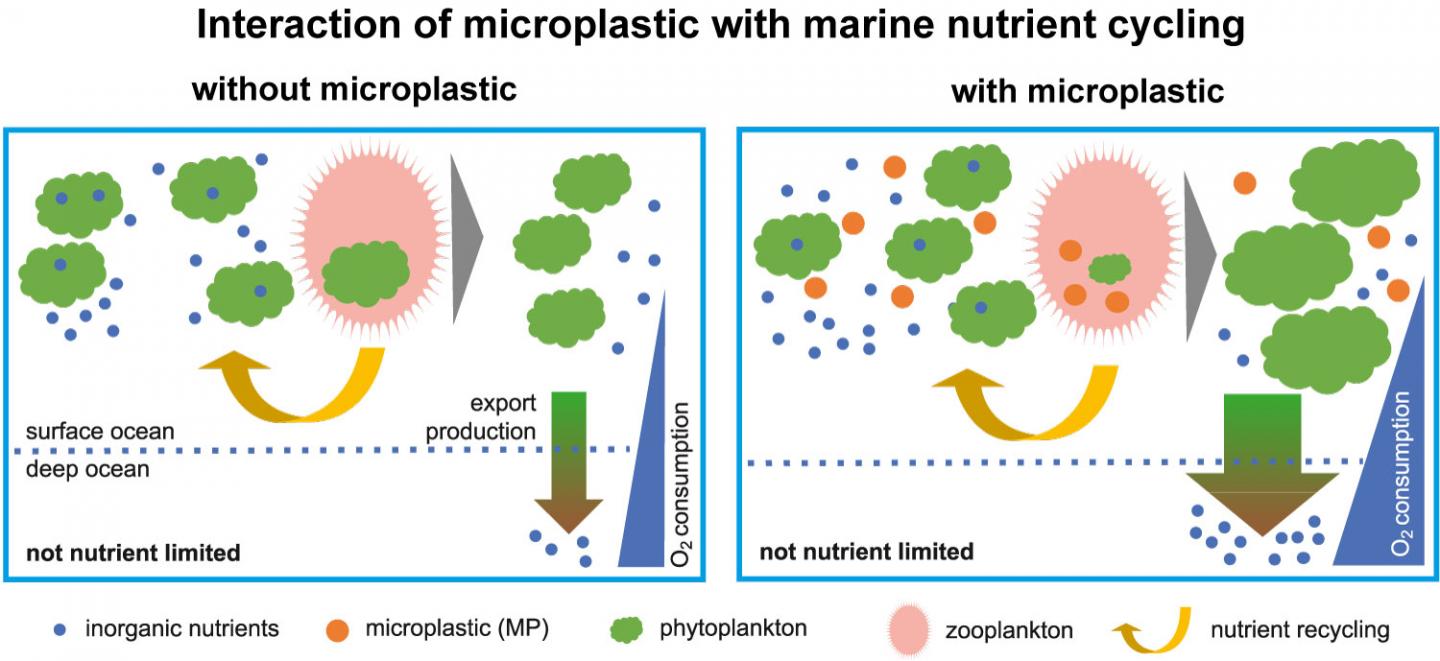
Credit: Graphics modified from Kvale et al. 2021.

The effects of the steadily increasing amount of plastic in the ocean are complex and not yet fully understood. Scientists at GEOMAR Helmholtz Centre for Ocean Research Kiel have now shown for the first time that the uptake of microplastics by zooplankton can have significant effects on the marine ecosystem even at low concentrations. The study, published in the international journal Nature Communications, further indicates that the resulting changes may be responsible for a loss of oxygen in the ocean beyond that caused by global warming.

Plastic debris in the ocean is a widely known problem for large marine mammals, fish and seabirds. These animals can mistake plastic objects, such as plastic bags, for similar-looking food items, such as jellyfish. Tiny zooplankton can also mistake very small plastic particles for food and ingest them either accidentally or by chance (when the particles have combined with organic particles).

The direct effects of such microplastic ingestion on zooplankton are poorly understood, but the broader effects on ecosystems of zooplankton replacing some of their food with plastic are much less well understood. Now, for the first time, a research team has used an Earth system model to simulate how zooplankton that ingest microplastics could affect the base of the ocean food web and nutrient cycling. The results, now published in the international journal Nature Communications, suggest that even low concentrations of microplastics can have a strong impact on ecosystems. “This influence is already sufficient to affect global nutrient cycling”, says Dr Karin Kvale, lead author of the study.

“These findings are significant because there has long been scepticism in the scientific community that microplastic concentrations in the ocean are high enough to have any impact on nutrient cycling”, says Dr Karin Kvale “Our study shows that even at levels present in the ocean today, it may already be the case if zooplankton replace some of their natural food with microplastics. If zooplankton eat the microplastics and thus take up less food, this can have far-reaching ecological effects that can, for example, lead to increased algal blooms via a reduction in feeding pressure that affect the oxygen content of the oceans almost as much as climate change”, Kvale continues. These findings point to a new potential driver of human-induced ocean change that has not been considered before. However, Kvale points out that the results are “very preliminary” because little is yet known about how the base of the food web interacts with microplastic pollution. Further work on this topic is needed, she says, but the study provides strong motivation to expand the capacity of Earth system models to include pollution effects as a new driver of ocean change.

###

Reference:

Kvale, K. A. E. F. Prowe, C.-T. Chien, A. Landolfi, and A. Oschlies, 2021: Zooplankton grazing of microplastic can accelerate global loss of ocean oxygen. Nature Communications, doi: https://doi.org/10.1038/s41467-021-22554-w

Contact:

Dr. Andreas Villwock (GEOMAR, Communication and Media), Tel.:+49 0431 600-2802, [email protected]

Media Contact
Karin Kvale
[email protected]

Related Journal Article

http://dx.doi.org/10.1038/s41467-021-22554-w

Tags: BiologyEcology/Environment
Share12Tweet8Share2ShareShareShare2

Related Posts

Nuclear Escape Accelerates as Stress Builds Inside the Atomic Nucleus

Nuclear Escape Accelerates as Stress Builds Inside the Atomic Nucleus

July 28, 2026
Lipid Regulator Modulates Sonic Hedgehog Pathway, Shaping Heart and Lungs

Lipid Regulator Modulates Sonic Hedgehog Pathway, Shaping Heart and Lungs

July 27, 2026

Stomach Signals Help Brain Build Memories, New Study Reveals

July 27, 2026

AI app identifies birds offline by recording animal sounds on your phone

July 27, 2026
Please login to join discussion

POPULAR NEWS

  • Nuclear Escape Accelerates as Stress Builds Inside the Atomic Nucleus

    29 shares
    Share 12 Tweet 7
  • Imaging Nanoscale Polar Textures Reveals Quantum Paraelectric Behavior in SrTiO3

    29 shares
    Share 12 Tweet 7
  • Atezolizumab After Single or Multiple Fractions of Stereotactic Radiotherapy in TNBC

    29 shares
    Share 12 Tweet 7
  • Inflation-Induced Changes in Epinephrine Pharmacokinetics and Dynamics in Piglets

    29 shares
    Share 12 Tweet 7

About

We bring you the latest biotechnology news from best research centers and universities around the world. Check our website.

Follow us

Recent News

Nuclear Escape Accelerates as Stress Builds Inside the Atomic Nucleus

Imaging Nanoscale Polar Textures Reveals Quantum Paraelectric Behavior in SrTiO3

Atezolizumab After Single or Multiple Fractions of Stereotactic Radiotherapy in TNBC

Subscribe to Blog via Email

Enter your email address to subscribe to this blog and receive notifications of new posts by email.

Join 85 other subscribers
  • Contact Us

Bioengineer.org © Copyright 2023 All Rights Reserved.

Welcome Back!

Login to your account below

Forgotten Password?

Retrieve your password

Please enter your username or email address to reset your password.

Log In
No Result
View All Result
  • Homepages
    • Home Page 1
    • Home Page 2
  • News
  • National
  • Business
  • Health
  • Lifestyle
  • Science

Bioengineer.org © Copyright 2023 All Rights Reserved.