WASHINGTON, July 16, 2024 — From cloud formation to sea temperatures, sea foam plays many roles in the dynamic interactions that occur at the surface level of the world’s oceans.
Credit: Jotam Bergfreund
WASHINGTON, July 16, 2024 — From cloud formation to sea temperatures, sea foam plays many roles in the dynamic interactions that occur at the surface level of the world’s oceans.
In an article published this week in Physics of Fluids, by AIP Publishing, researchers from ETH Zürich and The Ocean Cleanup, based in New Zealand, examined the specific impacts of microplastics on the geophysics of sea foam formation in the critical zone where water meets air in the top layer of the ocean.
“The surface microlayer is the first area of contact between the atmosphere and a water body, lake, or ocean,” author Peter Fischer said. “All exchanges of materials, whether gases, water, or particles, pass through the surface microlayer before they are distributed deeper into the water column or upper layers of the atmosphere through evaporation and cloud formation.”
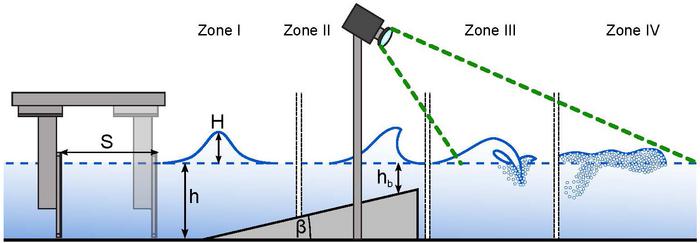
Fischer and his colleagues devised two simulations for their work: a column filled with sea water injected with air and a laboratory-scale breaking wave channel to test the impacts of wave height on sea foam in the surface microlayer. Using microplastics collected from the North Pacific by The Ocean Cleanup, along with naturally occurring compounds, they tested their effects on sea foam formation, stability, and duration.
The team closely examined the interplay between air, water, and suspended materials that affect the water surface tension, including microplastics and naturally occurring surface active materials. They found that the addition of microplastics increased the height and stability of sea foam, particularly when part of smaller breaking waves.
“Surface active materials such as plankton, proteins, and other byproducts of marine life already influence sea foam formation even without human input,” Fischer said. “Microplastic pollution adds a notable, but smaller, contribution to the formation of sea foam and actually leads to some positive effects like reflecting more UV light.”
Sea foam has several positive effects on the ocean and climate, so more of it might be one of the few positives stemming from microplastic pollution in our oceans. Sea foam drives an exchange of air and water at the ocean’s surface, resulting in more cloud formation and more oxygen in the water. The brighter foam also reflects sunlight, potentially lowering ocean temperature.
In future studies, the team is planning to refine the experiments to more closely mimic natural conditions and explore the effects of biofilms and photochemical degradation.
###
The article “Impact of microplastic pollution on breaking waves” is authored by Jotam Bergfreund, Ciatta Wobill, Frederic M. Evers, Benjamin Hohermuth, Pascal Bertsch, Laurent Lebreton, Erich J. Windhab, and Peter Fischer. It will appear in Physics of Fluids on July 16, 2024 (DOI: 10.1063/5.0208507). After that date, it can be accessed at https://doi.org/10.1063/5.0208507.
ABOUT THE JOURNAL
Physics of Fluids is devoted to the publication of original theoretical, computational, and experimental contributions to the dynamics of gases, liquids, and complex fluids. See https://pubs.aip.org/aip/pof.
###
Journal
Physics of Fluids
DOI
10.1063/5.0208507
Article Title
Impact of microplastic pollution on breaking waves
Article Publication Date
16-Jul-2024