Foodborne pathogens cause an estimated 600 million illnesses and 420,000 deaths annually worldwide, yet transitioning microfluidic biosensors from pristine laboratory buffers into routine food safety surveillance requires overcoming severe matrix interference, biofouling, and unverified workflow integration. In a comprehensive review published in Food Science and Nutrition, researchers examined the analytical performance and translational readiness of microfluidic platforms designed to detect major bacterial, viral, and fungal contaminants. While microfluidic devices leverage sub-millimeter fluid manipulation to accelerate reaction kinetics, diminish reagent consumption, and automate sample processing, the academic literature has reached saturation with prototype demonstrations that often fail to reflect operational food-testing environments. The evaluation emphasizes that analytical limits of detection established in pure buffer solutions cannot be equated with regulatory compliance or field efficacy in authentic foods. Diagnostic differentiation of pervasive threats—such as Shiga toxin-producing and enterotoxigenic Escherichia coli, invasive Listeria monocytogenes, Salmonella enterica serovars, fastidious Campylobacter jejuni, and enterotoxigenic Staphylococcus aureus—demands integrated platforms capable of handling opaque, viscous, and biochemically complex matrices.
Microbial contamination spans diverse bacterial agents, viral pathogens like norovirus responsible for roughly 685 million global infections annually, and toxigenic fungi including Aspergillus flavus. Conventional culture-based surveillance remains labor-intensive and requires three to five days for confirmation, frequently missing viable but non-culturable bacterial states that retain pathogenic potential. Alternative standard methods such as polymerase chain reaction and enzyme-linked immunosorbent assays provide higher specificity but depend on costly equipment, specialized personnel, and intricate off-chip nucleic acid extraction. Although microfluidic systems offer miniaturized lab-on-a-chip architectures to bridge this diagnostic gap, complex food matrices present aggressive analytical barriers. Raw meat exudates, opaque poultry homogenates, unpasteurized milk, and lipid-dense emulsions deposit proteins and fats onto sensor interfaces, producing severe biofouling, non-specific adsorption, and optical scattering. In addition, high concentrations of native background microflora and endogenous biochemical inhibitors suppress enzymatic amplification and physical signal transduction. Consequently, a sensor demonstrating femtomolar or single-cell sensitivity in filtered water may experience drastic signal attenuation or false-positive reporting when challenged with authentic agricultural or dietary commodities without specialized pre-analytical isolation.
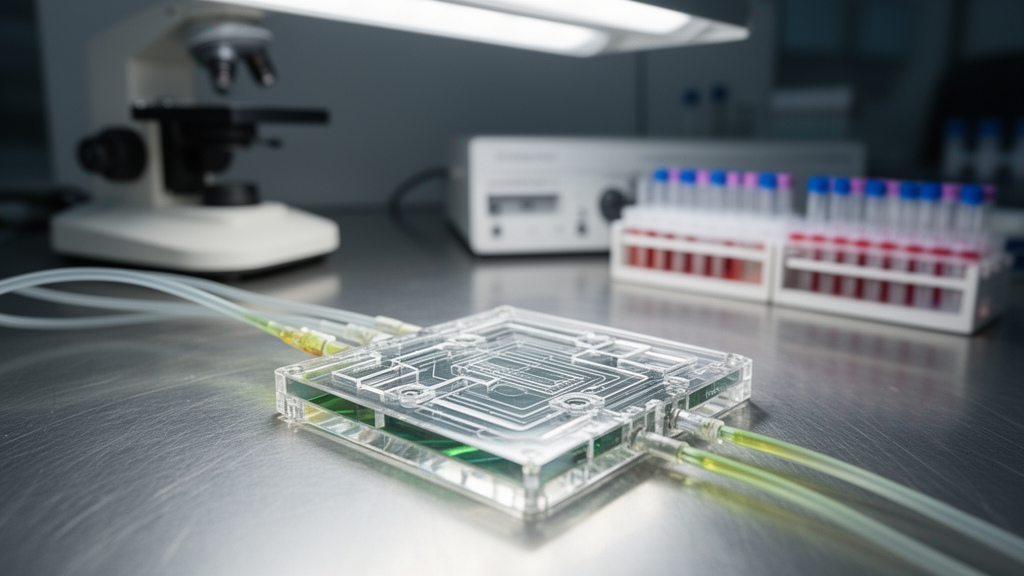
The practical translation of point-of-need microfluidic cartridges depends intrinsically on substrate material selection, which governs optical transparency, fabrication scalability, surface modification capability, mechanical durability, and unit cost. Polydimethylsiloxane has historically served as the predominant elastomeric material due to its optical clarity, gas permeability, and facile replica molding via cleanroom soft lithography. However, polydimethylsiloxane exhibits substantial physical limitations that impede commercial diagnostics, including the non-specific bulk partitioning and adsorption of hydrophobic molecules such as fluorophores and bacterial toxins, which severely degrades analytical limits of detection. Furthermore, thermodynamically driven hydrophobic recovery causes modified surfaces to revert to their native hydrophobic state within hours or days as uncrosslinked oligomers migrate to the interface, undermining the shelf life of pre-treated devices. To overcome cleanroom-dependent batch production bottlenecks and geometric constraints, stereolithographic three-dimensional printing has emerged as a viable alternative. Advanced resin-based stereolithography enables the rapid prototyping of monolithic three-dimensional fluidic architectures, check valves, and chaotic micromixers. Notably, researchers demonstrated a three-dimensional printed microfluidic chip coupled to an aptamer-based nanointerferometer capable of label-free simultaneous quantification of Listeria monocytogenes, Escherichia coli, Salmonella typhimurium, and Staphylococcus aureus without tedious multi-layer bonding.
Rigid thermoplastics represent the principal pathway toward commercial mass manufacturing of standardized diagnostic cartridges for food supply chain monitoring. Commodity polymers like polymethyl methacrylate and polycarbonate offer robust mechanical rigidity and straightforward functionalization, while polystyrene supports high-density cell analysis. For optical biosensing, cyclic olefin copolymer and cyclic olefin polymer represent superior materials owing to exceptional ultraviolet-visible transmission, negligible autofluorescence, high dimensional stability, and chemical resistance to aggressive solvents. Industrial translation relies heavily on high-throughput fabrication techniques, with injection molding achieving microchannel cycle times under forty-five seconds for polymethyl methacrylate and fifteen seconds for polystyrene platforms. Advanced molding even replicates nanoscale architectures, including embedded gold-capped nanocones in cyclic olefin copolymer substrates for surface-enhanced Raman scattering. Ultrasonic-assisted hot embossing uses localized interfacial friction generated by sonotrode vibrations to replicate microscale channels in seconds without prolonged thermal cycling, preserving the biological activity of pre-loaded antibodies and aptamers. Additionally, direct channel engraving using ultraviolet and femtosecond cold laser ablation avoids the melting artifacts and heat degradation characteristic of carbon dioxide lasers, allowing agile prototyping of complex microfluidic geometries.
Inorganic glass substrates and cellulosic paper represent contrasting engineering paradigms tailored to distinct diagnostic environments. Silicate and photosensitive glasses provide absolute chemical inertness, high mechanical strength, pristine optical clarity, and abundant surface silanol groups for durable covalent immobilization. Recent fabrication approaches have replaced cleanroom photolithography with dry film photoresist masking for wet etching, as well as femtosecond laser direct writing and laser-induced chemical etching to engrave true three-dimensional channels and superhydrophobic functional elements directly within the glass matrix. In contrast, paper-based analytical devices utilize capillary wicking through chromatographic cellulose, eliminating external micropumps to achieve ultra-low-cost, disposable, and incinerable diagnostic testing suited for resource-limited field locations. Stacking paper layers into three-dimensional architectures enables complex multiplexed fluid routing while preventing signal crosstalk. Contemporary fabrication has shifted from thermal wax printing, which suffers from boundary blurring and discontinued commercial printers, toward high-precision piezoelectric inkjet printing that dispenses picoliter droplets of hydrophobic polymers to define microchannels with high spatial resolution. Nonetheless, paper-based sensors frequently suffer from flow variability, humidity sensitivity, and poor quantitative accuracy in lipid-rich emulsions unless integrated with specialized pre-filtration membranes.
Optical detection constitutes a primary transduction modality within microfluidic pathogen screening, encompassing colorimetric, fluorescent, and plasmonic mechanisms. Colorimetric assays adhere to the Beer–Lambert absorption relationship and operate through either enzyme-catalyzed chromogenic reactions or nanoparticle aggregation. Enzymatic platforms frequently utilize alkaline phosphatase, a homodimeric metalloenzyme requiring zinc and magnesium cofactors, to catalyze visible chromogenic shifts, achieving limits of detection between 1.25 and 1.75 milliunits per milliliter in clinical serum and rapid threshold detection above thirty milliunits per milliliter on paper substrates. Programmable paper devices integrating bioenzyme-nanozyme cascades with cobalt-doped mesoporous cerium oxide have further augmented catalytic signal generation. Alternatively, gold nanoparticles functionalized with bio-recognition elements exhibit distinct localized surface plasmon resonance shifts upon target-induced cross-linking and aggregation. However, in raw food homogenates, non-specific adsorption of macromolecules forms a protein corona around metallic nanoparticles, triggering premature aggregation and false-positive readouts unless surfaces undergo PEGylation passivation. To mitigate subjective visual interpretation, microfluidic paper devices increasingly interface with smartphone cameras and deep learning algorithms, including convolutional neural networks and object detection models, to dynamically normalize ambient lighting, segment test zones, and analyze kinetic color evolution.
Fluorescence transduction provides elevated spatial resolution and multiplexing capacity for nucleic acid and single-cell detection, spanning pure affinity capture, isothermal amplification synergies, and CRISPR-Cas collateral cleavage. Standalone affinity designs, such as dual-rolling circle amplification aptamer chips, have isolated Escherichia coli O157:H7 from orange juice and milk at eighty cells per milliliter, although matrix autofluorescence and optical substrate background necessitate matrix-matched calibrations and bulky excitation hardware. Integrating fluorescence with isothermal amplification, such as automated droplet digital loop-mediated isothermal amplification, encapsulates single cells or nucleic acids into picoliter water-in-oil droplets to achieve absolute pathogen quantification via Poisson statistics within seventy-five minutes. Furthermore, combining microfluidics with CRISPR Cas12a and Cas13a effectors permits femtomolar analytical limits of detection within thirty-five minutes through target-triggered collateral trans-cleavage of fluorophore-quencher reporters. On polyethersulfone paper chips combining recombinase polymerase amplification with Cas12a, Salmonella enterica was detected at six colony-forming units per gram in lettuce following six hours of enrichment. Nevertheless, high lipid concentrations in milk and protein residues in meat can physically occlude CRISPR-Cas ribonucleoprotein complexes, inhibiting trans-cleavage kinetics and requiring compartmentalized orthogonal dual-guide architectures.
Electrochemical microfluidic biosensors deliver notable advantages for opaque food analysis because electrical signal transduction remains inherently unaffected by optical turbidity, light scattering, and matrix autofluorescence. Amperometric and voltammetric devices monitor Faradaic current generated by electroactive species under fixed or varied potentials, often integrating conductive nanomaterials like graphene oxide-wrapped carboxylated multi-walled carbon nanotubes to accelerate electron transfer kinetics for sensitive Salmonella typhimurium screening. Conversely, impedimetric biosensing using interdigitated microelectrode arrays offers label-free monitoring by measuring perturbations in interfacial electrical impedance and charge transfer resistance upon analyte binding. Advanced non-Faradaic electrochemical impedance spectroscopy utilizing immobilized monoclonal antibodies demonstrated detection of Escherichia coli O157:H7 at one colony-forming unit per milliliter within five minutes. Similarly, combining top-bottom electrode pairs for positive dielectrophoretic cell concentration with impedimetric measurement achieved a calculated limit of two colony-forming units per milliliter for Salmonella choleraesuis in undiluted milk across a fifty-minute workflow. Cost-effective paper impedance platforms incorporating magnetic core-shell iron oxide and cadmium selenide-zinc sulfide quantum dots quantified Escherichia coli at 270 colony-forming units per milliliter in thirty minutes, while cell-imprinted polymer microwires embedded in polydimethylsiloxane channels yielded a detection limit of 200 colony-forming units per milliliter across a broad dynamic range.
Surface plasmon resonance, localized surface plasmon resonance, and surface-enhanced Raman scattering detect target binding by tracking refractive index fluctuations and localized electromagnetic field enhancements at dielectric-metal boundaries. Microfluidic continuous-flow architectures mitigate the stochastic variability of static Raman hotspots, while hybrid copper-silver nanostructures produce ultra-dense electromagnetic hotspots that facilitate rapid mycotoxin and whole-cell detection in agricultural wash water. Furthermore, cesium lead bromide perovskite quantum dots leveraging fluorescence resonance energy transfer achieved detection limits of ten colony-forming units per milliliter for Salmonella and Vibrio species in complex foods by suppressing biological autofluorescence. Multifunctional nanomaterials, notably catalytic nanozymes and metal-organic frameworks, provide enhanced environmental stability against harsh pH, salinity, and temperature fluctuations. For example, self-oxygenating nanozymes decompose endogenous hydrogen peroxide to fuel oxidation cascades for Salmonella typhimurium detection in anaerobic food homogenates at 1,000 colony-forming units per milliliter. Similarly, copper dioxide nanodots encapsulated within metal-organic frameworks enabled dual-mode colorimetric and electrochemical detection of Vibrio parahaemolyticus at thirty colony-forming units per milliliter. Emerging label-free acoustic quartz crystal microbalance sensors and digital microfluidic chemiluminescence systems also offer distinct sensing pathways, though each requires rigorous verification against interfacial fouling and baseline drift.
Despite remarkable analytical sensitivity reported across diverse academic prototypes, the comprehensive review highlights a critical translational gap that prevents microfluidic biosensors from achieving routine deployment in commercial food safety assurance. Many published studies benchmark analytical limits of detection in purified buffers without accounting for the profound impacts of pre-analytical sample preparation, target recovery, matrix-specific inhibition, and total procedure duration. Proposed orthogonal biosensors that integrate dual recognition or multimodal readouts—such as concurrent optical and electrochemical channels—may reduce matrix interference, but their efficacy must be experimentally demonstrated against single-mode comparators in authentic, heterogeneous food matrices. The translational progression of foodborne pathogen diagnostics requires moving beyond isolated laboratory proofs of concept toward integrated prototype validation within representative agricultural matrices. Establishing field deployability mandates standardized thermoplastic cartridge manufacturing, long-term reagent stability, automated sample-to-answer processing, multi-site inter-laboratory validation, and rigorous alignment with regulatory sampling standards. Until biosensor engineering systematically integrates robust sample pretreatment with verifiable field performance, microfluidic platforms will remain sophisticated academic prototypes rather than deployable frontline defenses against global foodborne disease.
Subject of Research: Translational readiness and analytical performance of microfluidic biosensors for foodborne pathogen detection
Article Title: Microfluidic Biosensors for the Detection of Foodborne Pathogens: A Comprehensive Review
Article References: Mao, W., & Zhang, L. (2026). Microfluidic Biosensors for the Detection of Foodborne Pathogens: A Comprehensive Review. Food Science & Nutrition, 14(11), Article e72588. https://doi.org/10.1002/fsn3.72588
Image Credits: AI Generated
DOI: 10.1002/fsn3.72588
Keywords: microfluidic biosensors, foodborne pathogens, point-of-need diagnostics, food safety testing, matrix interference, biofouling, electrochemical impedance spectroscopy, CRISPR-Cas biosensing, isothermal amplification, paper-based microfluidics, thermoplastic cartridges, polydimethylsiloxane, surface-enhanced Raman scattering, nanozymes, droplet digital microfluidics, Salmonella detection, Escherichia coli O157:H7, Listeria monocytogenes
News Source: Kristina Jarvis. (November 12, 2026). Microfluidic Pathogen Biosensors Face Translation Hurdles Despite Rapid Analytical Advances. Scienmag.