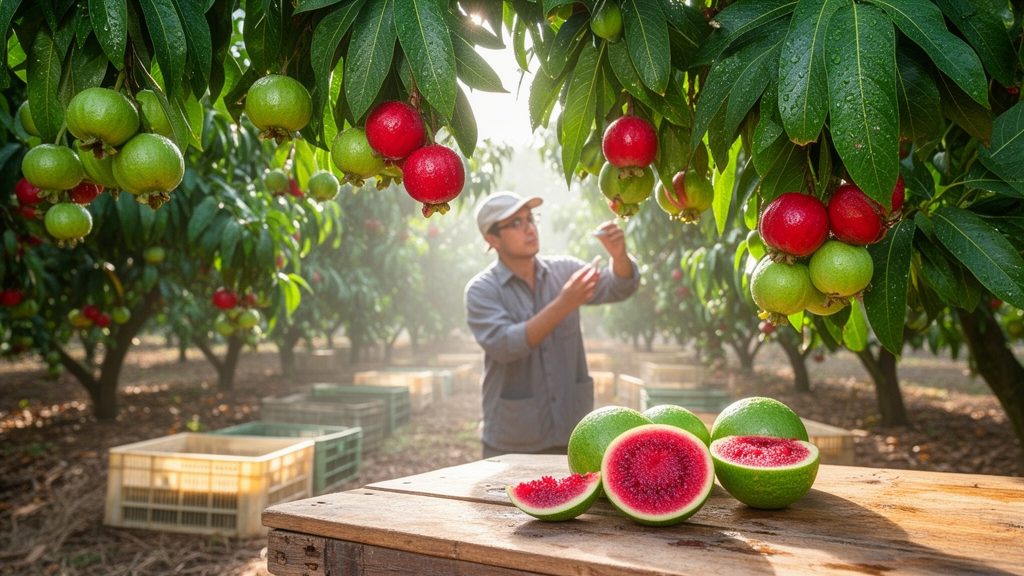
A comprehensive multi-trait evaluation of forty-nine red-pulped guava genotypes has demonstrated that ideotype-based distance selection effectively identifies superior high-yielding progenies while maintaining desirable fruit quality and reduced seediness. Evaluating forty-eight half-sib progenies derived from the cultivar Arka Kiran alongside the parental check, researchers examined twenty-seven distinct morpho-physiological, yield, seed, and biochemical traits across three consecutive seasons. Utilizing the Multi-Trait Genotype-Ideotype Distance Index at a twenty percent selection intensity, the investigation identified ten promising genotypes—designated PG 35-1, PG 28-1, PG 11-5, PG 34-1, PG 2-7, Arka Kiran, PG 32-3, PG 11-4, PG 1-7, and PG 23-10—closely aligned with the breeding ideotype. High genotypic and phenotypic coefficients of variation, coupled with broad-sense heritability estimates ranging from 75.00 percent to 99.92 percent, confirmed that observed variation was primarily genetic. These findings show that multivariate distance indexing resolves long-standing selection dilemmas in guava improvement, providing breeders with elite selections that combine high fruit yield with enhanced nutritional value and commercially desirable pulp properties.
Guava, botanically classified as Psidium guajava within the family Myrtaceae, is an important tropical and subtropical fruit crop originating in tropical America and introduced to India during the early seventeenth century by the Portuguese. India has become the world’s leading producer, yielding approximately 2.8 million metric tonnes annually with an average productivity of 12.7 metric tonnes per hectare, led by states including Bihar, Madhya Pradesh, Chhattisgarh, Uttar Pradesh, West Bengal, and Odisha. Globally termed the poor man’s fruit or apple of the tropics due to its nutritional richness and accessibility, guava bears various regional names across India, such as Koyya in Tamil, Amrud in Hindi, and Peraka in Malayalam. Although primarily self-pollinated, outcrossing rates around 35 percent generate valuable heterozygosity. Nevertheless, conventional varietal improvement is frequently constrained by genetic linkages between red pulp and bold seed size, high seed numbers, and a brief postharvest shelf life that severely limits export potential.
The experimental investigation was conducted at the College Orchard within the Department of Fruit Science, Horticultural College and Research Institute, Tamil Nadu Agricultural University in Coimbatore, Tamil Nadu, located at 11 degrees 02 minutes North latitude and 77 degrees 03 minutes East longitude. Open-pollinated seeds collected from mother trees of the red-pulped cultivar Arka Kiran were used to establish an initial population of 337 half-sib progenies during 2013–2014. From this population, forty-eight progenies were selected based on consistent flowering and fruiting behavior and designated as PG selections. The trial was established in a Randomized Block Design with single-plant plots at a spacing of 1.0 meter by 1.0 meter between rows and plants. To ensure statistical reliability across seasons, quantitative and biochemical data were gathered across three distinct seasons, using three replications per season, with the resulting pooled mean data utilized to evaluate twenty-seven morpho-physiological, yield, seed, and biochemical traits.
Standard laboratory analytical protocols were applied to assess the biochemical and physical characteristics of fruit samples. Total soluble solids were determined on filtered fruit juice using a digital refractometer spanning a zero to 32 degrees Brix scale. Titratable acidity was estimated by homogenizing ten grams of pulp, diluting to 50 milliliters with distilled water, filtering through muslin cloth, and titrating a ten-milliliter aliquot against 0.01 Normal sodium hydroxide using phenolphthalein indicator, expressed as citric acid percentage. Ascorbic acid, total sugars, reducing sugars, and non-reducing sugars were quantified following Somogyi procedures, while total pectin percentage was determined according to Ranganna. Statistical analyses were performed in R version 4.3.1 using the agricolae package for analysis of variance and Duncan’s Multiple Range Test at five percent significance. Genetic parameters were computed via the variability package, correlation matrices using corrplot, principal component analysis via FactoMineR and Factoshiny, and MGIDI calculations through the gamem and mgidi functions in Metan.
Pooled analysis of variance demonstrated significant differences among the forty-nine genotypes for all twenty-seven evaluated traits. Individual fruit weight ranged from 40.70 grams in PG 2-8 to 223.89 grams in PG 24-6, while fruit yield per tree varied from 3.46 kilograms in PG 2-8 to 22.14 kilograms in PG 24-6. Fruit set percentage spanned from 69.56 percent in PG 34-2 to 91.89 percent in PG 1-7, and days to fruit maturity ranged from 121.15 days in PG 13-3 to 133.87 days in PG 13-5. Fruit length extended from 5.14 centimeters in PG 8-7 to 9.35 centimeters in Arka Kiran, while pulp weight varied from 35.05 grams in PG 2-8 to 187.49 grams in PG 24-6. Total soluble solids ranged between 7.04 degrees Brix in PG 7-4 and 12.62 degrees Brix in PG 1-7, ascorbic acid varied from 156.30 milligrams in PG 25-1 to 223.23 milligrams per 100 grams in PG 28-1, and lycopene ranged from 3.01 milligrams to 6.12 milligrams per 100 grams.
Genetic variability analysis revealed that phenotypic coefficients of variation exceeded genotypic coefficients of variation across all traits, indicating minor environmental influence and strong genetic control. High genotypic and phenotypic coefficients of variation were observed for fruit yield per tree at 51.70 and 51.76 percent, seed number per fruit at 35.40 and 35.42 percent, individual fruit weight at 34.10 and 34.13 percent, pulp weight at 33.96 and 34.03 percent, 100-seed weight at 32.27 and 32.30 percent, total seed weight at 32.21 and 32.22 percent, fruit pulp thickness at 26.60 and 26.73 percent, and number of fruits per tree at 25.48 and 25.62 percent. Heritability was high for all twenty-seven traits, spanning 75.00 percent to 99.92 percent. High heritability paired with high genetic advance as a percentage of the mean occurred for fruit yield (99.76 percent heritability, 106.39 percent advance), fruit weight (99.82 and 70.19 percent), and pulp weight (99.62 and 69.84 percent), demonstrating that additive gene action predominates and phenotypic selection will be effective.
Correlation analysis revealed significant associations linking fruit yield, physical dimensions, and biochemical quality traits. Fruit yield per tree exhibited strong positive correlations with individual fruit weight at r = 0.83, pulp weight at r = 0.82, fruit length at r = 0.77, fruit width at r = 0.75, number of fruits per tree at r = 0.65, fruit circumference at r = 0.64, and pulp-to-seed ratio at r = 0.63. Fruit yield also correlated positively with total soluble solids at r = 0.55, titratable acidity at r = 0.45, ascorbic acid content at r = 0.42, and total sugars at r = 0.36, while showing a negative correlation with days to fruit maturity at r = -0.62. Among biochemical variables, total soluble solids correlated strongly with total sugars at r = 0.96, reducing sugars at r = 0.87, non-reducing sugars at r = 0.79, ascorbic acid at r = 0.71, and pectin content at r = 0.69. These relationships confirm that enhancing fruit yield can proceed simultaneously with improvements in sweetness and nutritional quality.
Multivariate hierarchical cluster analysis separated the forty-nine genotypes into four distinct clusters based on their morpho-physiological and biochemical profiles. Cluster I formed the largest group with twenty-one genotypes, displaying intermediate performance, a fruit set of 78.81 percent, a shelf life of 3.15 days, a balanced pulp-to-seed ratio of 31.32, and an average fruit yield of 7.57 kilograms per tree. Cluster II contained thirteen genotypes showing desirable dessert-quality traits, including a fruit set of 79.29 percent, pulp weight of 125.20 grams, fruit yield of 10.73 kilograms per tree, and elevated lycopene content averaging 5.17 milligrams per 100 grams. Cluster III included seven genotypes with the lowest yield metrics and smaller fruit size, but distinguished by earliest maturity at 128.09 days and higher fruit set at 80.87 percent. Cluster IV comprised eight superior genotypes recording the highest mean fruit weight of 203.02 grams, pulp weight of 166.88 grams, fruit yield of 15.59 kilograms per tree, total soluble solids of 10.45 degrees Brix, and ascorbic acid content of 184.74 milligrams per 100 grams.
Principal Component Analysis identified six principal components with eigenvalues exceeding one, collectively accounting for 80.34 percent of the total variation among the evaluated traits. The first principal component explained 36.61 percent of total variance, primarily driven by fruit productivity traits including individual fruit weight contributing 8.18 percent, fruit yield per tree at 8.19 percent, pulp weight at 8.02 percent, fruit length at 7.70 percent, fruit width at 7.28 percent, and total soluble solids at 5.19 percent. The second principal component explained 17.86 percent of variance, dominated by seed traits and sugars, including 100-seed weight at 8.62 percent, seed number per fruit at 8.51 percent, total seed weight at 8.28 percent, and total sugars at 7.86 percent. Together, PC1 and PC2 accounted for 54.48 percent of total variation in a two-dimensional biplot. Genotypes including PG 28-1, PG 11-5, PG 35-1, PG 34-1, PG 1-7, and Arka Kiran positioned in the first quadrant, aligning closely with fruit yield vectors, whereas days to fruit maturity and seed hardiness formed obtuse angles with fruit yield.
To integrate multiple opposing breeding goals, the researchers utilized the Multi-Trait Genotype-Ideotype Distance Index, defining an ideotype that prioritized increased fruit yield, pulp thickness, and biochemical quality while penalizing seed hardness, seed mass, seed number, and maturity duration. Applying a twenty percent selection intensity, MGIDI scores identified ten superior genotypes: PG 35-1, PG 28-1, PG 11-5, PG 34-1, PG 2-7, Arka Kiran, PG 32-3, PG 11-4, PG 1-7, and PG 23-10. These elite selections combined balanced agronomic profiles, with individual genotypes exhibiting distinctive advantages, such as PG 24-6 showing peak fruit yield and pulp thickness, PG 28-1 providing maximum ascorbic acid, PG 34-1 displaying highest lycopene, and PG 1-7 combining superior sweetness with longer shelf life. Crossing superior high-yielding Cluster IV selections with early-maturing Cluster III genotypes offers a promising route to generate transgressive segregants. However, researchers noted that these ten elite genotypes require further evaluation across multiple locations and seasons to validate stability before commercial varietal release.
Subject of Research: Multi-trait ideotype selection and genetic variability in red-pulped guava half-sib progenies
Article Title: Harnessing the MGIDI index for multi-trait ideotype selection and multi-trait selection for fruit quality among 49 red-pulped guava (Psidium guajava L.) half-sib progenies
Article References: Kavino, M., Devi, S. M., Nivethitha, T., Karunakaran, G., & Suresh, R. (2026). Harnessing the MGIDI index for multi-trait ideotype selection and multi-trait selection for fruit quality among 49 red-pulped guava (Psidium guajava L.) half-sib progenies. Discover Plants, 3(1), Article 541. https://doi.org/10.1007/s44372-026-01015-y
Image Credits: AI Generated
DOI: 10.1007/s44372-026-01015-y
Keywords: Psidium guajava, MGIDI, half-sib progenies, Arka Kiran, fruit yield, total soluble solids, heritability, genetic advance, principal component analysis, cluster analysis, ascorbic acid, lycopene content, pulp weight, seed hardness, titratable acidity, plant breeding, Tamil Nadu Agricultural University
News Source: Alan Morgan. (November 16, 2026). MGIDI Analysis Identifies Ten Superior High-Yielding Red Guava Progenies. Scienmag.