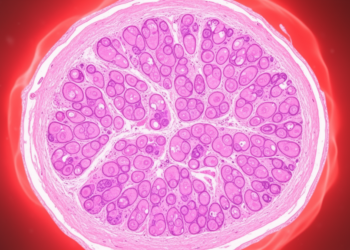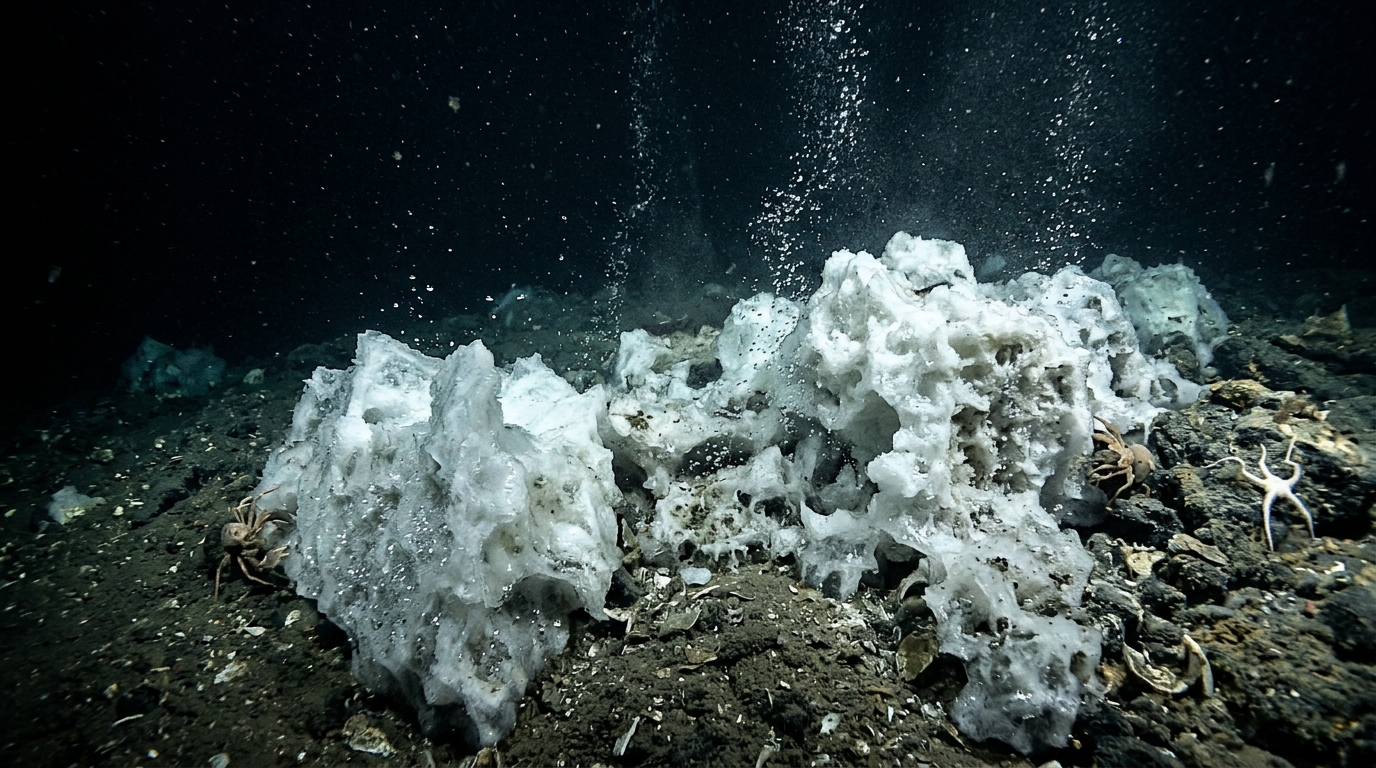
Injecting carbon dioxide into marine methane hydrate formations allows carbon storage while extracting clean natural gas, but the complex interactions governing this exchange have remained an active scientific puzzle. In a laboratory study published in the journal Carbon Neutrality, researchers led by Jun Liu and colleagues demonstrated that the decomposition of pure methane hydrate directly promotes subsequent carbon dioxide hydrate formation rather than obstructing it. Using high-pressure differential scanning calorimetry, Raman spectroscopy, and optical microscopy, the research team revealed that partial dissociation of methane hydrate lowered the required carbon dioxide partial pressure, significantly improving overall extraction and sequestration performance. The experimental findings establish that the replacement process is governed primarily by reaction kinetics within porous silica gel matrices rather than by gas diffusion limits across hydrate particles.
Natural gas hydrates are crystalline host-guest compounds formed under low temperatures and elevated pressures, where water molecules create hydrogen-bonded polyhedral cages enclosing volatile gas molecules. Globally, the volume of methane stored in natural gas hydrates is estimated at approximately 3 × 10^15 cubic meters at standard temperature and pressure, representing twice the energy content of conventional fossil fuel reserves. Conventional extraction approaches rely on thermodynamic destabilization, such as thermal stimulation, chemical inhibitor injection, or depressurization. Because methane possesses a greenhouse warming potential roughly 26 times higher than that of carbon dioxide, preventing accidental seafloor release during exploitation is an urgent technological objective.
Replacing encapsulated methane with carbon dioxide presents an appealing dual-purpose alternative by sequestering a major greenhouse gas while recovering valuable fuel. Thermodynamically, the crystallization of carbon dioxide hydrate releases 57.98 kilojoules per mole of heat, which exceeds the 54.49 kilojoules per mole absorbed during methane hydrate dissociation, theoretically supplying the thermal energy needed to sustain continuous gas production. Despite these thermodynamic advantages, prior replacement experiments in quartz sand beds often suffered from low efficiency, yielding less than 5 percent carbon dioxide sequestration and less than 20 percent methane recovery. These poor rates were largely attributed to transport resistances, as dense mixed hydrate crusts or sand tortuosity impeded gas diffusion between external gas phases and hydrate-covered surfaces. Whether the underlying replacement mechanism relies on direct inter-cage molecule exchange or a sequence of complete hydrate decomposition and reformation has remained widely debated.
To overcome diffusion barriers and measure intrinsic reaction kinetics, the researchers employed spherical silica gel particles as porous sediment analogues with an average pore diameter of approximately 77 to 80 nanometers. Three discrete silica gel size distributions were examined, designated SG I with particle diameters spanning 25 to 143 micrometers, SG II covering 47 to 302 micrometers, and SG III ranging from 112 to 635 micrometers. Water equivalent to the total pore volume was introduced and uniformly dispersed by centrifugation to achieve 100 percent water saturation inside the pore networks. Synthetic formation experiments in a dual-reactor high-pressure apparatus showed 100 percent conversion of pore water into pure methane hydrate without forming free residual ice, yielding stoichiometric hydration numbers between 5.75 and 6.20 that correspond closely with structure I clathrate hydrate stoichiometry.
Microscopic observations inside sapphire-window reactors showed that the initial conversion of water to methane hydrate generated volumetric expansion that formed a dense, solid spherical hydrate film covering the outer surface of each silica gel grain. For the medium-sized silica gel particles, experimental optical measurements demonstrated a uniform surface hydrate film thickness averaging 3.05 micrometers, which matched theoretical predictions derived from particle geometry. Because this dense hydrate shell completely encapsulated the spherical silica particles, the interfacial contact area between the hydrate phase and surrounding gas remained constant during subsequent gas injection. This geometrically stable configuration provided an ideal experimental baseline, allowing the team to separate intrinsic reaction kinetics from changing contact surface geometries or tortuous pore diffusion restrictions.
During subsequent replacement experiments in the high-pressure system at 278.1 Kelvin, introducing gaseous carbon dioxide triggered a rapid initial reaction stage where reactor temperature and pressure stabilized within 3 to 4 hours. Measurements of residual gas sampled from both upper and lower reactor ports confirmed that pure methane hydrate underwent partial dissociation during this early stage. By controlling injected carbon dioxide volumes, the researchers observed that decomposition of methane hydrate yielded between 0.0917 and 0.1518 moles of released methane. This pure methane hydrate dissociation elevated the methane partial pressure in the gas phase while simultaneously suppressing the required carbon dioxide partial pressure to as low as 0.7 megapascals. Overall, the recovery fraction of methane increased up to 87.9 mole percent, with residual gas methane purity reaching 84.8 mole percent.
Complementary thermal and pressure tracking in high-pressure micro-differential scanning calorimetry cells elucidated the precise energetic pathway of the gas replacement sequence. Under controlled thermal conditions, the calorimetric traces revealed a broad endothermic peak corresponding to pure methane hydrate dissociation, upon which multiple sharp exothermic events were directly superimposed between 258.1 and 268.1 Kelvin. These simultaneous thermal signals proved that carbon dioxide hydrate crystallized actively while pure methane hydrate was dissociating. In subsequent steady reaction stages at 278.1 Kelvin, methane decomposition and carbon dioxide hydrate formation proceeded at matched equimolar rates, producing a stable, horizontal heat flow baseline that reflects the close similarity between their respective latent heats. This definitive thermal evidence contradicts traditional assumptions of inert, purely solid-state cage swapping.
The experimental decomposition of methane hydrate altered local phase equilibria in a manner favorable to carbon dioxide capture. Under normal thermodynamic conditions without prior methane dissociation, capturing carbon dioxide in hydrates requires maintaining an operating carbon dioxide partial pressure above the equilibrium threshold of the mixed gas hydrate. However, in experiments where methane hydrate underwent dissociation, the resulting equilibrium carbon dioxide partial pressure dropped below this standard mixed hydrate equilibrium curve. When an experimental run was repeated by heating the formed mixed hydrate to 298.1 Kelvin and recooling it without altering gas composition, no hydrate reformed.
To evaluate whether transport limitations across individual grains restricted the replacement extent, the authors evaluated silica gel beds across the three distinct grain size classes spanning 25 to 635 micrometers. The gas recovery fraction, carbon dioxide sequestration fraction, terminal reactor pressure, and replacement factor remained nearly identical across all three particle size distributions.
Micro-Raman spectroscopic depth profiling across individual hydrate particles corroborated this kinetic independence from spatial diffusion. By comparing spectral peak area ratios of methane molecules housed in large 5^12 6^2 cages versus small 5^12 cages at 213.1 Kelvin, the researchers monitored guest molecule redistribution from the particle surface to its core across depths of 0 to 60 micrometers. Raman spectra demonstrated that carbon dioxide preferentially replaced methane within the larger polyhedral cages, with cage ratios dropping significantly compared to pristine methane hydrates. More importantly, this replacement efficiency remained remarkably uniform at varying radial depths, exhibiting minimal divergence between the outer boundary and the particle interior. The decomposition of the outer methane hydrate lattice appears to generate open molecular pathways that eliminate intraparticle mass-transfer barriers, confirming that the entire exchange operates in a reaction-controlled regime.
Subject of Research: Methane hydrate dissociation and carbon dioxide replacement kinetics in porous media
Article Title: Investigation on the influence of CH4 hydrate dissociation on depressurization replacement efficiency in CO2 hydrate sequestration
Article References: Liu, J., Lin, R., Zheng, Z., Zhang, H., Gao, J., Hong, B., Yin, Z., Liang, D., Zhu, J., & Zhao, Y. (2026). Investigation on the influence of CH4 hydrate dissociation on depressurization replacement efficiency in CO2 hydrate sequestration. Carbon Neutrality, 5(1), Article 8. https://doi.org/10.1007/s43979-026-00161-2
Image Credits: AI Generated
DOI: 10.1007/s43979-026-00161-2
Keywords: methane hydrate, carbon dioxide sequestration, hydrate replacement, natural gas recovery, porous media, differential scanning calorimetry, Raman spectroscopy, reaction kinetics, Investigation, influence, hydrate, dissociation
News Source: Denise Maddox. (November 7, 2026). Methane Hydrate Decomposition Enhances Carbon Dioxide Replacement and Storage Efficiency. Scienmag.