• HOME
  • NEWS
  • EXPLORE
    • CAREER
      • Companies
      • Jobs
    • EVENTS
    • iGEM
      • News
      • Team
    • PHOTOS
    • VIDEO
    • WIKI
  • BLOG
  • COMMUNITY
    • FACEBOOK
    • INSTAGRAM
    • TWITTER
Monday, May 11, 2026
BIOENGINEER.ORG
No Result
View All Result
  • Login
  • HOME
  • NEWS
  • EXPLORE
    • CAREER
      • Companies
      • Jobs
        • Lecturer
        • PhD Studentship
        • Postdoc
        • Research Assistant
    • EVENTS
    • iGEM
      • News
      • Team
    • PHOTOS
    • VIDEO
    • WIKI
  • BLOG
  • COMMUNITY
    • FACEBOOK
    • INSTAGRAM
    • TWITTER
  • HOME
  • NEWS
  • EXPLORE
    • CAREER
      • Companies
      • Jobs
        • Lecturer
        • PhD Studentship
        • Postdoc
        • Research Assistant
    • EVENTS
    • iGEM
      • News
      • Team
    • PHOTOS
    • VIDEO
    • WIKI
  • BLOG
  • COMMUNITY
    • FACEBOOK
    • INSTAGRAM
    • TWITTER
No Result
View All Result
Bioengineer.org
No Result
View All Result
Home NEWS Science News Chemistry

Methane-consuming bacteria could be the future of fuel

Bioengineer by Bioengineer
May 9, 2019
in Chemistry
Reading Time: 2 mins read
0
IMAGE
Share on FacebookShare on TwitterShare on LinkedinShare on RedditShare on Telegram

Discovery illuminates how bacteria turn methane gas into liquid methanol
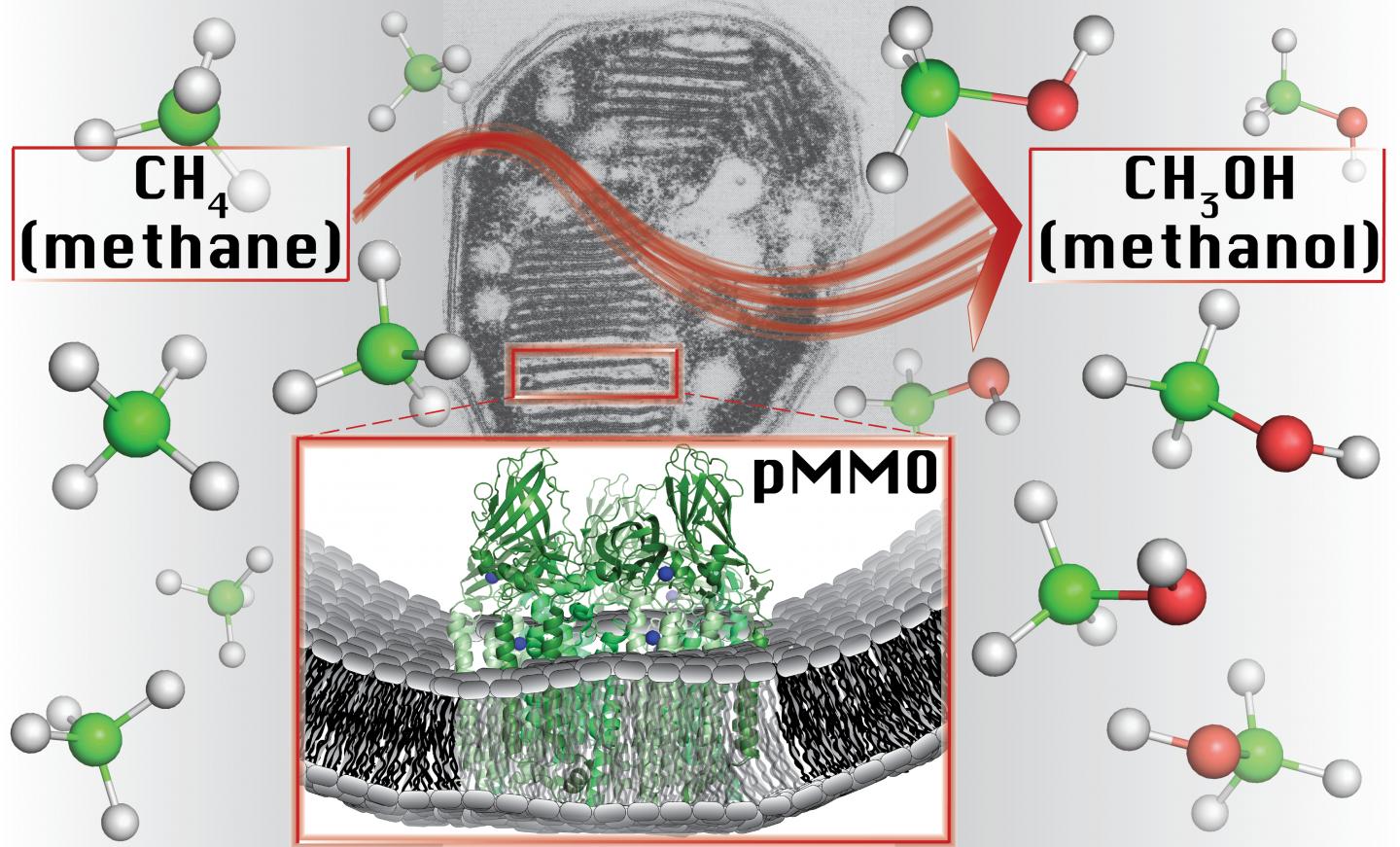
IMAGE

Credit: Northwestern University

EVANSTON, Ill. — Known for their ability to remove methane from the environment and convert it into a usable fuel, methanotrophic bacteria have long fascinated researchers. But how, exactly, these bacteria naturally perform such a complex reaction has been a mystery.

Now an interdisciplinary team at Northwestern University has found that the enzyme responsible for the methane-methanol conversion catalyzes this reaction at a site that contains just one copper ion.

This finding could lead to newly designed, human-made catalysts that can convert methane — a highly potent greenhouse gas — to readily usable methanol with the same effortless mechanism.

“The identity and structure of the metal ions responsible for catalysis have remained elusive for decades,” said Northwestern’s Amy C. Rosenzweig, co-senior author of the study. “Our study provides a major leap forward in understanding how bacteria methane-to-methanol conversion.”

“By identifying the type of copper center involved, we have laid the foundation for determining how nature carries out one of its most challenging reactions,” said Brian M. Hoffman, co-senior author.

The study will publish on Friday, May 10 in the journal Science. Rosenzweig is the Weinberg Family Distinguished Professor of Life Sciences in Northwestern’s Weinberg College of Arts and Sciences. Hoffman is the Charles E. and Emma H. Morrison Professor of Chemistry at Weinberg.

By oxidizing methane and converting it to methanol, methanotrophic bacteria (or “methanotrophs”) can pack a one-two punch. Not only are they removing a harmful greenhouse gas from the environment, they are also generating a readily usable, sustainable fuel for automobiles, electricity and more.

Current industrial processes to catalyze a methane-to-methanol reaction require tremendous pressure and extreme temperatures, reaching higher than 1,300 degrees Celsius. Methanotrophs, however, perform the reaction at room temperature and “for free.”

“While copper sites are known to catalyze methane-to-methanol conversion in human-made materials, methane-to-methanol catalysis at a monocopper site under ambient conditions is unprecedented,” said Matthew O. Ross, a graduate student co-advised by Rosenzweig and Hoffman and the paper’s first author. “If we can develop a complete understanding of how they perform this conversion at such mild conditions, we can optimize our own catalysts.”

###

The study, “Particulate methane monooxygenase contains only mononuclear copper centers,” was supported by the National Institutes of Health (award numbers GM118035, GM111097 and 5T32GM008382) and the National Science Foundation (award number 1534743).

Media Contact
Amanda Morris
[email protected]

Related Journal Article

http://dx.doi.org/10.1126/science.aav2572

Tags: BacteriologyBiochemistryBiologyCell BiologyEnergy SourcesMicrobiologyMolecular Biology
Share12Tweet8Share2ShareShareShare2

Related Posts

Miniature Sensor Uses Light to Detect Touch — Chemistry

Miniature Sensor Uses Light to Detect Touch

May 8, 2026
Iron Minerals Determine Whether Dissolved Organic Matter Fuels Microbes or Becomes Long-Term Carbon Storage — Chemistry

Iron Minerals Determine Whether Dissolved Organic Matter Fuels Microbes or Becomes Long-Term Carbon Storage

May 8, 2026

Kate Evans Appointed Associate Lab Director for Biological and Environmental Systems Science at ORNL

May 8, 2026

Advancing Multiscale Modeling and Overcoming Operational Challenges in Autothermal COâ‚‚-to-Methanol Reactors

May 8, 2026
Please login to join discussion

POPULAR NEWS

  • Research Indicates Potential Connection Between Prenatal Medication Exposure and Elevated Autism Risk

    840 shares
    Share 336 Tweet 210
  • New Study Reveals Plants Can Detect the Sound of Rain

    727 shares
    Share 290 Tweet 181
  • Salmonella Haem Blocks Macrophages, Boosts Infection

    61 shares
    Share 24 Tweet 15
  • Breastmilk Balances E. coli and Beneficial Bacteria in Infant Gut Microbiomes

    57 shares
    Share 23 Tweet 14

About

We bring you the latest biotechnology news from best research centers and universities around the world. Check our website.

Follow us

Recent News

New Post-Hoc Analysis Explores Daily Oral Orforglipron Use in Adults Over 65 with Obesity, Regardless of Diabetes Status

Evaluating Digoxin Use in Patients with Symptomatic Rheumatic Heart Disease

Evaluating the Effectiveness and Safety of Digitalis Glycosides in Treating Heart Failure

Subscribe to Blog via Email

Enter your email address to subscribe to this blog and receive notifications of new posts by email.

Join 82 other subscribers
  • Contact Us

Bioengineer.org © Copyright 2023 All Rights Reserved.

Welcome Back!

Login to your account below

Forgotten Password?

Retrieve your password

Please enter your username or email address to reset your password.

Log In
No Result
View All Result
  • Homepages
    • Home Page 1
    • Home Page 2
  • News
  • National
  • Business
  • Health
  • Lifestyle
  • Science

Bioengineer.org © Copyright 2023 All Rights Reserved.