• HOME
  • NEWS
  • EXPLORE
    • CAREER
      • Companies
      • Jobs
    • EVENTS
    • iGEM
      • News
      • Team
    • PHOTOS
    • VIDEO
    • WIKI
  • BLOG
  • COMMUNITY
    • FACEBOOK
    • INSTAGRAM
    • TWITTER
Saturday, January 17, 2026
BIOENGINEER.ORG
No Result
View All Result
  • Login
  • HOME
  • NEWS
  • EXPLORE
    • CAREER
      • Companies
      • Jobs
        • Lecturer
        • PhD Studentship
        • Postdoc
        • Research Assistant
    • EVENTS
    • iGEM
      • News
      • Team
    • PHOTOS
    • VIDEO
    • WIKI
  • BLOG
  • COMMUNITY
    • FACEBOOK
    • INSTAGRAM
    • TWITTER
  • HOME
  • NEWS
  • EXPLORE
    • CAREER
      • Companies
      • Jobs
        • Lecturer
        • PhD Studentship
        • Postdoc
        • Research Assistant
    • EVENTS
    • iGEM
      • News
      • Team
    • PHOTOS
    • VIDEO
    • WIKI
  • BLOG
  • COMMUNITY
    • FACEBOOK
    • INSTAGRAM
    • TWITTER
No Result
View All Result
Bioengineer.org
No Result
View All Result
Home NEWS Science News Chemistry

Mechanism of controlling autophagy by liquid-liquid phase separation revealed

Bioengineer by Bioengineer
February 14, 2020
in Chemistry
Reading Time: 2 mins read
0
IMAGE
Share on FacebookShare on TwitterShare on LinkedinShare on RedditShare on Telegram

Research of autophagy is stepping into the next phase
IMAGE

Credit: Institute of Microbial Chemistry


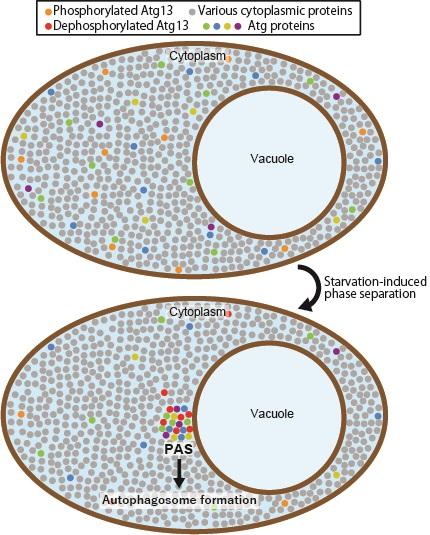
Under JST’s Strategic Basic Research Programs, Noda Nobuo (Laboratory Head) and Fujioka Yuko (Senior Researcher) of the Institute of Microbial Chemistry, in collaboration with other researchers, discovered that a liquid-like condensate (liquid droplets(1)) in which the Atg protein is clustered through the liquid-liquid phase separation(2) is the structure responsible for the progression of autophagy.

Autophagy is one of the mechanisms through which cellular protein is degraded. Previously, it was known that Atg proteins assemble to form a structure called PAS(3). However, the mechanism through which Atg proteins assemble and the physicochemical property of the formed structures had been unclear.

The research team elucidated characteristics of PAS through observing the Atg protein using a fluorescence microscope and successfully reconstituted PAS in vitro. The team revealed, for the first time, that PAS is in the state of liquid droplets formed by liquid-liquid phase separation of Atg13 together with other Atg proteins and that this liquid droplet is responsible for autophagy.

The finding that liquid-liquid phase separation directly controls autophagy suggests its involvement in a wide range of intracellular life phenomena. Reconsideration of molecular mechanisms underlying various intracellular phenomena is expected to proceed. Moreover, development of autophagy-specific control agents that focus on the regulation of liquid-liquid phase separation in autophagy-related diseases is anticipated.

###

(1) Liquid droplet

A condensate of macromolecules with fluidity created when protein and/or nucleic acids undergo liquid-liquid phase separation. The droplets are also known as “membraneless organelles” and perform various functions within the cell. A droplet spontaneously assumes a spherical form. It also has high internal fluidity, and it actively exchanges molecules with its surroundings.

(2) Liquid-liquid phase separation

This is the phenomenon of a uniform liquid phase separating into multiple liquid phases. It is observed in daily life as the separation of water and oil, and occurs within cells with proteins and nucleic acids.

(3) PAS (Pre-autophagosomal structure)

The collected structure that the Atg protein forms near the vacuole under nutrient starvation in yeast is called PAS. It is assumed that autophagosomes formation starts at PAS.

Media Contact
Nobuo Noda
[email protected]
81-334-414-173

Original Source

https://www.jst.go.jp/pr/announce/20200206/index_e.html

Related Journal Article

http://dx.doi.org/10.1038/s41586-020-1977-6

Tags: BiochemistryBiomechanics/BiophysicsCell BiologyChemistry/Physics/Materials SciencesMolecular Biology
Share13Tweet8Share2ShareShareShare2

Related Posts

blank

Chiral Catalysis Powers Rotary Molecular Motors

January 16, 2026
Selective GlcNAc to GalNAc Epimerization via Kinetic Control

Selective GlcNAc to GalNAc Epimerization via Kinetic Control

January 15, 2026

Thermal [2+2] Cycloaddition Builds Gem-Difluoro Bicycloalkanes

January 13, 2026

Cobalt-Catalyzed Thioester Coupling via Siloxycarbene

January 12, 2026
Please login to join discussion

POPULAR NEWS

  • Enhancing Spiritual Care Education in Nursing Programs

    155 shares
    Share 62 Tweet 39
  • PTSD, Depression, Anxiety in Childhood Cancer Survivors, Parents

    147 shares
    Share 59 Tweet 37
  • Robotic Ureteral Reconstruction: A Novel Approach

    77 shares
    Share 31 Tweet 19
  • Study Reveals Lipid Accumulation in ME/CFS Cells

    54 shares
    Share 22 Tweet 14

About

BIOENGINEER.ORG

We bring you the latest biotechnology news from best research centers and universities around the world. Check our website.

Follow us

Recent News

Evaluating Telemedicine Apps for Opioid Recovery Support

Skin Microbiome Stability Enables Site Tracing, ID

3D Printed Foot Scale Aids Intramedullary Nail Selection

Subscribe to Blog via Email

Success! An email was just sent to confirm your subscription. Please find the email now and click 'Confirm' to start subscribing.

Join 71 other subscribers
  • Contact Us

Bioengineer.org © Copyright 2023 All Rights Reserved.

Welcome Back!

Login to your account below

Forgotten Password?

Retrieve your password

Please enter your username or email address to reset your password.

Log In
No Result
View All Result
  • Homepages
    • Home Page 1
    • Home Page 2
  • News
  • National
  • Business
  • Health
  • Lifestyle
  • Science

Bioengineer.org © Copyright 2023 All Rights Reserved.