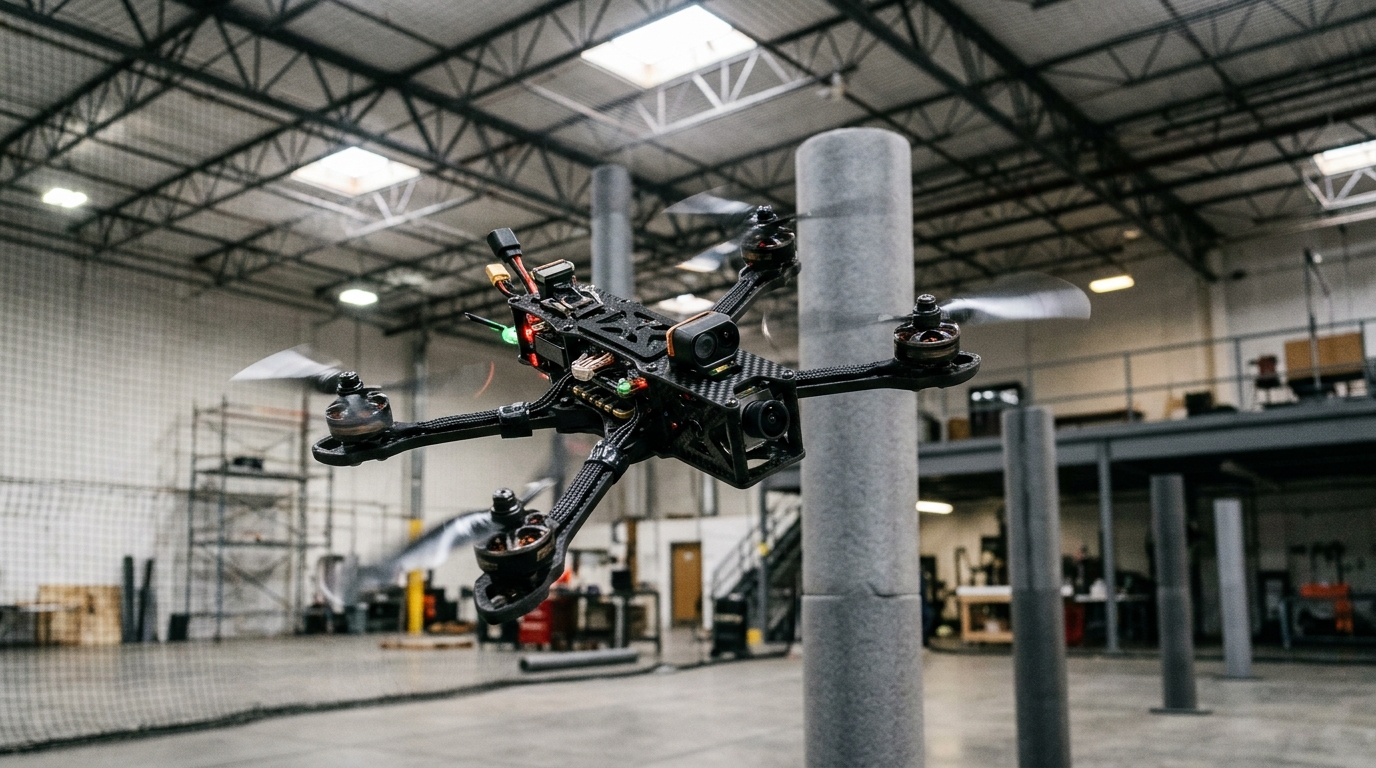
Researchers have developed a novel Markov Decision Process (MDP) framework to improve real-time navigation for autonomous aerial vehicles. This approach addresses the dual challenge of severe computational limits and power constraints inherent in drone hardware. Unlike traditional methods that often rely on static configurations or computationally expensive 3D point clouds, this dynamic model optimizes object detection parameters in real-time, significantly lowering operational overhead without sacrificing navigation quality.
The framework operates by intelligently selecting algorithm configurations from both feature-based pipelines, such as HoG/Edgeboxes with SVMs, and neural network-based detection pipelines. By utilizing classifier confidence scores as continuous quality indicators, the system adapts its strategy to varying environmental conditions. This flexibility ensures the vehicle maintains high performance, bypassing the rigid, performance-bottlenecked constraints typically found in standard computer vision algorithms that fail to adjust during flight.
Extensive evaluation across KUL traffic sign datasets, custom BU-RU drone-collected footage, and hardware-in-the-loop AirSim simulations demonstrated substantial efficiency gains. The framework achieved a 20% to 70% reduction in execution time while sustaining high detection accuracy levels between 98% and 100%. Furthermore, the system successfully supported real-time processing at 30 frames per second at a 480×270 resolution, while providing up to an 18-fold improvement in frame processing rates during closed-loop navigation tasks.
These computational efficiencies translate directly into significant energy savings for resource-constrained platforms. Experimental tests on NVIDIA Jetson TX2 hardware demonstrated a 6.9-watt reduction in power consumption. By dynamically decreasing processing time and computational load, this MDP-based navigation approach offers an energy-efficient solution for autonomous drones, such as those utilized in search and rescue operations or warehouse automation.
Subject of Research: Autonomous drone navigation optimization using Markov Decision Processes.
Article Title: Markov Decision Process-based Real-time Navigation for Autonomous Aerial Vehicles Using Video
Article References: Anjum, K., Pandey, P., Sadhu, V., Tron, R., & Pompili, D. (2026). Markov Decision Process-based Real-time Navigation for Autonomous Aerial Vehicles Using Video. Journal of Intelligent & Robotic Systems. https://doi.org/10.1007/s10846-026-02388-8
Image Credits: AI Generated
DOI: 10.1007/s10846-026-02388-8
Keywords: Markov Decision Process, autonomous navigation, aerial vehicles, drone technology, computer vision, object detection, real-time processing, computational efficiency, neural networks, machine learning, robotics, power consumption, NVIDIA Jetson, sensor fusion, traffic sign recognition, image processing, dynamic parameter optimization, drone hardware
News Source: Denise Maddox. (November 17, 2026). MDP Framework Cuts Drone Execution Time by Up to 70 Percent. Scienmag.