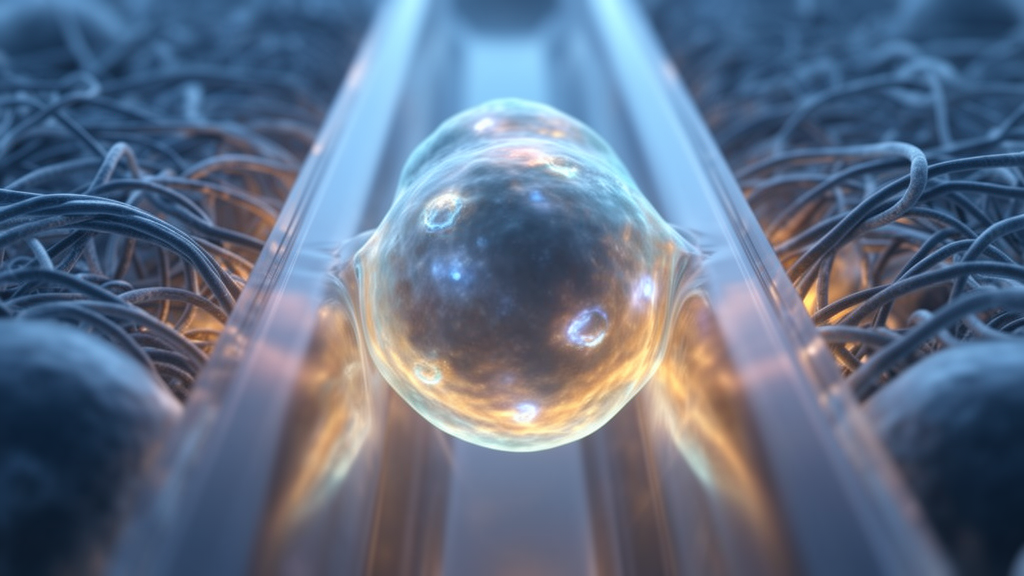
A newly developed mathematical model reveals that release of curvature-elastic energy stored as membrane tension at the rear of the nuclear envelope drives a peak in nuclear velocity when cells exit narrow constrictions. Developed by researchers David Hernandez-Aristizabal, Anotida Madzvamuse, and Rachele Allena, the computational framework also predicts that mechanical coupling between the plasma membrane and the nuclear envelope can actively hinder overall cell translocation because a portion of locomotion energy must be invested in nuclear positioning. The biophysically grounded study provides quantitative estimates for mechanical forces that remain difficult to record experimentally, clarifying how mechanical interactions govern cell movement through physically confined environments.
Cell migration represents a fundamental physiological process essential to biological events ranging from embryogenesis to cancer metastasis. The migration process is primarily governed by cytoskeletal dynamics acting alongside the coupled mechanics of the plasma membrane and the cell nucleus. Because the nucleus is the largest and stiffest cellular organelle, researchers consider it a major rate-limiting factor during confined migration. However, nuclear positioning varies across different cell types and modes of migration, leaving the mechanical forces that orchestrate coupling between the plasma membrane and the nuclear envelope incompletely understood. While mathematical modelling has gained relevance to support migration research, existing computational models face a fundamental challenge in balancing mechanistic detail with computational efficiency.
To address this challenge, the authors formulated a dimensionless model based on geometric surface partial differential equations for cell migration. This theoretical approach benefits from dimensional reduction by treating both the plasma membrane and the nuclear envelope as energetic geometric membranes. The governing equations are solved computationally using the evolving surface finite element method, balancing mechanistic fidelity with computational feasibility. This mathematical formulation establishes an interpretable simulation platform capable of testing and proposing mechanistic hypotheses regarding confined migration, allowing researchers to evaluate cellular structural constraints that are otherwise inaccessible in living laboratory samples.
In numerical simulations, the model reproduces several experimentally observed migration patterns. Specifically, it captures how the exhaustion of lipid reservoirs and nuclear-lamina unfolding limit the surface area of both the plasma membrane and the nuclear envelope, ultimately blocking cell passage through narrow constrictions. The simulations also reproduce the observation that nuclear velocity peaks immediately upon pore exit, while nuclear movement alternates between distinct pulling and pushing mechanical regimes. By replicating these physical behaviors, the computational framework confirms the direct regulatory influence of membrane availability and nuclear deformability during migration through confined spaces.
Beyond replicating known behaviors, the modelling framework quantifies several specific physical forces that are not easily accessible through empirical experiments. The model calculates membrane tension, bending energy, osmotic pressure, contact forces, and the elasticity coupling the plasma membrane to the nuclear envelope. By evaluating these distinct energetic and physical contributions, the framework demonstrates how energy allocation toward nuclear positioning directly constrains translocational progress. The authors present their evolving surface finite element approach as an interpretable platform to guide future experimental investigations into the complex mechanical forces that regulate confined cell movement.
Subject of Research: Biophysical modeling of membrane tension and nuclear coupling in confined cell migration
Article Title: Membrane tension and cell–nucleus mechanical coupling regulate confined cell migration
Article References: Hernandez-Aristizabal, D., Madzvamuse, A., & Allena, R. (2026). Membrane tension and cell–nucleus mechanical coupling regulate confined cell migration. PLOS Computational Biology, 22(11), e1014909. https://doi.org/10.1371/journal.pcbi.1014909
Image Credits: AI Generated
DOI: 10.1371/journal.pcbi.1014909
Keywords: cell migration, computational biology, membrane tension, nuclear envelope, biomechanics, finite element method, mechanobiology, cellular constrictions, Membrane, tension, cell, nucleus
News Source: Reid Dalton. (November 9, 2026). Mathematical Model Reveals How Membrane Tension Regulates Confined Cell Migration. Scienmag.