A new mathematical study suggests that when neighboring cells adjust their pulling forces in response to one another, they create an attraction that could help explain why cells gather on soft surfaces. The research, led by Dr. Assaf Zemel of the Hebrew University of Jerusalem and published in Proceedings of the National Academy of Sciences (PNAS), offers a physical explanation for a long-standing observation in cell biology: cells grown on soft surfaces often aggregate into groups or networks, while those on harder surfaces tend to remain more dispersed.
The study develops a mathematical framework that accounts for the mutual adjustment of forces between cells. Rather than treating each cell’s pull as a fixed, static value, the theory allows the force to change dynamically in response to the stretching produced by surrounding cells. This approach captures the back-and-forth interaction where cells tug on the material around them, sense the deformation caused by their neighbors, and subsequently adjust their own internal force-generating machinery. By modeling this reciprocal response, the researchers identified an additional, short-range interaction that emerges specifically from this dynamic feedback loop.
The calculations reveal that for cells that strengthen their pulling forces when stretched, this interaction is attractive. Their responses generate stresses in the surrounding material that tend to pull them together. In essence, the cells’ ability to react to one another becomes part of what draws them closer. This mechanism is physically analogous to the universally attractive van der Waals interactions between molecules, which drive molecular cohesion and the condensation of matter. However, in this biological context, the interaction is carried by the deformation of the cells’ surroundings, and living cells actively adjust their internal machinery, changing the forces experienced by their neighbors.
One of the study’s most striking predictions concerns the role of surface softness. The conventional elastic interaction considered in earlier models is strongest at an intermediate surface stiffness and weakens as the surface becomes very soft. In contrast, the additional attraction identified in this study behaves differently: it strengthens as the supporting material softens.
Distance also plays a critical role in the predicted interactions. The theory predicts that cells whose overall mechanical interaction is repulsive when they are farther apart can become attractive at closer separations.
The study is based on mathematical analysis rather than new experiments with living cells. It uses simplified representations of cells to uncover a fundamental physical principle. The authors note that more detailed models will be needed to describe cell behavior accurately at very close distances, where the simplifications may break down. Nevertheless, the predictions suggest clear experimental questions for future research. Researchers could position cells at controlled distances on surfaces of different stiffnesses and measure how their pulling forces and internal structures change in response to one another.
Understanding these mechanical interactions could help explain how cells organize into tissues and networks. Mechanical communication is relevant to various biological processes, including fibrosis and cancer. However, the study does not test treatments or establish clinical applications. The work points to a simple possibility with broad implications: part of what brings cells together may lie in how they respond to each other’s pull, turning a neighbor’s force into a cohesive attraction.
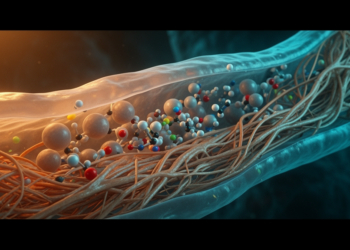
The extracellular matrix, a network of fibers surrounding cells, provides structural support and transmits mechanical forces. By pulling on this material, a cell alters the mechanical environment experienced by its neighbors. Scientists have long recognized that cells communicate through these mechanical channels, yet the specific consequences of continuous, reciprocal responses remained a challenge to understand. Zemel’s framework addresses this by modeling how each cell’s pull changes in response to the stretching produced by surrounding cells, rather than treating forces as static values.
The study’s predictions suggest clear experimental avenues for future investigation. Researchers could position cells at controlled distances on surfaces of varying stiffnesses to measure how their pulling forces and internal structures change in response to one another.
Subject of Research: Mathematical modeling of mechanical cell interactions on soft surfaces
Article Title: How cells pull together: new theory reveals a hidden source of attraction
Article References: How cells pull together: new theory reveals a hidden source of attraction. Original publication (Bibliographic details unavailable.)
Image Credits: AI Generated
DOI: Not provided
Keywords: cell mechanics, extracellular matrix, mathematical biology, cell adhesion, tissue organization, biophysics, PNAS, Hebrew University of Jerusalem, cells, pull, together, theory
News Source: Reid Dalton. (November 10, 2026). Mathematical model explains cell attraction on soft surfaces. Scienmag.