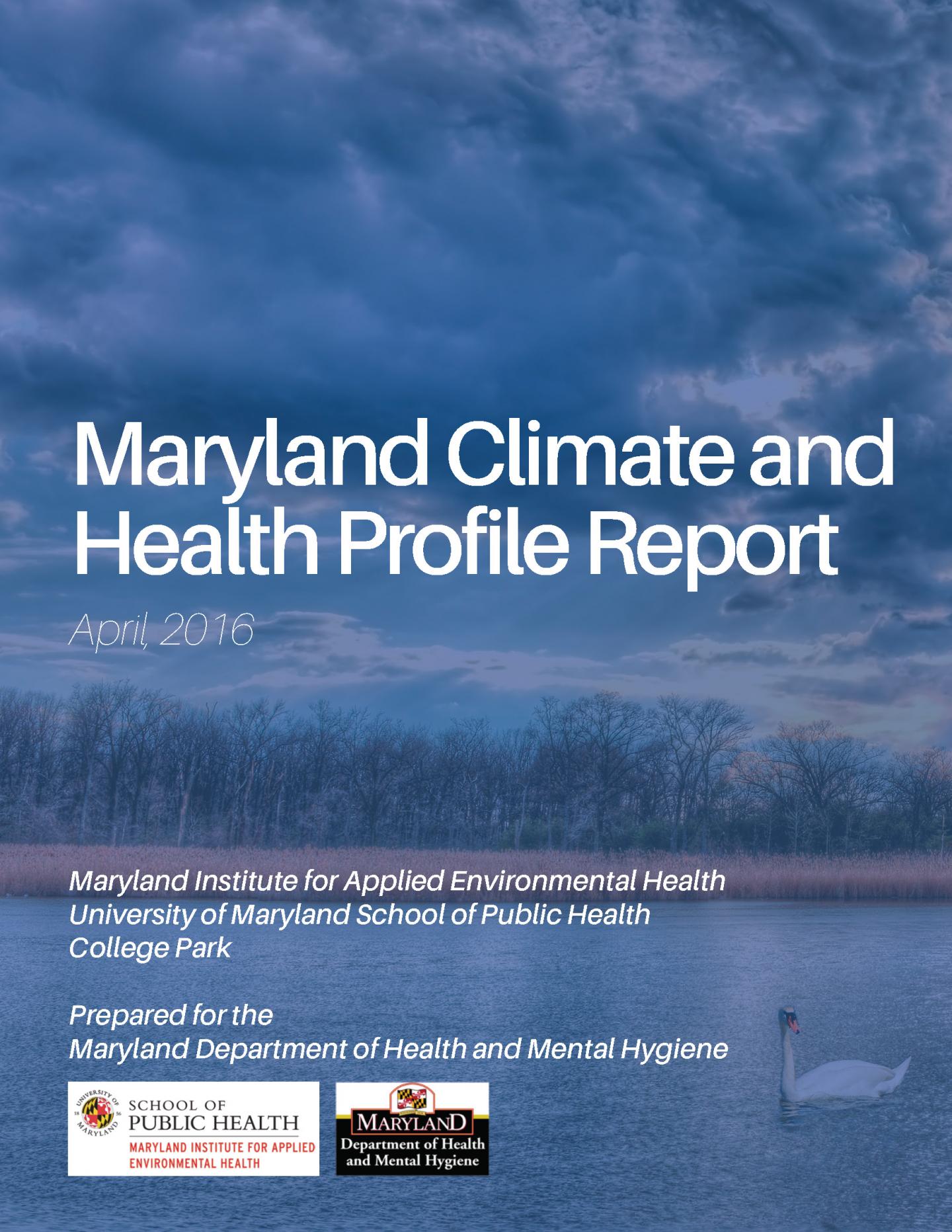
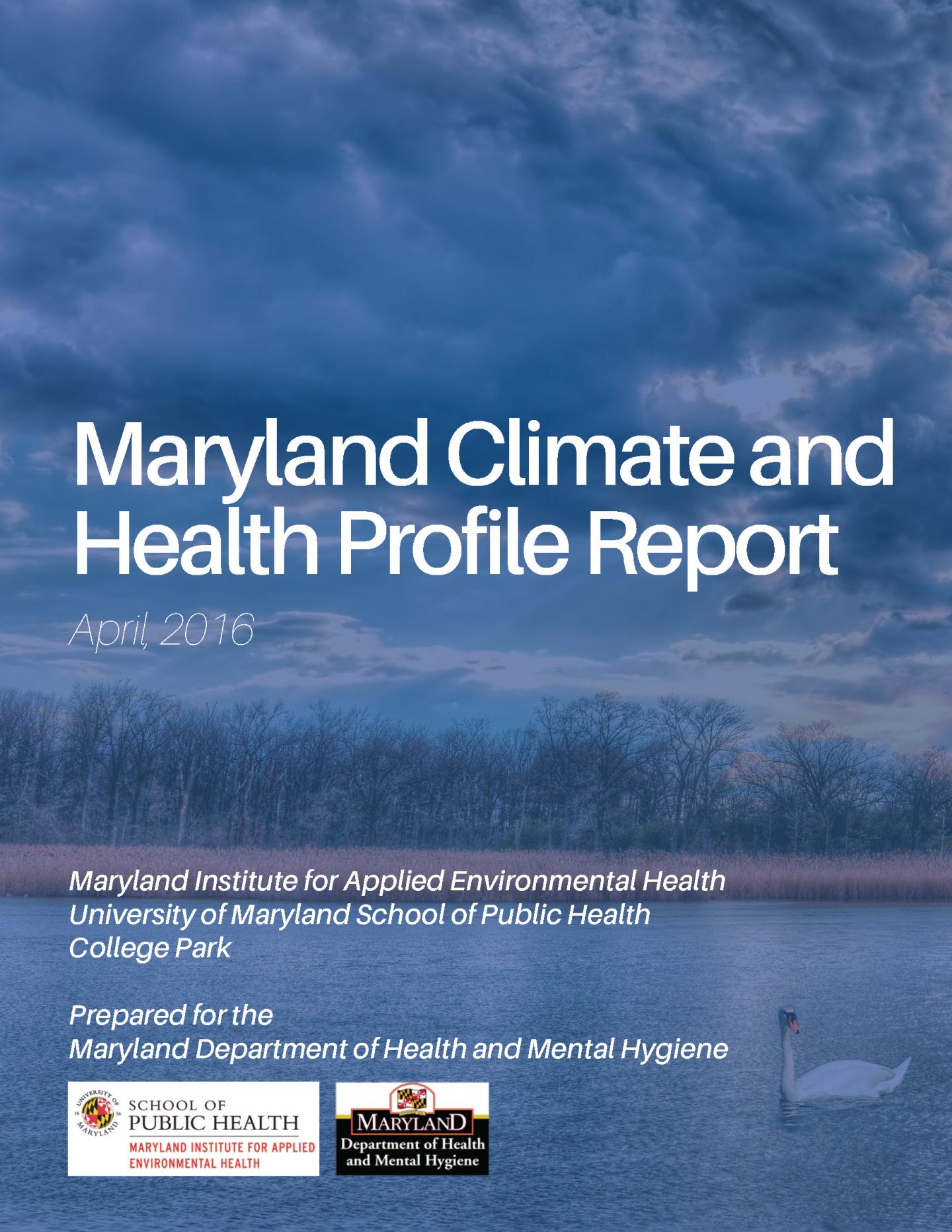
As world leaders convene in Washington, DC this week for the Climate Action 2016 summit, a new report by Maryland public health leaders, the Maryland Climate and Health Profile report, details the impacts of climate change on the health of Marylanders now and in the future.
Developed by the University of Maryland School of Public Health's Maryland Institute for Applied Environmental Health in collaboration with the Maryland Department of Health and Mental Hygiene, the report examines the relationship between exposure to extreme weather events and risk of selected health outcomes including food and waterborne illnesses (caused by Salmonella and Campylobacter), hospitalization for heart attacks and asthma, and motor vehicle accidents. Using historical climate data along with health data, researchers were able to describe relationships between exposure to extreme events and risk of these selected diseases. These data, along with the climate projections, were used to calculate health burdens among Marylanders in future decades.
In addition, the report recommends actions that individuals, families and communities can take to minimize the negative health burdens. It describes how the negative health burdens are not equally distributed across race/ethnicity or geographical areas of Maryland. The report concludes that local and state level strategies to build healthy and resilient communities must take into account these differential burdens.
Key findings of the Maryland Climate and Health Profile report include:
- -Extreme weather is on the rise: Summertime extreme heat events more than doubled in Maryland during the 1980s, 1990s, and 2000s compared to the 1960s and 1970s.
-Extreme weather increases risk of foodborne illnesses: Both extreme heat and extreme precipitation events significantly increase the risk of Salmonella infections in Maryland. The increases in risk associated with extreme weather events is considerably higher among coastal communities compared to more inland communities.
-Extreme heat raises heart attack risk: Exposure to summertime extreme heat events increases the risk of hospitalization for heart attack in Maryland. Non-Hispanic blacks have a much higher risk compared to non-Hispanic whites.
-Extreme heat and precipitation raise severe asthma attack risk: Exposure to summertime extreme heat and precipitation events increase the risk of hospitalization for asthma in Maryland.
-Extreme precipitation raises accident risk: Exposure to extreme precipitation events increases the risk of motor vehicle accidents, particularly during the fall and summer months.
According to the report, the increases in frequency of extreme weather events during summer months in the future (2040) are projected to result in higher rates of asthma and heart attack hospitalization as well as Salmonella infections. The magnitude of these increases will likely vary considerably across the 24 counties in Maryland.
###
Download the Maryland Climate and Health Profile Report: http://phpa.dhmh.maryland.gov/OEHFP/EH/Shared%20Documents/Reports/MD_climate_and_health_FullReport_04182016%20Final.pdf
Highlights from the Maryland Climate and Health Profile Report: https://sph.umd.edu/sites/default/files/images/Dean's%20Office/MD_climate_and_health_highlights.pdf
Climate Change and Public Health Resources on the Maryland Department of Health and Mental Hygiene website: http://phpa.dhmh.maryland.gov/OEHFP/EH/Pages/about_climate.aspx
The Maryland Climate and Health Profile report is based on and developed in conjunction with the DHMH Maryland Public Health Strategy for Climate Change project, funded by the U.S. Centers for Disease Control and Prevention (CDC) as part of its Climate-Ready States and Cities Initiative. Research studies led by Dr. Amir Sapkota in the UMD School of Public Health informed many of the report's key findings. This Climate and Health Profile report summarizes a collaborative effort between the DHMH, local health departments, and the University of Maryland School of Public Health's Maryland Institute for Applied Environmental Health. The report utilized the CDC's Building Resilience Against Climate Effects (BRACE) framework to identify vulnerable populations and use this data to inform interventions and increase resilience.
Media Contact
Kelly Blake
[email protected]
301-405-9418
@UMDRightNow
http://www.newsdesk.umd.edu/