• HOME
  • NEWS
  • EXPLORE
    • CAREER
      • Companies
      • Jobs
    • EVENTS
    • iGEM
      • News
      • Team
    • PHOTOS
    • VIDEO
    • WIKI
  • BLOG
  • COMMUNITY
    • FACEBOOK
    • INSTAGRAM
    • TWITTER
Sunday, August 9, 2026
BIOENGINEER.ORG
No Result
View All Result
  • Login
  • HOME
  • NEWS
  • EXPLORE
    • CAREER
      • Companies
      • Jobs
        • Lecturer
        • PhD Studentship
        • Postdoc
        • Research Assistant
    • EVENTS
    • iGEM
      • News
      • Team
    • PHOTOS
    • VIDEO
    • WIKI
  • BLOG
  • COMMUNITY
    • FACEBOOK
    • INSTAGRAM
    • TWITTER
  • HOME
  • NEWS
  • EXPLORE
    • CAREER
      • Companies
      • Jobs
        • Lecturer
        • PhD Studentship
        • Postdoc
        • Research Assistant
    • EVENTS
    • iGEM
      • News
      • Team
    • PHOTOS
    • VIDEO
    • WIKI
  • BLOG
  • COMMUNITY
    • FACEBOOK
    • INSTAGRAM
    • TWITTER
No Result
View All Result
Bioengineer.org
No Result
View All Result
Home NEWS Science News Chemistry

Mars: Water could disappear faster than expected

Bioengineer by Bioengineer
January 9, 2020
in Chemistry
Reading Time: 2 mins read
0
IMAGE
Share on FacebookShare on TwitterShare on LinkedinShare on RedditShare on Telegram

IMAGE

Credit: © ESA


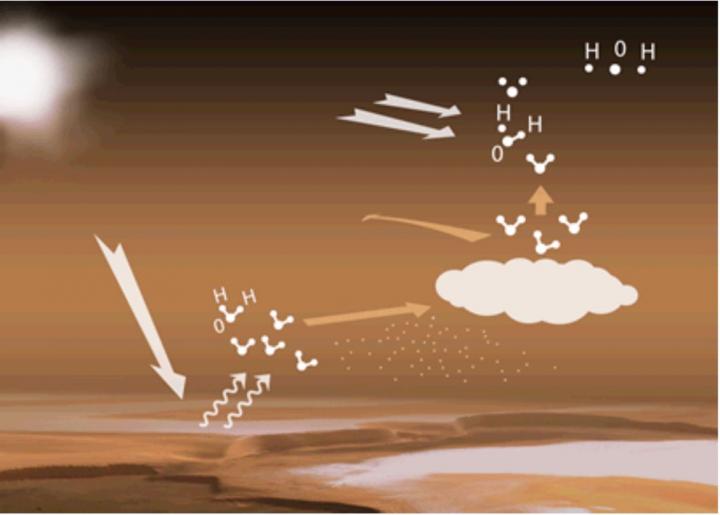
The small red planet is losing water more quickly than what theory as well as past observations would suggest. The gradual disappearance of water (H2O) occurs in the upper atmosphere of Mars: sunlight and chemistry disassociate water molecules into hydrogen and oxygen atoms that the weak gravity of Mars cannot prevent from escaping into space. An international research team,1 led partly by CNRS researcher Franck Montmessin, has just revealed that water vapour is accumulating in large quantities and unexpected proportions at an altitude of over 80 km in the Martian atmosphere. Measurements showed that large atmospheric pockets are even in a state of supersaturation, with the atmosphere containing 10 to 100 times more water vapour than its temperature should theoretically allow. With the observed supersaturation rates, the capacity of water to escape would greatly increase during certain seasons. These results, which were published in Science on 9 January 2020, were obtained thanks to the Trace Gas Orbiter probe from the ExoMars mission, financed by the European Space Agency and the Russian space agency Roscosmos.

###

* – In France this research involved scientists from the Laboratoire atmosphères, milieux, observations spatiales (CNRS/Université de Versailles Saint-Quentin-en-Yvelines/Sorbonne Université) and the Laboratoire de météorologie dynamique (CNRS/École polytechnique/ENS Paris/Sorbonne Université).

Media Contact
Francois Maginiot
[email protected]
33-144-964-309

Related Journal Article

http://dx.doi.org/10.1126/science.aay9522

Tags: AstrophysicsPlanets/MoonsSatellite Missions/ShuttlesSpace/Planetary Science
Share12Tweet8Share2ShareShareShare2

Related Posts

Hebrew University Congratulates Haim Sompolinsky on Receiving 2026 Dirac Medal

Hebrew University Congratulates Haim Sompolinsky on Receiving 2026 Dirac Medal

August 8, 2026
New brain model reveals how regional chemistry shapes large-scale neural activity

New brain model reveals how regional chemistry shapes large-scale neural activity

August 8, 2026

Topological coupler breaks bandwidth tradeoff in broadband coupled resonator waveguides

August 8, 2026

Radical Chemistry Selectively Cleaves Strong Bonds While Preserving Weaker Ones

August 7, 2026
Please login to join discussion

POPULAR NEWS

  • How Neuroblastoma Balances Replication Stress and Genome Stability Across Chromosome 17q

    29 shares
    Share 12 Tweet 7
  • Cigar, Cigarillo, and Pipe Smoking: Lung Cancer Risk and Screening Eligibility

    29 shares
    Share 12 Tweet 7
  • How Low Gravity and Pressure Affect Space Manufacturing of Carbon-Fiber Structures

    29 shares
    Share 12 Tweet 7
  • Calreticulin-targeted L-asparaginase–flagellin conjugate boosts Salmonella’s antitumor effectiveness

    29 shares
    Share 12 Tweet 7

About

We bring you the latest biotechnology news from best research centers and universities around the world. Check our website.

Follow us

Recent News

How Neuroblastoma Balances Replication Stress and Genome Stability Across Chromosome 17q

Cigar, Cigarillo, and Pipe Smoking: Lung Cancer Risk and Screening Eligibility

How Low Gravity and Pressure Affect Space Manufacturing of Carbon-Fiber Structures

Subscribe to Blog via Email

Success! An email was just sent to confirm your subscription. Please find the email now and click 'Confirm' to start subscribing.

Join 86 other subscribers
  • Contact Us

Bioengineer.org © Copyright 2023 All Rights Reserved.

Welcome Back!

Login to your account below

Forgotten Password?

Retrieve your password

Please enter your username or email address to reset your password.

Log In
No Result
View All Result
  • Homepages
    • Home Page 1
    • Home Page 2
  • News
  • National
  • Business
  • Health
  • Lifestyle
  • Science

Bioengineer.org © Copyright 2023 All Rights Reserved.