

• HOME
  • NEWS
  • EXPLORE
    • CAREER
      • Companies
      • Jobs
    • EVENTS
    • iGEM
      • News
      • Team
    • PHOTOS
    • VIDEO
    • WIKI
  • BLOG
  • COMMUNITY
    • FACEBOOK
    • INSTAGRAM
    • TWITTER
Saturday, February 7, 2026
BIOENGINEER.ORG
No Result
View All Result
  • Login
  • HOME
  • NEWS
  • EXPLORE
    • CAREER
      • Companies
      • Jobs
        • Lecturer
        • PhD Studentship
        • Postdoc
        • Research Assistant
    • EVENTS
    • iGEM
      • News
      • Team
    • PHOTOS
    • VIDEO
    • WIKI
  • BLOG
  • COMMUNITY
    • FACEBOOK
    • INSTAGRAM
    • TWITTER
  • HOME
  • NEWS
  • EXPLORE
    • CAREER
      • Companies
      • Jobs
        • Lecturer
        • PhD Studentship
        • Postdoc
        • Research Assistant
    • EVENTS
    • iGEM
      • News
      • Team
    • PHOTOS
    • VIDEO
    • WIKI
  • BLOG
  • COMMUNITY
    • FACEBOOK
    • INSTAGRAM
    • TWITTER
No Result
View All Result
Bioengineer.org
No Result
View All Result
Home NEWS Science News Biology

Marine exploration sensing with light and sound

Bioengineer by Bioengineer
March 12, 2018
in Biology
Reading Time: 2 mins read
0
Share on FacebookShare on TwitterShare on LinkedinShare on RedditShare on Telegram
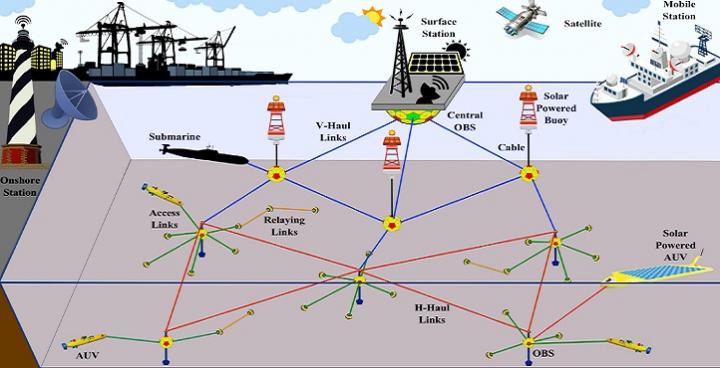
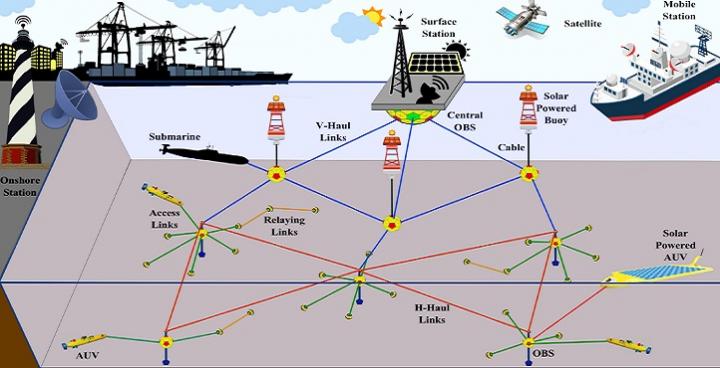
IMAGE

Credit: © 2018 Abdulkadir Celik

Oceanic sensor networks that collect and transmit high-quality, real-time data could transform our understanding of marine ecology, improve pollution and disaster management, and inform the multiple industries that draw on ocean resources. A KAUST research team is designing and optimizing underwater wireless sensor networks that could vastly improve existing ocean sensing equipment.

"Currently, underwater sensors use acoustic waves to communicate data," explains Nasir Saeed, who is working on a new hybrid optical-acoustic sensor design with colleagues Abdulkadir Celik, Mohamed Slim Alouini and Tareq Al-Naffouri. "However, while acoustic communication works over long distances, it can only transmit limited amounts of data with long delays. Recent research has also shown that noise created by humans in the oceans adversely affects marine life. We need to develop alternative, energy-efficient sensors that limit noise pollution while generating high-quality data."

One option is to use optical communication technology instead, but light waves will only travel short distances underwater before they are absorbed. Optical sensors also rely heavily on pointing and tracking mechanisms to ensure they are correctly orientated to send and receive signals. The team therefore propose a hybrid sensor capable of transmitting both acoustic and optical signals simultaneously. In this way, a data-collection buoy on the water surface can communicate with every sensor in a network spread out beneath it.

However, marine research requires accurate measurements taken from precise locations, so scientists need to know where every sensor is at any given time. The team used mathematical modeling to develop a proof-of-concept localization technique.

"Using our technique, the sensors transmit their received signal strength information (RSSI) to the surface buoy," says Saeed. "For a large communication distance, the sensors use acoustic signals, but if the sensor is within close range of another sensor, it will send an optical signal instead."

Multiple RSSI measurements for each sensor are collected by the surface buoy. The buoy then weights these measurements to give preference to the most accurate readings before calculating where each sensor is positioned.

Alouini's and Al-Naffouri's teams propose that their sensors will require a new energy source rather than relying on short-term battery power. They envisage an energy-harvesting system that powers fuel cells using microscopic algae or piezoelectric (mechanical stress) energy.

###

Media Contact

Carolyn Unck
[email protected]

http://kaust.edu.sa/

Original Source

https://discovery.kaust.edu.sa/en/article/481/marine-exploration-sensing-with-light-and-sound http://dx.doi.org/10.3390/s18010051


Share12Tweet8Share2ShareShareShare2

Related Posts

Florida Cane Toad: Complex Spread and Selective Evolution

Florida Cane Toad: Complex Spread and Selective Evolution

February 7, 2026
New Study Uncovers Mechanism Behind Burn Pit Particulate Matter–Induced Lung Inflammation

New Study Uncovers Mechanism Behind Burn Pit Particulate Matter–Induced Lung Inflammation

February 6, 2026

DeepBlastoid: Advancing Automated and Efficient Evaluation of Human Blastoids with Deep Learning

February 6, 2026

Navigating the Gut: The Role of Formic Acid in the Microbiome

February 6, 2026
Please login to join discussion

POPULAR NEWS

  • Robotic Ureteral Reconstruction: A Novel Approach

    Robotic Ureteral Reconstruction: A Novel Approach

    82 shares
    Share 33 Tweet 21
  • Digital Privacy: Health Data Control in Incarceration

    63 shares
    Share 25 Tweet 16
  • Study Reveals Lipid Accumulation in ME/CFS Cells

    57 shares
    Share 23 Tweet 14
  • Breakthrough in RNA Research Accelerates Medical Innovations Timeline

    53 shares
    Share 21 Tweet 13

About

We bring you the latest biotechnology news from best research centers and universities around the world. Check our website.

Follow us

Recent News

Florida Cane Toad: Complex Spread and Selective Evolution

Exploring Decision-Making in Dementia Caregivers’ Mobility

Succinate Receptor 1 Limits Blood Cell Formation, Leukemia

Subscribe to Blog via Email

Enter your email address to subscribe to this blog and receive notifications of new posts by email.

Join 73 other subscribers
  • Contact Us

Bioengineer.org © Copyright 2023 All Rights Reserved.

Welcome Back!

Login to your account below

Forgotten Password?

Retrieve your password

Please enter your username or email address to reset your password.

Log In
No Result
View All Result
  • Homepages
    • Home Page 1
    • Home Page 2
  • News
  • National
  • Business
  • Health
  • Lifestyle
  • Science

Bioengineer.org © Copyright 2023 All Rights Reserved.
