In a groundbreaking study set to redefine forest management practices in boreal regions, researchers from the University of Eastern Finland have unveiled a predictive model estimating the likelihood of damage caused by the European spruce bark beetle, Ips typographus, at the stand level across Finland’s expansive forests. This innovative approach harnesses a comprehensive integration of forest inventory, disturbance histories, and climatic data to anticipate beetle infestations, thus offering a proactive tool for forest health preservation.
The scale of this investigation is unprecedented: utilizing data spanning over two million individual forest stands across approximately 11.4 million hectares, the study meticulously analyzes the intricate interplay between stand characteristics and their surrounding landscape. The overarching goal is to discern the forest and environmental conditions that predispose specific stands to heightened vulnerability against Ips typographus outbreaks.
Central to the methodology was the amalgamation of detailed forest inventory datasets with contemporary climate records and disturbance reports collected between 2020 and 2022. This integrative data fusion enabled the researchers to scrutinize variables ranging from tree diameter distributions within stands to proximity metrics relative to recent clear-cuts and prior beetle infestations, recognizing the spatial context’s critical influence on damage probability.
One of the most pivotal findings highlights the profound influence of landscape configuration on bark beetle damage risk. Stands located adjacent to previous infestations or near extensive clear-cut areas consistently exhibited increased susceptibility. These boundary effects suggest that beetle populations exploit disturbed areas as invasion fronts, facilitating rapid colonization of neighboring healthy stands, a phenomenon intensifying the epidemic potential under specific forest management regimes.
Moreover, intrinsic stand attributes substantially modulate beetle infestation likelihood. Larger average tree diameters within stands emerged as a key predictor, aligning with the biological preference of Ips typographus for mature, thicker-barked spruce hosts. This finding underscores the importance of stand age and structural condition not merely as forest productivity indicators but also as risk parameters for pest susceptibility.
Compounding these biological and spatial determinants are climatic influences, notably the occurrence of short but intense summer heatwaves. The analysis revealed that elevated temperature extremes temporarily increase developmental rates and reproductive success of Ips typographus, thereby amplifying their population growth and infestation pressure. This insight elegantly integrates the effects of climate variability into predictions, foreshadowing how ongoing climate change may exacerbate pest dynamics.
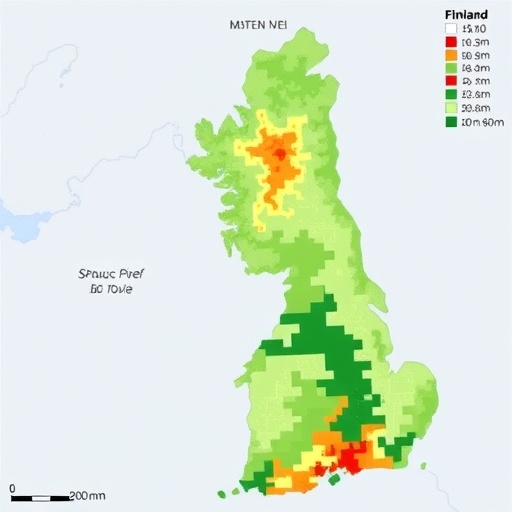
The practical upshot of this research is articulated in a detailed stand-level probabilistic map for 2022, demarcating regions with elevated bark beetle damage risk. This geospatial tool equips forest managers and stakeholders with actionable intelligence to prioritize surveillance and implement early interventions, potentially curtailing outbreak initiation and transmission before ecological and economic losses mount.
Alexander Pulgarín Díaz, PhD, a leading researcher on the project, emphasized the applied significance of these risk maps, noting their value in enabling forest proprietors to evaluate their stands’ vulnerability retrospectively and adapt monitoring intensity and preventive responses accordingly. Such adaptive management is crucial in dynamic forest landscapes, especially under shifting disturbance regimes.
Furthermore, the study draws attention to the role of forest disturbances, including salvage logging and clear-cutting, in shaping future infestation trajectories. These anthropogenic activities alter habitat continuity and resource availability, thereby indirectly influencing beetle colonization patterns. Recognizing these interactions offers an avenue for refining forest management techniques to mitigate inadvertent facilitation of pest outbreaks.
Technically, the research employed advanced spatial statistics combined with climatological modeling to distill complex datasets into interpretable risk assessments. This multidisciplinary integration exemplifies the frontier of precision forestry, where data-driven insights enable balancing timber production goals with ecosystem health and resilience objectives.
Beyond its immediate applicability in Finland, this research sets a precedent for boreal forest pest management globally. By elucidating the interconnected factors driving Ips typographus outbreaks, it paves the way for transnational collaborations and the development of predictive frameworks adaptable to different ecological contexts confronted with bark beetle challenges.
As climate change continues to reshape disturbance regimes, such proactive predictive capabilities become indispensable. They allow stakeholders not only to react to outbreaks once they manifest but to preemptively reinforce forest resilience through targeted silvicultural interventions and landscape-level planning, thereby safeguarding biodiversity, timber resources, and carbon sequestration functions.
This comprehensive approach marries forest science with modern analytical techniques, highlighting the critical nexus between ecological understanding and practical forest stewardship. As the boreal belt confronts increasing pressures from pests and climate anomalies, tools like the stand-level likelihood maps generated by this study could transform how forest landscapes are managed for sustainability.
Ultimately, these advances resonate beyond forestry, offering a model for other natural resource sectors grappling with spatially explicit risks under climate change. By illuminating the conditions that precipitate biological disturbances, they lay foundational knowledge for fostering resilient ecosystems in an uncertain future.
Subject of Research: Prediction of Ips typographus (European spruce bark beetle) damage risk at the forest stand level in Finland, integrating forest inventory, landscape disturbance, and climatic variables.
Article Title: Stand, landscape and climatic attributes contributing to the probability of Ips typographus damage in Finland.
News Publication Date: 19-Dec-2025
Web References: http://dx.doi.org/10.1016/j.foreco.2025.123436
Keywords: Bark beetle, Ips typographus, forest stand, boreal forests, forest disturbance, landscape ecology, climate impact, heatwaves, predictive modeling, forest management, outbreak risk, Finland
Tags: boreal forest management Finlandclimatic impact on bark beetle outbreaksdisturbance history in forest healthEuropean spruce bark beetle control strategiesforest inventory data analysisforest landscape susceptibility modelingIps typographus infestation risklarge-scale forest stand assessmentproactive forest pest management toolsspatial analysis of beetle vulnerabilityspruce bark beetle damage predictionstand-level beetle damage mapping