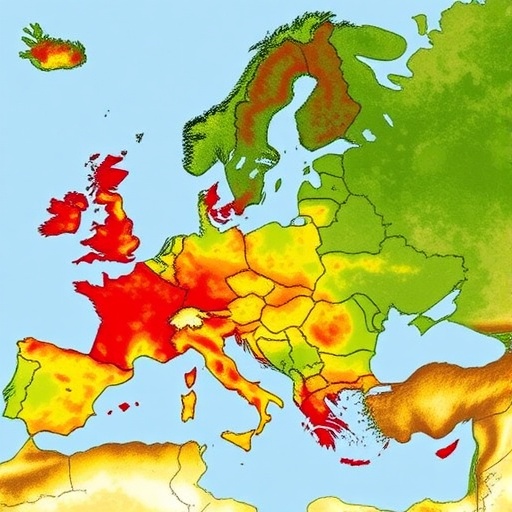
In a groundbreaking study published in Nature Communications, researchers have unveiled a comprehensive assessment of greenhouse gas emissions emanating from drained peatlands across the European Union. These ecosystems, long recognized for their carbon storage potential, are under increasing scrutiny as significant hotspots of emissions due to extensive drainage activities primarily for agriculture and forestry. The study harnesses advanced remote sensing techniques combined with field measurements to pinpoint the most intense emission zones, thereby offering critical insights for climate mitigation strategies.
Peatlands, which are wetlands rich in organic matter accumulated over millennia, act as significant carbon sinks, storing more carbon than all other vegetation types globally combined. However, human-driven drainage of these areas introduces oxygen into soils, accelerating the decomposition of previously stored organic carbon and resulting in CO2 and methane emissions. This research marks a vital step towards quantifying the exact locations within the EU where drained peatlands contribute most to greenhouse gas fluxes, enabling targeted conservation and restoration efforts.
The investigation integrates satellite data with in situ observations across diverse climatic regions and peatland types. By deploying machine learning models trained on a robust dataset, the researchers were able to map emission intensities at an unprecedented resolution, capturing spatial variability that was previously obscured in continental-scale analyses. This innovative approach sheds light on the complex interplay of environmental variables, land use, and peat characteristics driving emission hotspots.
A surprising revelation from the study is the identification of specific peatland regions in countries with extensive agricultural activity that exhibit disproportionately high greenhouse gas emissions. These hotspots, often localized in relatively small drained peat areas, contribute significantly to the overall carbon footprint of the EU. The precision of these findings challenges prior assumptions that emissions were more diffusely spread and highlights the necessity for place-based intervention measures.
The implications for EU climate policy are profound. With the EU’s ambitious Carbon Neutrality goals slated for 2050, understanding that targeted restoration or rewetting of certain hotspot peatlands can yield outsized benefits adds a powerful tool in the mitigation arsenal. The study advocates that policy frameworks must incorporate geospatially explicit data on peatland degradation to prioritize funding, policy incentives, and conservation efforts effectively.
Further technical examinations reveal that methane—the more potent greenhouse gas compared to CO2—is released in significant quantities from rewetted peatlands. The researchers emphasize a nuanced approach, suggesting that management strategies need to balance methane emissions with the benefits of carbon sequestration when considering peatland restoration. This insight challenges simplistic narratives advocating for universal rewetting without accounting for methane flux trade-offs.
The methodological advancements set forth by van Giersbergen and colleagues harness multiple sensor platforms, including optical, radar, and thermal remote sensing instruments, which collectively capture fluctuations in moisture content, vegetation cover, and soil temperature. Coupling these observations with controlled experimental plots where gas flux chambers measure emissions in situ offers a calibration baseline, strengthening the reliability of emission estimates.
Crucially, the study also explores temporal dynamics, revealing how seasonal and inter-annual climatic variations influence emission patterns. During drier periods, emission rates tend to spike due to enhanced aerobic decomposition, while wetter years see altered methane emission profiles. This understanding underscores the importance of integrating climate variability into predictive models for greenhouse gas emissions from peatlands.
One innovative aspect of the research is the employment of a multi-criteria decision support system that integrates emission data with socio-economic considerations such as land ownership, agricultural productivity, and restoration feasibility. Such a framework empowers stakeholders—from policymakers to local land managers—to make informed decisions that optimize both ecological and economic outcomes.
The authors underscore the urgency of their findings in the context of escalating climate change feedback loops. Drained peatlands, if not managed attentively, could become ever-greater sources of emissions, compounding warming trends and potentially triggering further ecosystem destabilization. This study thus serves as a clarion call for immediate action grounded in precise scientific evidence.
Another critical observation is the potential for underestimation of greenhouse gas emissions in current national inventories. The meticulous mapping exercise reveals emission fluxes that surpass previous estimates, suggesting the need to revise reporting methodologies to include spatial heterogeneity and drainage status as core parameters.
Furthermore, the research posits that integrating peatland management into the broader EU agriculture and land-use sectors could foster synergies aligning food security with climate objectives. For example, practices such as paludiculture—cultivating wetland-adapted plants—may offer sustainable alternatives that preserve peat integrity and reduce emissions.
The interdisciplinary nature of the research team, combining expertise in ecology, remote sensing, biogeochemistry, and policy analysis, exemplifies a holistic approach necessary to tackle complex environmental challenges. Their work elegantly bridges science and practical application, positioning peatland management at the forefront of climate mitigation discussions within the EU.
At the global scale, the study provides a replicable blueprint for other regions grappling with peatland degradation and emissions, especially in the tropics and boreal zones where peatlands are prevalent. Scaling this approach could fundamentally transform how peat ecosystems are accounted for in international climate agreements.
In conclusion, van Giersbergen et al.’s research not only advances scientific understanding of greenhouse gas dynamics in drained peatlands but also empowers actionable interventions aligned with Europe’s climate ambitions. Addressing these peatland hotspots promises substantial emissions reductions and safeguards a critical natural carbon reservoir, underscoring peatlands’ overlooked yet indispensable role in the global climate system.
Subject of Research:
Greenhouse gas emissions from drained peatlands in the European Union, focusing on mapping and quantifying emission hotspots to inform climate mitigation strategies.
Article Title:
Identifying hotspots of greenhouse gas emissions from drained peatlands in the European Union
Article References:
van Giersbergen, Q., Barthelmes, A., Couwenberg, J. et al. Identifying hotspots of greenhouse gas emissions from drained peatlands in the European Union. Nat Commun 16, 10825 (2025). https://doi.org/10.1038/s41467-025-65841-6
Image Credits: AI Generated
DOI:
https://doi.org/10.1038/s41467-025-65841-6
Tags: advanced mapping of emission hotspotsagricultural drainage impact on peatlandsclimate mitigation strategies for peatlandsconservation efforts for peatland restorationdrained peatlands carbon storageEU peatlands greenhouse gas emissionsforestry activities and emissionsin situ observations of peatlandsmachine learning in environmental researchmethane emissions from peatlandsremote sensing techniques for emissionsspatial variability in greenhouse gas fluxes