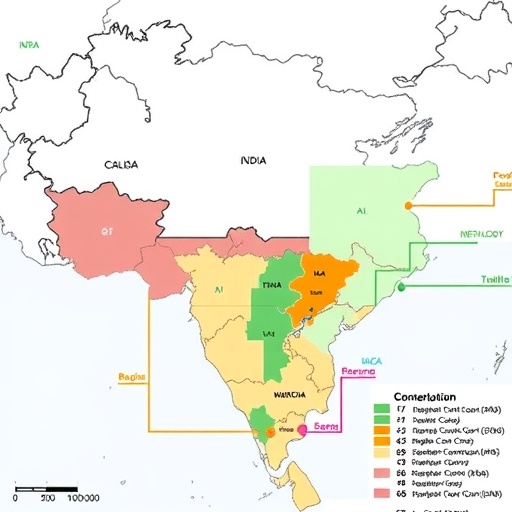
In an era where the intersection of agriculture and nutrition is increasingly critical, a new study presents compelling insights into the biodiversity of crops across South Asia, emphasizing the intricate links between species diversity and functional crop traits. This pioneering research, published in npj Sustainable Agriculture, undertakes a spatial assessment to unravel the complexities of agrobiodiversity with a clear focus on nutrition-sensitive agriculture. The study not only maps the richness of crop species but also explores the functional diversity that underpins agricultural sustainability and nutritional outcomes in one of the world’s most populous and agriculturally significant regions.
South Asia’s agricultural landscape is a mosaic of vast heterogeneity in terms of climatic zones, soil types, and farming systems, making it a focal point for studying agrobiodiversity. The researchers, led by Kamal, M., Nandi, R., and Amjath-Babu, T.S., have leveraged spatial data analytics and ecological metrics to create a detailed picture of how species diversity correlates with functional diversity — a concept that encapsulates the specific traits crops exhibit, such as nutrient content, growth patterns, and resilience to environmental stressors. Their endeavor is not merely academic; it aims to inform policies that optimize crop choices for improving dietary quality and environmental sustainability.
One of the hallmark contributions of this research lies in its methodological innovation. By integrating spatially explicit datasets and sophisticated modeling techniques, the team confronts the challenge of linking crop species diversity to functional traits on a large scale. This approach departs from traditional biodiversity studies that often focus solely on species counts without accounting for the ecological roles played by different crops. Their results reveal nuanced patterns: areas with high species richness do not necessarily equate to high functional diversity. This discovery has profound implications for agricultural planning, suggesting that preservation of diverse crop species must be complemented by an understanding of their functional attributes to truly harness agrobiodiversity’s potential.
The implications for nutrition-sensitive agriculture are profound. The functional traits of crops directly influence their nutrient profiles — vital for addressing micronutrient deficiencies prevalent in populations across South Asia. The study identifies spatial hotspots where functional diversity aligns with nutritional richness, providing crucial guidance for targeted interventions aimed at diversifying diets in vulnerable communities. These findings underscore the strategic importance of not just promoting crop variety but also ensuring that the chosen crops contribute meaningfully to dietary diversity and public health.
Furthermore, the research addresses environmental sustainability, highlighting how functionally diverse cropping systems can enhance ecosystem resilience. Functional traits such as drought tolerance, nitrogen fixation, and pest resistance contribute to ecological stability and reduce dependency on chemical inputs. By mapping these traits spatially, the researchers provide a powerful tool for designing farming systems that are both productive and environmentally sustainable. This approach dovetails with global efforts to mitigate climate change impacts on agriculture, offering a pathway for adaptive management in a region highly susceptible to climatic variability.
The spatial assessment conducted in the study also reveals significant regional disparities within South Asia. While some areas demonstrate robust species and functional diversity, others suffer from homogenization due to monoculture practices and market-driven crop choices. This heterogeneity calls for localized strategies that recognize the socio-economic and ecological contexts influencing crop selection. The paper argues convincingly for integrative policies that support smallholder farmers, promote indigenous crop varieties, and preserve traditional knowledge systems as pillars of agrobiodiversity conservation.
Emphasizing the role of technology, the study highlights the value of geospatial tools and big data in advancing agricultural research. The ability to visualize and analyze crop diversity patterns across vast and varied landscapes facilitates evidence-based decision-making. This technological leverage is crucial for scaling sustainable agricultural practices and aligning them with nutrition goals, representing a significant step forward in the use of data-driven approaches in agricultural sciences.
The comprehensive nature of this spatial analysis offers a transformative lens on agrobiodiversity. It bridges the gap between ecological theory and practical agriculture by linking species richness to traits that directly impact human nutrition and ecosystem health. The authors articulate a vision of agriculture that transcends yield maximization alone, advocating for multifunctional crop systems that enhance food security, nutritional quality, and environmental stewardship simultaneously.
Additionally, the study delivers actionable insights for stakeholders ranging from policymakers to farmers and agricultural extension workers. By clarifying which crop species and traits should be prioritized in different agroecological zones, it supports the development of adaptive management plans tailored to local conditions. This alignment of scientific knowledge with on-the-ground realities empowers communities to make informed choices that promote both agronomic productivity and nutritional outcomes.
The paper also confronts the broader challenge of biodiversity loss in agricultural landscapes. The documented declines in crop species variety threaten not only ecological balance but also dietary diversity and resilience to shocks such as pest outbreaks or extreme weather. Through its spatially explicit findings, the research advocates for conservation strategies that recognize the multifaceted value of agrobiodiversity, extending well beyond mere species counts.
In the context of global food systems, this study contributes to the growing recognition that nutrition-sensitive agriculture is essential for achieving sustainable development goals. It articulates a compelling case for integrating biodiversity metrics into agricultural policy frameworks, aligning food production with human well-being and ecosystem integrity. This integrative perspective is crucial as South Asia grapples with the dual challenges of feeding a growing population and managing the environmental footprint of agriculture.
Moreover, the research sets a precedent for further interdisciplinary studies that combine ecology, nutrition science, and agricultural economics. The demonstrated links between species diversity, functional traits, and nutrition prompt new questions and avenues for investigation, such as the socioeconomic determinants influencing crop diversity and the market mechanisms that could incentivize the cultivation of functionally diverse crops.
In synthesizing rich spatial datasets and ecological principles, this study not only advances academic understanding but also offers practical solutions for one of the most pressing issues of our time: nourishing populations sustainably while preserving the planet’s biological resources. Its findings pave the way for agricultural innovations that are ecologically informed and nutrition-sensitive, offering hope for resilient food systems in South Asia and beyond.
Ultimately, this extensive spatial assessment redefines the concept of agrobiodiversity by anchoring it in functional traits directly linked to both nutrition and sustainability. It challenges traditional agricultural paradigms and provides a new toolkit for researchers and practitioners aiming to foster crop diversity that translates into tangible health and environmental benefits. As the world moves toward more sustainable agriculture, studies like this highlight the indispensable role of biodiversity as a cornerstone of food security and human health.
In conclusion, the work by Kamal, Nandi, Amjath-Babu, and colleagues stands as a landmark contribution to sustainable agriculture research. It emphasizes the critical need to evaluate and promote functional diversity within crop systems to nurture resilient and nutrition-sensitive agricultural landscapes. Their spatially grounded approach offers a replicable model for other regions seeking to harness the power of agrobiodiversity amid global challenges of climate change, population growth, and nutritional deficiencies.
Subject of Research: Agrobiodiversity and its linkage to nutrition-sensitive agriculture in South Asia through spatial assessment of species and functional crop diversity.
Article Title: Linking species and functional crop diversity in South Asia: a spatial assessment of agrobiodiversity for nutrition-sensitive agriculture.
Article References: Kamal, M., Nandi, R., Amjath-Babu, T.S. et al. Linking species and functional crop diversity in South Asia: a spatial assessment of agrobiodiversity for nutrition-sensitive agriculture. npj Sustain. Agric. 4, 17 (2026). https://doi.org/10.1038/s44264-026-00130-3
Image Credits: AI Generated
DOI: https://doi.org/10.1038/s44264-026-00130-3
Tags: agricultural sustainability in South Asiaagrobiodiversity and nutritionbiodiversity’s impact on nutritioncrop species richness mappingecological metrics in farmingenhancing dietary quality through cropsenvironmental resilience in agriculturefunctional traits of cropsnutrition-sensitive agriculturepolicies for sustainable agricultureSouth Asia crop diversityspatial assessment of agriculture