Manufacturing-induced voids reduce the longitudinal compressive strength of resin transfer moulded gapped unidirectional carbon fibre reinforced polymer laminates by up to approximately thirty-five to forty percent when void contents reach between one and three percent. In a comprehensive investigation published in Applied Composite Materials, a research team led by Aristea Giannakopoulou, Marie Jonsson, Sergio Costa, Sibin Saseendran, and Mohamed Sahbi Loukil systematically evaluated the mechanisms governing damage initiation, crack propagation, and compressive failure in this novel material architecture. The experimental findings revealed that while compressive load-bearing capacity deteriorated dramatically in the presence of process-induced porosity, tensile crack initiation remained largely insensitive to localized resin-rich areas and binder-related inclusions. Under progressive transverse tensile loading, damage consistently initiated as isolated matrix microcracks within the central transverse plies at strain thresholds between 0.4% and 0.5%, demonstrating that early tensile damage is primarily governed by ply orientation and internal stress distribution rather than sporadic resin inhomogeneities within the composite matrix.
Carbon fibre reinforced polymers are indispensable materials throughout modern aerospace engineering because of their high specific stiffness, high specific strength, excellent fatigue resistance, and low density. Their laminated construction permits extensive tailoring of directional mechanical properties to meet the stringent structural and aerodynamic demands of critical components, such as fan outlet guide vanes in commercial aeroengines. For these demanding applications, resin transfer moulding is widely utilized because the closed-mould infusion process facilitates the fabrication of complex structural geometries with high fibre volume fractions and tight dimensional accuracy. Despite strict process controls, variations in resin flow behaviour, preform permeability, and thermal curing conditions inevitably introduce manufacturing imperfections into finished parts. Among these imperfections, microvoids caused by air entrapment during mould filling represent the most common flaw, frequently accumulating near resin outlets where incomplete evacuation occurs. Additionally, preform compaction causes fibre nesting and out-of-plane waviness that alter local permeability and promote resin-rich pockets, making the quantification of defect sensitivity essential for structural reliability.
To investigate these failure phenomena, the researchers fabricated composite test plates utilizing an emerging material system consisting of TeXtreme gapped unidirectional carbon fibre preforms impregnated with a toughened PR520 epoxy resin system. The intentional gaps present within the unidirectional dry plies provide unique manufacturing and design opportunities, yet the resulting architecture remains susceptible to compaction-induced fibre nesting, through-thickness waviness, and uneven permeability. Square laminate panels measuring 300 millimetres by 300 millimetres were prepared with a symmetric stacking sequence designated as [±45°, 0°, 90°, 02°]s. Dry preform plies were cut using automated cutting machinery and assembled manually on a rigid mould tool. In selected panels, circular artificial delaminations were introduced by embedding eighty-micrometre-thick Teflon film discs with a diameter of twenty millimetres directly at the laminate mid-plane, providing a controlled surrogate defect for interlaminar debonding. Following mould closure and controlled clamping, the PR520 epoxy was injected under pressure, cured, and demoulded to yield dense composite plates possessing an average fibre volume fraction of approximately 45%.
Before destructive mechanical evaluation, the manufactured composite panels underwent non-destructive evaluation using a Dolphicam ultrasonic matrix array inspection system operating in pulse-echo mode. Direct-contact transducer modules acquired both Time-of-Flight and amplitude C-scan representations, complemented by orthogonal B-scan cross-sections, to verify internal structural integrity. The acoustic inspection utilized a calibrated longitudinal sound velocity of 2800 metres per second corresponding to the carbon fibre laminate. These ultrasonic scans mapped internal features, confirming that the embedded circular Teflon inserts remained planar, undistorted, and precisely centred at the intended mid-plane throughout the high-pressure resin transfer moulding cycle. The resulting Time-of-Flight scans displayed sharp, uniform circular zones matching the twenty-millimetre insert diameter without evidence of resin washing, edge folding, or through-thickness migration. This non-destructive characterisation confirmed that the artificial flaws provided reproducible, well-defined defect geometries, ensuring that subsequent mechanical testing accurately reflected the intended interlaminar discontinuities rather than uncontrolled processing distortions.
Following non-destructive scanning, test specimens were sectioned from the cured panels to permit rigorous microstructural examination using a Leica DM6M optical microscope. Micrographs taken across fifty-millimetre gauge sections revealed that while resin impregnation was generally uniform, pronounced through-thickness fibre waviness was present within the internal 90° plies near the laminate mid-plane. To quantify void content across different panels, the researchers implemented a digital image processing workflow using MATLAB R2023b. High-resolution cross-sectional micrographs of selected compression specimens were converted to grayscale, and an empirical brightness threshold was applied to segment dark void pixels from the surrounding polymeric matrix and carbon fibres. Multiple fields of view were analysed per sample to account for local microstructural variations, while surface scratches and edge polishing artefacts were systematically filtered out. The resulting dark-pixel area fractions yielded comparative void content estimates ranging from negligible porosity up to approximately 3%, establishing a consistent baseline to correlate void fractions with mechanical properties.
Tensile testing was conducted on an Instron 5582 universal testing frame operated under displacement control at a quasi-static crosshead speed of one millimetre per minute under ambient laboratory conditions. Specimens designated T1 through T4 were sectioned perpendicular to the primary fibre direction to impose transverse loading across the laminate layup, clustering four central plies in the 90° orientation. To suppress gripping damage and ensure uniform load transfer, one-millimetre-thick glass/epoxy end tabs were bonded to each specimen end, and longitudinal strain was continuously recorded using an extensometer featuring a twenty-five-millimetre gauge length. Unlike conventional tensile evaluations that pull specimens continuously until ultimate failure, the researchers applied an interrupted, incremental loading protocol. Tensile loading was paused at predefined strain intervals of 0.4%, 0.8%, and 1.2%, allowing specimens to be removed from the test grips for stepwise optical microscopic examination. This progressive approach allowed direct tracking of crack nucleation, crack multiplication, and ply interface debonding as functions of applied strain.
Stepwise optical inspection demonstrated that damage evolution under transverse tensile loading adhered to a distinct, ply-dependent progression. Initial damage appeared between 0.4% and 0.5% strain as sparse, isolated matrix microcracks confined strictly to the central 90° layers. As tensile strain rose toward 0.8%, crack density multiplied across the transverse plies, and the extending cracks began interacting with adjacent ply boundaries where elastic mismatch generated high interlaminar stresses. By 1.2% strain, extensive delamination propagated along ply interfaces, causing a noticeable deviation from linearity in the stress-strain curve that signalled severe structural stiffness degradation. Significantly, despite the presence of occasional resin-rich volumes and partially dissolved preform binder inclusions between adjacent layers, cracks showed no preferential tendency to nucleate at these microstructural heterogeneities. Instead, crack initiation was governed by macroscopic transverse stress concentrations within the 90° plies, whereas the outer ±45° plies exhibited remarkable damage resistance, developing cracks only at the maximum applied strain of 1.2%.
The introduction of artificial Teflon defects and process-induced voids exerted a pronounced influence on tensile crack development. In transverse tensile specimens containing embedded mid-plane Teflon inserts, the strain threshold required for crack initiation was notably reduced. Delaminated specimens exhibited visible matrix cracks at 0.6% strain, whereas non-defective control laminates remained free of observable damage at that same loading level. As strain increased to 1.0%, cracks within defective specimens coalesced into dense networks that encircled the artificial delamination, culminating in catastrophic laminate failure at 1.2% strain characterized by extensive transverse ply fragmentation and fibre fracture. Similarly, among the transversely loaded specimens without Teflon inserts, specimen T4, which contained visible manufacturing porosity near the mould outlet, exhibited consistently higher crack densities across all ply orientations throughout the loading sequence. Microscopic tracking around individual voids revealed radial microcrack growth initiating at void boundaries at 0.6% strain, followed by crack coalescence at 0.9% strain and widespread interlaminar cracking by 1.2% strain.
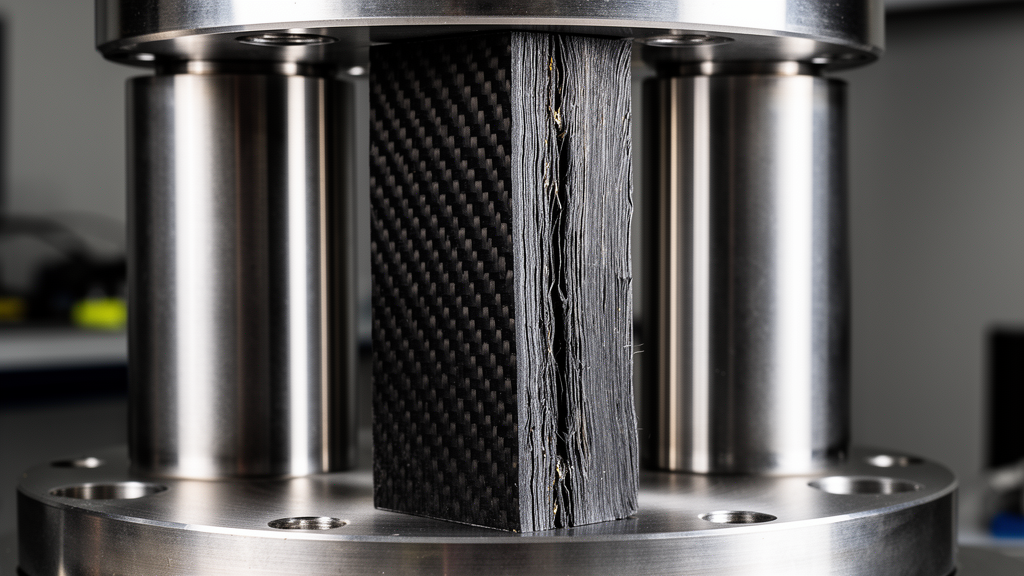
Compressive testing was carried out based on the principles of ASTM D6641/D6641M to assess the longitudinal compressive response and defect sensitivity of the gapped unidirectional composites. Rectangular specimens measuring approximately 2.75 millimetres in nominal thickness and twenty-five millimetres in width were reinforced with two-millimetre-thick bonded glass/epoxy tabs, leaving an unsupported gauge length of fourteen millimetres between fixture grips to suppress global structural buckling. Compressive loading was applied under displacement control at a crosshead speed of one millimetre per minute. In contrast to the progressive damage accumulation observed during tensile testing, compressive loading suppressed gradual cracking because compressive forces naturally acted to close microcracks and delaminations. Strain gauge measurements recorded peak compressive failure strains of approximately 0.4%, at which point the specimens experienced sudden, brittle collapse marked by a sharp load drop in the load-displacement recordings, with post-failure microscopy revealing catastrophic through-thickness shear cracking and widespread delamination across multiple plies.
Microstructural correlation revealed that void content was the decisive factor governing composite compressive performance. While nearly void-free laminates achieved compressive strengths between approximately 560 and 610 megapascals, specimens containing between 1% and 3% porosity exhibited severe compressive degradation, falling to strength levels between 350 and 400 megapascals. This decline represents an overall compressive strength reduction of roughly thirty-five to forty percent. Voids act as severe internal stress concentrators that disrupt matrix continuity, impairing load transfer between adjacent reinforcing fibres and promoting premature local microbuckling and shear crippling under compression. Even within identical manufacturing batches, minor experimental scatter of five to six percent was observed due to subtle fixture alignment variations and localized microstructural heterogeneity. Ultimately, the authors concluded that while gapped unidirectional preforms provide advantageous processing characteristics, mitigating void formation during resin transfer moulding remains paramount to ensuring the structural integrity and defect tolerance demanded by high-performance aerospace composite components.
Subject of Research: Damage initiation, crack propagation, and compressive performance of defect-bearing gapped unidirectional carbon fibre composite laminates manufactured via resin transfer moulding
Article Title: Effect of Manufacturing Defects on Damage Initiation and Propagation in Gapped UD Carbon Fibre Composite Laminates
Article References: Giannakopoulou, A., Jonsson, M., Costa, S., Saseendran, S., & Loukil, M. S. (2026). Effect of Manufacturing Defects on Damage Initiation and Propagation in Gapped UD Carbon Fibre Composite Laminates. Applied Composite Materials, 33(5), Article 156. https://doi.org/10.1007/s10443-026-10538-2
Image Credits: AI Generated
DOI: 10.1007/s10443-026-10538-2
Keywords: carbon fibre reinforced polymers, resin transfer moulding, gapped unidirectional composites, manufacturing defects, compressive strength degradation, matrix cracking, interlaminar delamination, void content measurement, ultrasonic matrix array inspection, aerospace composite structures, damage initiation threshold, ply orientation effects, fibre waviness, microstructural characterisation, toughened epoxy resin, progressive tensile loading, interfacial stress redistribution
News Source: Denise Maddox. (November 23, 2026). Manufacturing Defects Slash Compressive Strength in Aerospace Carbon Composites. Scienmag.