• HOME
  • NEWS
  • EXPLORE
    • CAREER
      • Companies
      • Jobs
    • EVENTS
    • iGEM
      • News
      • Team
    • PHOTOS
    • VIDEO
    • WIKI
  • BLOG
  • COMMUNITY
    • FACEBOOK
    • INSTAGRAM
    • TWITTER
Wednesday, November 11, 2026
BIOENGINEER.ORG
No Result
View All Result
  • Login
  • HOME
  • NEWS
  • EXPLORE
    • CAREER
      • Companies
      • Jobs
        • Lecturer
        • PhD Studentship
        • Postdoc
        • Research Assistant
    • EVENTS
    • iGEM
      • News
      • Team
    • PHOTOS
    • VIDEO
    • WIKI
  • BLOG
  • COMMUNITY
    • FACEBOOK
    • INSTAGRAM
    • TWITTER
No Result
View All Result
Bioengineer.org
No Result
View All Result
Home NEWS Science News Biology

Man sees cat features in human faces after brain surgery

by
November 10, 2026
in Biology
Reading Time: 3 mins read
0
Man sees cat features in human faces after brain surgery

Man sees cat features in human faces after brain surgery

Share on FacebookShare on TwitterShare on LinkedinShare on RedditShare on Telegram

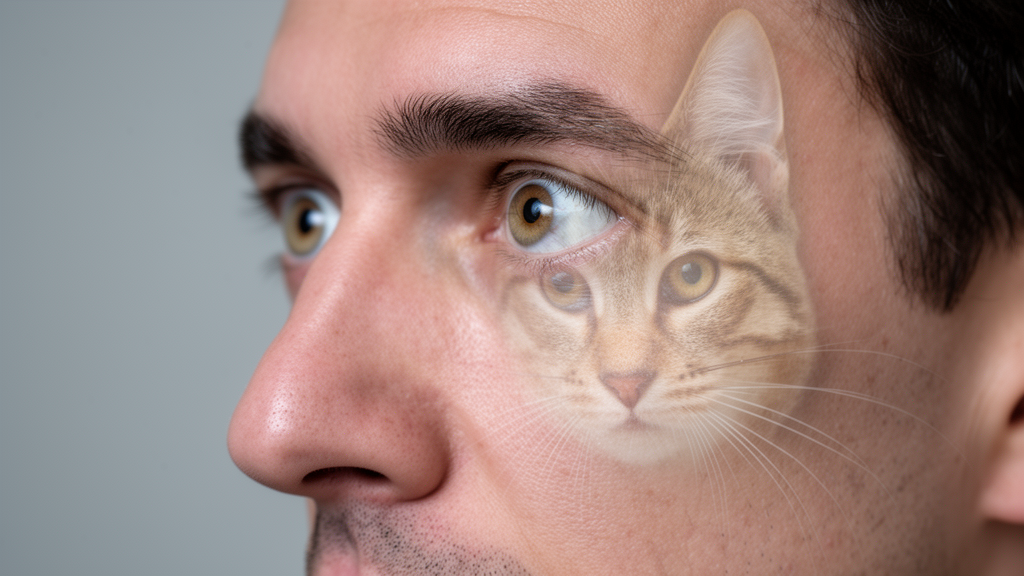
Karl, a 28-year-old man living in the northeastern United States, experiences a rare visual phenomenon in which features of his grey tabby cat, Luna, appear superimposed on the faces of people he encounters. This condition, documented in a report published in the journal Cortex, involves a form of palinopsia that leads to face distortions known as prosopometamorphopsia, or PMO.

Karl’s symptoms began two years ago following a surgical procedure in which part of his right temporal lobe was removed. The surgery was necessary to treat an arteriovenous malformation, a tangled mass of blood vessels between arteries and veins that can lead to a brain bleed if left untreated.

In the mornings, Karl’s cat is often the first face he sees. On some days, this initial exposure to Luna’s face triggers a persistent visual effect where he sees the cat’s almond-shaped eye sockets, enlarged pupils, and stripes on the human faces he encounters later in the day. This transfer of features occurs whether he is interacting with people in person or viewing them online. Conversely, if Karl sees a human face at the start of his day instead of his cat, he may perceive that person’s pupils and eye shape on other people’s faces, and even on his own cat’s face.

Lead author Brad Duchaine, a professor and chair of psychological and brain sciences at Dartmouth College, notes that this case demonstrates that individual features can be pulled from memory and influence ongoing perception. Duchaine’s lab studies PMO and has heard from more than 250 people who experience face distortions. He points out that some of these individuals have been misdiagnosed with psychiatric problems and placed on antipsychotics, when in fact they are experiencing visual processing issues rather than mental health disorders.

Duchaine was reminded of a 1986 study published in Cortex that reported on a woman who, after a stroke, saw a poodle on a passenger’s lap and subsequently perceived the poodle’s face on every passenger on the bus. While both cases involve the transfer of facial features, Karl’s experience differs in that only components of faces are transferred rather than an entire face.

To illustrate visually what Karl was experiencing, Duchaine prepared a line-drawn sketch and fed it into a large language model to make the image more photo-realistic. He then shared the image with Karl, and the two went back and forth modifying a set of images that are included in the report. Duchaine explains that AI provides researchers with the ability to generate more accurate visualizations of what people are experiencing when they have distorted visual perceptions. This collaborative process allows the patient to take part in creating the visualizations, which can help researchers better understand and potentially control the condition.

The use of AI in this context is also helpful for patients who want to convey to their healthcare professionals, friends, and family what faces look like to them.

Antônio Mello, a PhD student in the Department of Psychological and Brain Sciences, and Jennifer Nosker, a neuropsychologist at Brigham and Women’s Hospital, also contributed to the study.

Subject of Research: After brain surgery, man sees cat's eyes in human faces

Article Title: After brain surgery, man sees cat's eyes in human faces

Article References: After brain surgery, man sees cat's eyes in human faces. Original publication (Bibliographic details unavailable.)

Image Credits: AI Generated

DOI: Not provided

Keywords: brain, surgery, sees, cat's, eyes, human, faces, scientific research

News Source: Cassandra Pierce. (November 10, 2026). Man sees cat features in human faces after brain surgery. Scienmag.


Tags: Braincatseyesfaceshumanscientific researchseesSurgery
Share12Tweet7Share2ShareShareShare1

Related Posts

Rare late-onset Niemann-Pick C diagnosed in woman after years of falls and jerking arms

Rare late-onset Niemann-Pick C diagnosed in woman after years of falls and jerking arms

November 11, 2026
Metagenomics Reveals Contrasting Microbial Profiles in Alpine Freshwaters and Sediments

Metagenomics Reveals Contrasting Microbial Profiles in Alpine Freshwaters and Sediments

November 11, 2026

Engineered Probiotic E. coli Produces Indican from Crude Glycerol

November 11, 2026

Microbial Crosstalk Influences Tumor Microenvironment and Therapy Resistance in Urologic Oncology

November 11, 2026

POPULAR NEWS

  • Surgical Decompression Resolves Secondary Trigeminal Neuralgia in Rare Osteopetrosis Case Report

    Surgical Decompression Resolves Secondary Trigeminal Neuralgia in Rare Osteopetrosis Case Report

    29 shares
    Share 12 Tweet 7
  • Inline HPLC Detects Radioactive Daughters in Actinium Radiopharmaceuticals

    29 shares
    Share 12 Tweet 7
  • Blood Cancer United Launches Real-World Evidence Initiative for Pediatric Acute Myeloid Leukemia

    29 shares
    Share 12 Tweet 7
  • Standardized Breast Cancer Mortality Among Chinese Women Declined Gradually Through 2021

    29 shares
    Share 12 Tweet 7

About

We bring you the latest biotechnology news from best research centers and universities around the world. Check our website.

Follow us

Recent News

Tree Models Explain Intrusion Detection More Faithfully Than Deep Learning

Modified RRT Algorithm Boosts Robot Navigation Efficiency in Three-Dimensional Simulations

Case Study Shows Collaborative Clinical Reasoning Extends Beyond Individual Expertise

Subscribe to Blog via Email

Enter your email address to subscribe to this blog and receive notifications of new posts by email.

Join 87 other subscribers
  • Contact Us

Bioengineer.org © Copyright 2023 All Rights Reserved.

Welcome Back!

Login to your account below

Forgotten Password?

Retrieve your password

Please enter your username or email address to reset your password.

Log In
No Result
View All Result
  • Homepages
    • Home Page 1
    • Home Page 2
  • News
  • National
  • Business
  • Health
  • Lifestyle
  • Science

Bioengineer.org © Copyright 2023 All Rights Reserved.