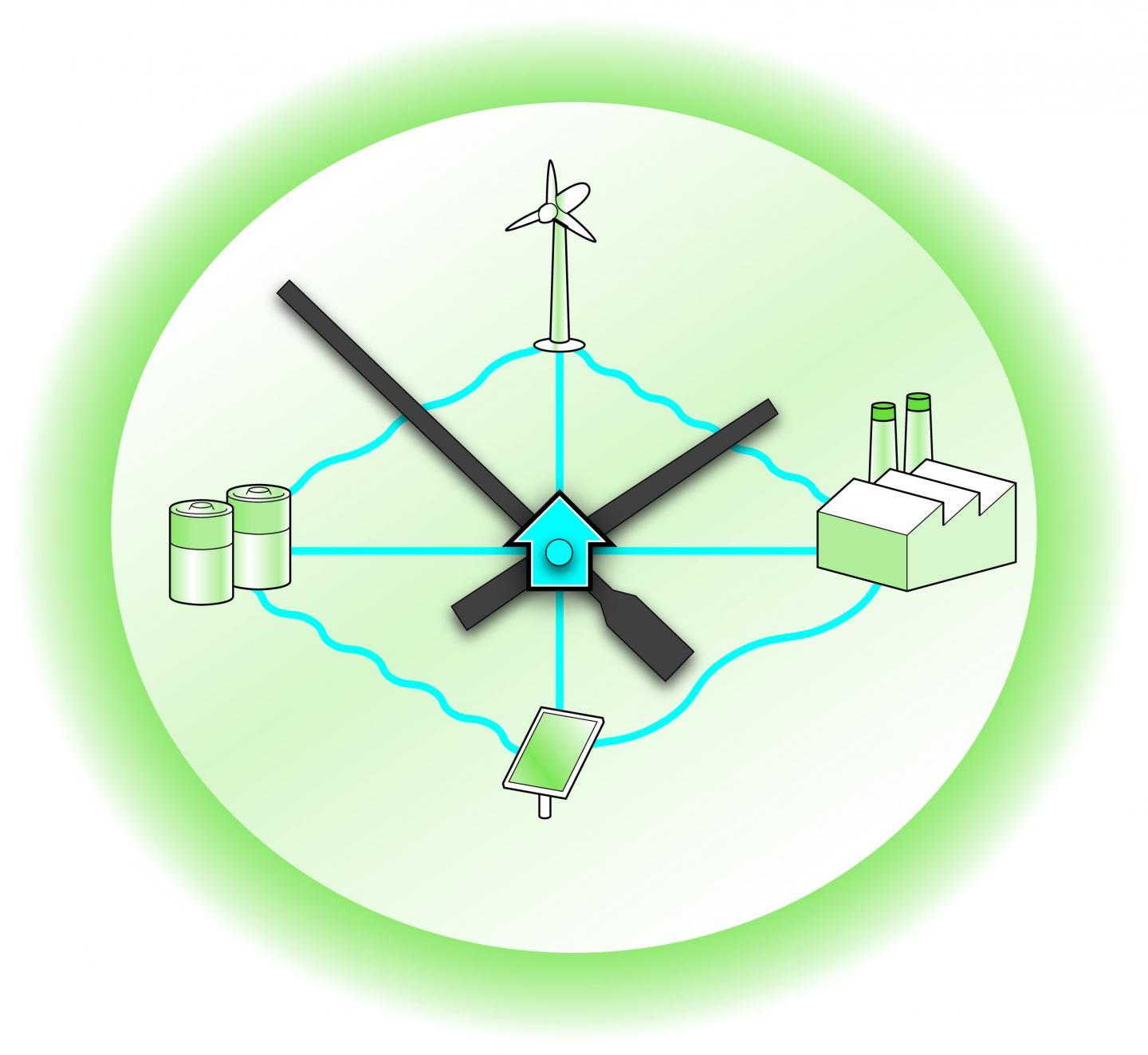

Credit: Lehigh University, P.C. Rossin College of Engineering and Applied Science
Recent years have witnessed the rise of an economic revolution–the so-called sharing economy. Businesses such as Uber, Lyft, and Airbnb have created a new kind of marketplace, in essence, by relying on the investments of others.
Could the electricity marketplace be next?
Boris Defourny, assistant professor of industrial and systems engineering at Lehigh University and member of its Integrated Networks for Electricity (INE) research cluster, seeks to understand how this could take shape. He's recently won a grant from the National Science Foundation to analyze associated market models and develop theory and algorithmic strategies to help optimize the integration of renewable energy for usage across the power grid.
A 'network effect' boost to our environment
Defourny believes the distributed nature of renewable energy capture, which can reasonably be undertaken by everyone from individual households to major corporations and government agencies, makes it ripe for a similar economic disruption.
"Renewables are on the rise," he says. "Currently, about 10 percent of U.S. electric power comes from renewable energy systems. In some countries this can be as much as 20 percent, thanks to interconnections with neighbors. Yet in terms of instantaneous production levels, wind and solar are inherently volatile, and as such cannot be relied upon and fully utilized. This variability gives rise to the idea that a better coordination of these smaller, diverse, distributed power sources, coupled with an expansion of distributed energy storage resources, would allow for greater overall utilization of clean, renewable energy."
Defourny sees a day in the not-so-distant future where small energy producers and residential consumers who have invested in renewable energy technologies will be incentivized to become suppliers of clean energy. Load aggregators and utility firms will be able to leverage that clean power for other customers in real-time, even as its supply, and overall demand, fluctuates.
At the moment, he says, contractual and operational issues stand in the way. Yet the fact remains–the ability to seamlessly integrate more clean energy into the grid would, by definition, drastically reduce reliance on fossil fuels as well as associated environmental impact.
"Today, anyone can sell energy 'back' to the grid, but the risks are economically prohibitive," he says."And under the current approach, power companies are operationally constrained from relying upon and distributing this power."
Defourny is looking to develop business and technology models that would create mutually-agreeable conditions for both the consumer/supplier and the utility firms. His goal is to better understand issues such as the sharing of associated economic risk, required payment mechanisms, and incentives that would support widescale adoption and participation.
"It is a classic network effect," he says. "Greater participation yields greater individual and societal benefit. It needs a critical mass to really take off, and hopefully we can build some tools to help move the market in that direction."
In his research, Defourny will study control mechanisms, contracts, and transaction environments that will enable optimal pooling of clean energy. Hopefully, this leads to a power grid based upon short-term, "on demand" transactions. "If a windmill farm is capturing far more power than its owner predicted," he explains, "the sudden bursts of power should ideally be sent through the grid to the load centers where it is useful, thus easing the burden on traditional generation methods. This feat can be enabled by having more distributed devices plugged into the grid and willing to provide balancing services. Those who share capacity or provide flexibility for this purpose should be fairly compensated."
Defourny earned his doctorate and master's degrees in electrical engineering and computer science from the University of Liege in Belgium. He also studied piano at the Conservatoire Royal de Musique de Liege, and Japanese at the Centre d'Etudes Japonaises de l'Universite de Liege.
Before joining Lehigh's faculty, Defourny served as associate professional specialist with the Princeton Laboratory for Energy Analysis (PENSA) in the Operations Research and Financial Engineering Department at Princeton University. His research interests include stochastic optimization, robust optimization, machine learning, modeling and approximation, energy systems analysis, electricity markets, and operations planning.
Electrifying innovation at Lehigh
Defourny is a key player in Lehigh's INE research cluster–a collaborative, multi-faceted team of Lehigh researchers focused upon the interdependent flow of electricity, information, and money needed to operate what's popularly known as the 'smart grid'–a term that represents broad efforts across industry, academia, and government to incorporate and leverage modern technologies across power infrastructures.
The team's overarching goal: to meet global energy demand while protecting the environment for future generations. "In a research area where focus tends to be dominated by traditional fields and perspectives, few academic research centers can do what Lehigh does," says Rick Blum, the Robert W. Wieseman Professor of electrical and computer engineering and director of the INE. "Boris' systems-level perspective on the business case for shared renewables is yet another great example."
###
Related Links:
- NSF Award Notice: A Nonbinding Commitment Modeling and Control for Deployment of Distributed Flexible Energy Resources
- Faculty Profile: Boris Defourny, Lehigh University
- Web site: Integrated Networks for Electricity, Lehigh University
- Web site: Department of Industrial and Systems Engineering, Lehigh University
Media Contact
Chris Larkin, Lehigh University
[email protected]
@lehighu
http://www.lehigh.edu