Dietary supplementation with magnesium oxide or magnesium aspartate does not consistently reduce the occurrence of tail or ear lesions or lower physiological stress markers in young pigs, according to a Danish on-farm study. Investigating alternative strategies to address tail biting in pigs with intact tails, researchers monitored 381 rearing pigs across two batches postweaning until nine weeks of age. Although supplementation influenced circulating magnesium status, neither compound reliably decreased lesion rates or altered blood cortisol patterns under commercial conditions.
Tail biting is a complex, multifactorial behavioural disorder in domestic pigs that leads to severe welfare compromises and substantial economic penalties, including reduced growth rates, extra labour, elevated veterinary expenses, and carcass condemnations. While routine tail docking remains widely used to prevent biting outbreaks, the practice is recognised as painful and is banned under European Union regulations. Identifying viable nutritional and management alternatives requires managing critical stressors such as postweaning regrouping, pen overcrowding, and dietary deficiencies, which commonly trigger destructive biting behaviours.
Magnesium supplementation has been proposed as a practical dietary intervention to alleviate stress-induced behaviours because the mineral plays vital roles in cellular enzyme function, adenosine triphosphate production, immune regulation, and neurotransmitter activity within the serotoninergic and adrenergic systems. Although earlier studies noted improvements in stress markers following magnesium provision, reported outcomes across the literature have remained inconsistent, with some research indicating that inappropriate dosing might exacerbate stress responses. Furthermore, while bioavailable organic forms such as magnesium aspartate are considered potentially superior, direct empirical comparisons between inorganic and organic compounds under commercial housing environments have remained scarce.
The field trial was conducted between May and August 2024 on a conventional Danish farrow-to-finisher farm raising commercial crossbreed pigs, Duroc crossed with Landrace and Yorkshire, with undocked tails. Male piglets underwent surgical castration with local anaesthesia and analgesia during their first three days of life. Following a standard 28-day suckling period, weaners were sorted by body weight and housed in rearing units until reaching approximately 30 kilograms around ten to eleven weeks of age, with five pens allocated per batch and a maximum stocking density of 50 animals per pen.
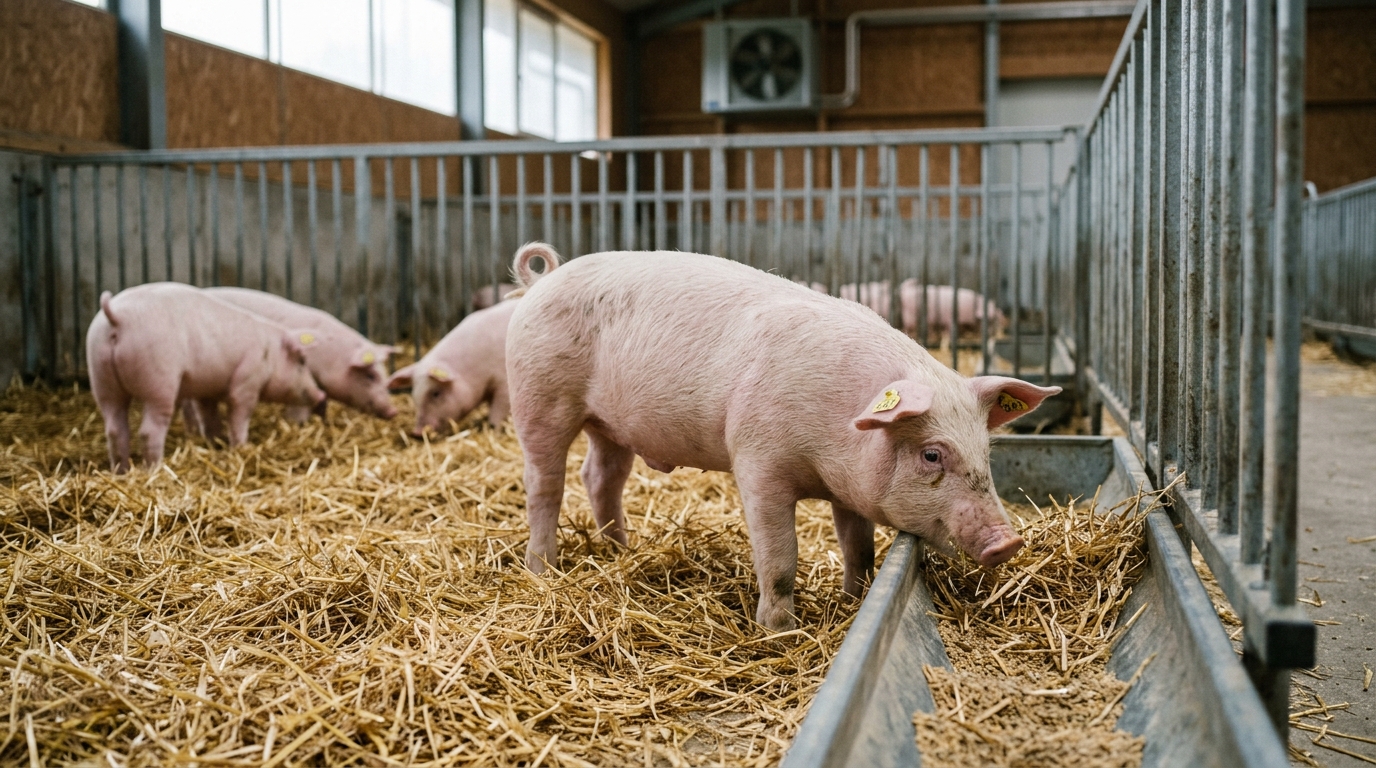
Housing conditions provided enriched standards exceeding basic regulatory requirements, enabling the producer to market pork under a national animal welfare label at a premium price. Pens featured 50 percent slatted concrete floors with straw bedding, supplemented daily with two handfuls of fresh straw per pen. Space allowance expanded from 0.26 square metres per pig during the initial three weeks to 0.52 square metres per pig thereafter. Pens were equipped with multiple enrichment materials, including a lick stone, a wooden beam, and a ceiling-suspended plastic toy, alongside ad libitum dry meal feeding through automatic feeders and eight nipple drinkers per pen.
The experimental setup evaluated two distinct magnesium sources across consecutive cohorts using a three-phase feeding programme consisting of basic feed and vitamin-mineral premixes. Batch 1 examined magnesium oxide supplementation across planned concentrations of 2, 4, 6, and 8 milligrams per kilogram of feed alongside an unsupplemented control. Batch 2 examined magnesium aspartate across dosages of 5, 40, 1000, and 2000 milligrams per kilogram of feed alongside an unsupplemented control. However, operational adjustments required excluding the 8 milligram per kilogram magnesium oxide group due to farmer preferences and the 40 milligram per kilogram magnesium aspartate group due to on-farm communication issues, leaving 191 animals in the first batch and 190 animals in the second batch for final analysis.
Blood sampling occurred at three key intervals: on day two of the rearing phase at approximately 29 days of age to avoid confounding sampling with arrival stress, after three weeks at approximately seven weeks of age, and after five weeks at approximately nine weeks of age. Blood was collected from the cranial vena cava while piglets were positioned on their backs at the first two intervals, and from the jugular vein using sling fixation at the final interval. Sampling protocols prioritised animal welfare, terminating attempts if an animal showed excessive agitation or if blood could not be drawn within three attempts, before serum was separated, frozen at minus 21 degrees Celsius, and analysed for magnesium and cortisol concentrations.
Trained observers systematically monitored pigs twice weekly on a pen level for tail, ear, and skin lesions, tail posture, and clinical signs of illness such as lameness, coughing, and diarrhoea. Lesion data were classified into binary categories of presence or absence for exact Pearson Chi-Square testing, while original severity categories distinguishing superficial and small lesions were tracked descriptively. Blood magnesium and cortisol levels were evaluated separately for each time point using one-way analysis of variance with Bonferroni adjustments for pairwise comparisons.
Circulating blood magnesium concentrations peaked at the initial sampling point across all groups, dropped significantly after three weeks in the rearing stable, and exhibited a slight rebound by nine weeks of age. Although statistically significant differences in blood magnesium were identified among treatment groups at all time points, no systematic dose-dependent pattern emerged. Crucially, baseline blood magnesium differed significantly among treatment groups in the magnesium aspartate batch on day two before supplemental diets were introduced, suggesting unmeasured variations in maternal milk supply, mineral uptake, or initial physiological baselines rather than treatment effects.
Physiological stress assessments based on serum cortisol concentrations did not indicate a therapeutic effect from magnesium supplementation. In the magnesium oxide trial, cortisol peaked at day two, declined after three weeks, and rose again at nine weeks, whereas the magnesium aspartate cohort showed no discernible pattern over time. The elevated initial cortisol concentrations reflected the conventional stress trajectory associated with weaning, separation, and hierarchy establishment among newly grouped piglets rather than treatment-induced mitigation, and magnesium dosing did not systematically attenuate these responses.
Overall tail lesion prevalence remained very low throughout the trial, with superficial damage peaking at 11 percent in the unsupplemented control group of the first batch at week seven, and no deep or severe lesions observed. While the higher magnesium aspartate dosages of 1000 and 2000 milligrams per kilogram were associated with lower ear lesion frequencies at week nine compared to lower doses, ear lesions generally followed a distinct epidemiological trajectory from tail lesions. The overall scarcity of tail damage likely reflected the farm’s generous space allowance, straw provision, and environmental enrichment, which maintained background aggression at minimal levels.
The universal drop in circulating magnesium observed across all pens around seven weeks of age coincides with the developmental window when tail biting outbreaks typically emerge in pigs with intact tails, supporting hypotheses that a secondary mineral deficit or postweaning refeeding challenge may temporarily constrain nutrient absorption. However, because blood magnesium levels never dropped below established physiological reference ranges into clinical hypomagnesemia, and neither supplement reliably curtailed lesion incidence, dietary magnesium supplementation alone appears insufficient to mitigate tail biting under practical commercial rearing conditions.
Several methodological constraints inherent to the commercial field setting shaped the trial’s execution and findings. Because researchers prioritized pig welfare over data collection, blood sampling was promptly halted whenever an animal became overly agitated or when extraction exceeded three attempts. Furthermore, blood collection techniques differed across sampling intervals based on piglet size and growth, shifting from handling pigs on their backs to draw from the cranial vena cava at 29 days and seven weeks of age, to using sling fixation to sample from the jugular vein at nine weeks. Although these shifts introduced technical variability, researchers noted that physical handling differences alone could not explain the marked initial drop in cortisol from time point one to time point two. Additionally, animals were evaluated on a pen level rather than through individual marking, preventing repeated-measures tracking of individual animals over time.
The low incidence of severe biting damage also distinguished the study from broader commercial pig production literature. Under typical conventional rearing conditions, tail lesion rates in the literature range from 15 to 66 percent and ear lesions from 11 to 72 percent, whereas enriched environments generally display lower rates of 8 to 41 percent for tails and 0.9 to 40 percent for ears. The trial facility already employed extensive preventative management strategies, including generous space allowances, fresh daily straw bedding, experienced stockmanship, and multiple manipulable enrichment items. Because tail biting cannot be artificially induced or predicted under experimental conditions, testing within working commercial operations remains essential despite operational trade-offs, such as the inability to implement a planned 10-milligram magnesium oxide cohort. Researchers also acknowledged that monitoring physical lesions served as an outcome-based proxy for biting, noting that directly observing tail and ear manipulation behaviors might have provided a more sensitive evaluation of emerging oral vices.
Study duration and supplementation protocols may also account for discrepancies with previous studies reporting positive stress-mitigating outcomes. Previous swine trials demonstrating measurable reductions in physiological stress markers frequently maintained magnesium supplementation over substantially longer periods, extending up to 115 days, whereas the current intervention lasted approximately five weeks postweaning. Reassuringly, elevated magnesium supplementation produced no adverse consequences on pig health or growth performance throughout the feeding trial. Given the substantial variation across published studies regarding chemical formulations, dosing regimens, and intervention timelines, the authors emphasized that standardized experimental protocols are urgently needed to clarify magnesium metabolism in young pigs and establish rigorous evidence-based nutritional guidelines for commercial herds.
Subject of Research: Effects of dietary magnesium supplementation on blood parameters and tail lesions in rearing pigs
Article Title: A pilot study on the effect of feed supplementation with magnesium oxide and magnesium aspartate on blood magnesium content and tail lesions in pigs under practical on-farm conditions
Article References: Jensen, C., Czycholl, I., Nison, P., Jacquerot, T., Sandøe, P., & Büttner, K. (2026). A pilot study on the effect of feed supplementation with magnesium oxide and magnesium aspartate on blood magnesium content and tail lesions in pigs under practical on-farm conditions. Porcine Health Management, 12(1), Article 45. https://doi.org/10.1186/s40813-026-00526-0
Image Credits: AI Generated
DOI: 10.1186/s40813-026-00526-0
Keywords: magnesium oxide, magnesium aspartate, tail biting, tail lesions, ear lesions, rearing pigs, blood magnesium, blood cortisol, undocked tails, swine welfare, feed supplementation, postweaning stress, commercial pig farming, pen enrichment, animal health
News Source: Ophelia Keating. (November 18, 2026). Magnesium Feed Supplements Do Not Consistently Reduce Tail Biting in Rearing Pigs. Scienmag.