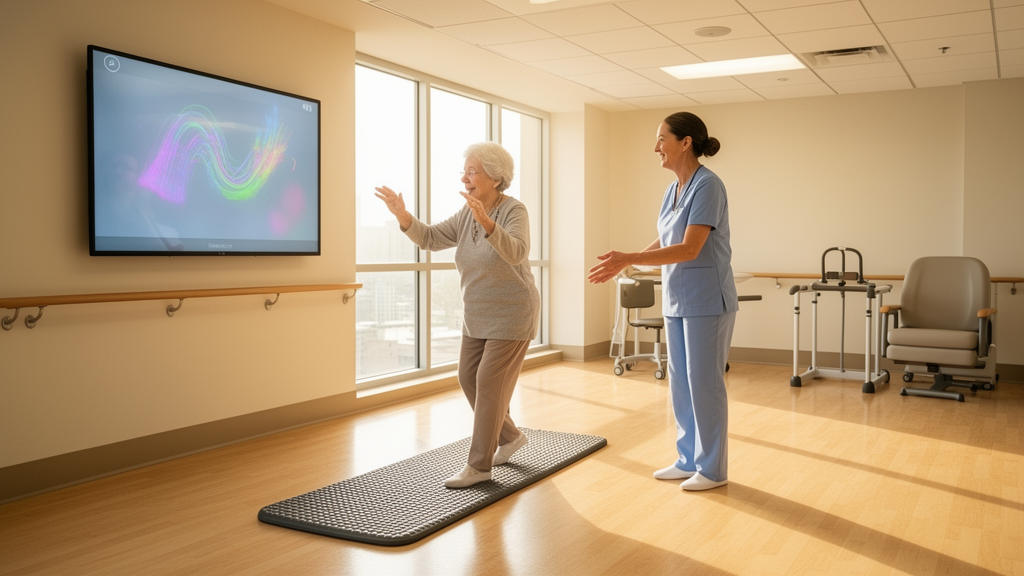
A machine-learning decision-support model utilizing clinically accessible patient data can predict exergaming ability among older residents of long-term care facilities who experience cognitive impairments, according to findings from a cross-sectional study published in the Journal of NeuroEngineering and Rehabilitation. The investigation, conducted by researchers including Moreno Sutter, Evrim Gökçe, Antoine Langeard, and Eleftheria Giannouli, evaluated whether automated computational tools could generate personalized recommendations for cognitive-motor training. When tested across twenty distinct interactive training games, the trained machine-learning model achieved a macro-averaged area under the receiver operating characteristic curve of 0.79 in cross-validation and maintained a discrimination metric of 0.77 on an independent held-out test set.
The research addresses significant clinical care challenges associated with Major Neurocognitive Disorder, a condition defined by progressive impairments across multiple cognitive domains. Within institutional environments, these compounding cognitive deficits frequently diminish personal autonomy, lower daily quality of life, and contribute directly to transitions into long-term residential care facilities. Cognitive-motor exergames, which integrate full-body physical movements with embedded cognitive tasks, have emerged as a promising intervention designed to slow physical and cognitive functional decline while preserving participant engagement. Despite this recognized potential, practical and personalized implementation strategies for matching specific games to vulnerable residents have remained largely unexplored.
To develop a reliable framework capable of tailoring initial game recommendations and anticipating assistance requirements, the investigators designed a cross-sectional study involving 100 residents living in long-term care settings. The participant cohort had an average age of 86.6 years and was predominantly female, accounting for 71 percent of the total sample. As anticipated for this residential population, the participating individuals exhibited substantial baseline cognitive and motor impairments. The research team systematically documented individual demographic characteristics alongside standardized functional evaluations, assessing cognitive performance through the Quick Mild Cognitive Impairment screen and evaluating baseline motor capabilities with the Short Physical Performance Battery.
During the empirical assessment phase, each participant completed a series of 20 exergames utilizing the Dividat Senso hardware platform. Throughout these gameplay sessions, researchers systematically documented each resident’s gameplay ability as well as the specific degree of verbal and physical assistance required to participate. Using these documented observations, the team trained a LightGBM machine-learning algorithm to predict both gameplay ability and assistance demands. The model calculated these predictions by integrating individual demographic features, cognitive assessment results from the Quick Mild Cognitive Impairment tool, physical scores from the Short Physical Performance Battery, and the unique identity of each individual game.
Subsequent explainability analyses demonstrated that individual game identity and Quick Mild Cognitive Impairment screening scores served as the most influential contributors to the algorithm’s predictions. The analysis revealed that individual game selection and cognitive status were substantially stronger determinants of gameplay ability than demographic variables or physical motor function. Although the model demonstrated robust discrimination when predicting overall gameplay ability, it exhibited lower performance when classifying the specific assistance needs of the residents. For predicting the required physical and verbal support, the model achieved area under the receiver operating characteristic curve values ranging between 0.67 and 0.71.
The study authors concluded that routine, clinically accessible functional data offer meaningful potential for guiding personalized, data-driven cognitive-motor training recommendations in long-term care facilities. Because the specific game and cognitive status emerged as primary drivers of performance, the authors emphasized the necessity of cognitively informed game selection over reliance on physical ability alone. Although the decision-support system demonstrated promising internally validated discrimination for initial game selection, the authors noted that larger and more diverse datasets remain essential to refine and optimize individualized recommendations for clinical assistance needs.
Subject of Research: Machine-learning decision support for personalized cognitive-motor exergaming in long-term care
Article Title: Toward personalized exergaming: a machine learning-based decision-support approach to cognitive-motor training for long-term care residents with cognitive impairments
Article References: Sutter, M., Gökçe, E., Langeard, A., & Giannouli, E. (2026). Toward personalized exergaming: a machine learning-based decision-support approach to cognitive-motor training for long-term care residents with cognitive impairments. Journal of NeuroEngineering and Rehabilitation. https://doi.org/10.1186/s12984-026-02174-5
Image Credits: AI Generated
DOI: 10.1186/s12984-026-02174-5
Keywords: machine learning, personalized exergaming, cognitive-motor training, long-term care, major neurocognitive disorder, cognitive impairment, LightGBM, Dividat Senso, Quick Mild Cognitive Impairment screen, Short Physical Performance Battery, clinical decision support, receiver operating characteristic curve, assistance needs prediction, gameplay ability, older adult care, cross-sectional study
News Source: Teresa Odom. (November 20, 2026). Machine Learning Predicts Exergame Ability for Residents With Cognitive Impairments. Scienmag.