Chemical engineers have developed an artificial neural network surrogate coupled with particle swarm optimization to model and optimize the uncatalyzed continuous synthesis of isoamyl acetate in a microreactor system. The process intensification framework balances the competing objectives of maximizing ester formation, reducing energy demands, and limiting unreacted reagents. By systematically evaluating machine learning architectures against experimental continuous-flow data, the research team established that surrogate-guided optimization can accurately map complex multivariable reaction spaces. This computational approach resolves the traditional friction between chemical conversion and operational heating and pumping requirements, offering a clear digital blueprint for continuous esterification without relying on added catalysts or organic solvents.
Isoamyl acetate, commonly identified as 3-methylbutyl acetate or isopentyl acetate, is a short-chain organic ester prized across flavor and fragrance sectors for its signature banana-like and pear aromatic profile. Beyond olfactory applications, its solvency parameters make it an important industrial solvent in coatings, paints, inks, adhesives, plastics, and wood finishes. Historically, industrial production has depended either on direct extraction from natural materials or conventional chemical esterification. Natural extraction suffers from low efficiency, raw material variation, and intensive purification hurdles, while conventional industrial synthesis depends on acid catalysts, ion-exchange resins, or auxiliary organic solvents. These traditional catalysts introduce significant equipment corrosion, generate corrosive aqueous waste streams requiring neutralization, and introduce operational and occupational hazards. Enzymatic pathways using lipases present a greener route but remain constrained by high enzyme costs and severe vulnerability to thermal denaturation outside tight temperature windows.
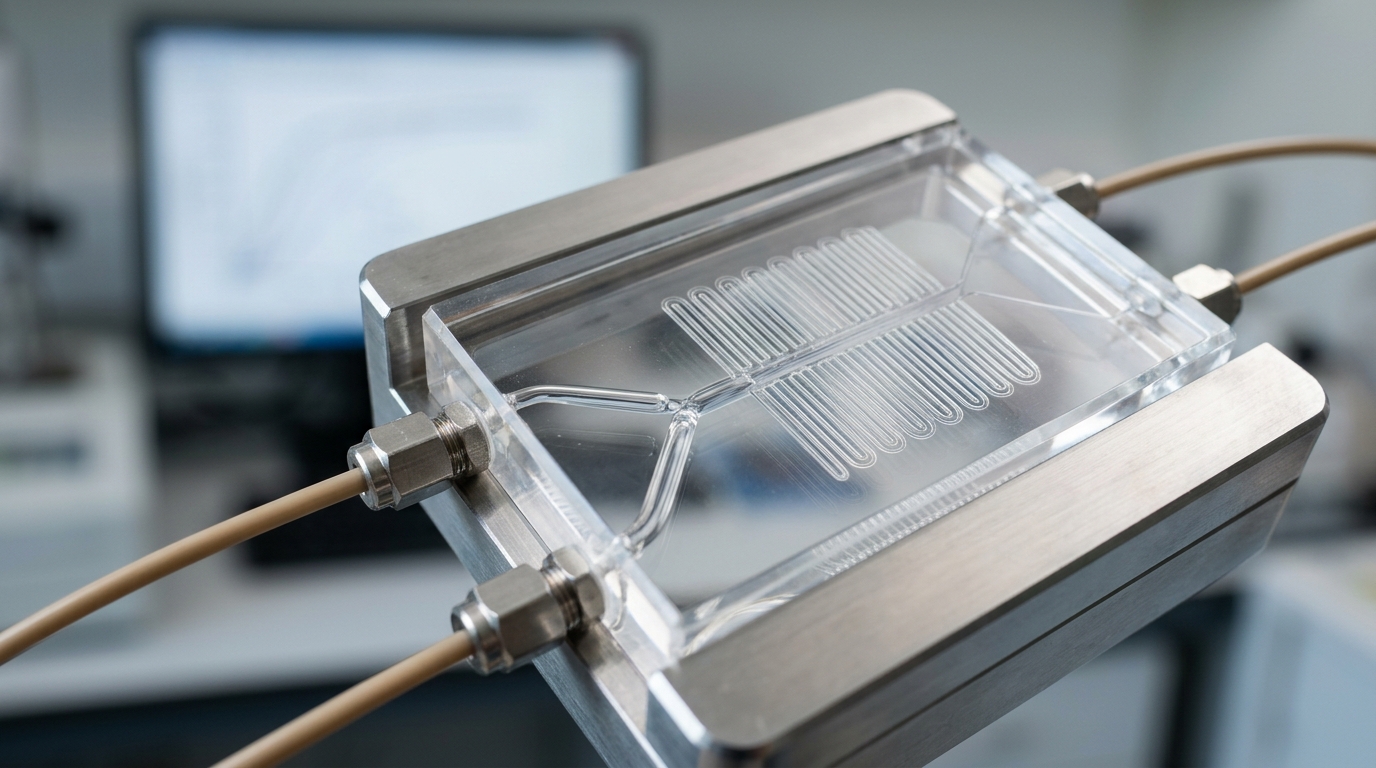
To bypass these manufacturing liabilities, researchers have focused on uncatalyzed esterification pathways that eliminate catalyst handling, simplify downstream product separation, and reduce overall environmental impact. Uncatalyzed reactions, however, are exceptionally sensitive to processing conditions and typically demand elevated temperatures to achieve viable kinetic rates. The Miniaturized Intensified Reactor platform mitigates these challenges by exploiting continuous microchannels. Microreactors provide high surface-area-to-volume ratios, remarkably short diffusion lengths, and exceptional heat and mass transfer capabilities that ensure precise thermal regulation during continuous processing. Furthermore, continuous microscale flow maintains low fluid holdup, which substantially enhances inherent process safety when handling reactive acetylating agents such as acetic anhydride. Despite these benefits, microreactor optimization has often focused solely on product yield while neglecting pumping power and thermal energy demands.
In the experimental phase, researchers investigated the liquid-phase acetylation of isoamyl alcohol using acetic anhydride under completely solvent-free conditions. The continuous setup utilized two programmable syringe pumps delivering reactants into a three-meter coiled polytetrafluoroethylene microtube immersed in a thermally stabilized circulating water bath. The capillary tubing featured an inner diameter of 1/32 inch and an outer diameter of 1/16 inch, corresponding to a wall thickness of 1/64 inch. Reactants met at an inlet T-junction at a fixed 2:1 molar ratio of isoamyl alcohol to acetic anhydride. Reaction temperatures spanned 65 to 85 degrees Celsius, while total fluid flow rates ranged between 14.4 and 327.9 microliters per minute, establishing residence times from 7.9 to 180.3 minutes. Reaction effluents were collected in capped vials and analyzed via gas chromatography equipped with a flame ionization detector and a specialized capillary column, using calibrated standards to determine the concentrations of isoamyl acetate, residual alcohol, and unreacted anhydride.
Because direct experimental mapping of multivariable continuous regimes is resource-intensive, the investigators developed a multiple-input multiple-output surrogate modeling framework. The surrogate models accepted three key process inputs—temperature, flow rate, and residence time—and predicted three simultaneous outputs: isoamyl acetate concentration, residual alcohol concentration, and residual acetic anhydride concentration. To overcome the constraints of a baseline dataset comprising eleven experimental points, the investigators applied a statistical bootstrapping technique in MATLAB. By drawing synthetic bootstrap datasets with replacement, the data volume was expanded fourfold to 44 points, preserving the underlying physical distribution while boosting data diversity. All inputs and outputs were normalized via z-score standardization before partitioning into 70 percent training, 15 percent validation, and 15 percent testing subsets.
The researchers evaluated three distinct machine learning regression paradigms under uniform data conditions: Decision Trees, Support Vector Machines, and Artificial Neural Networks. Predictive performance was quantified using the coefficient of determination alongside the root mean square error. Decision Tree regression demonstrated moderate performance, capturing broad trends with coefficients of determination between 0.652 and 0.792, but produced elevated root mean square errors ranging from 0.125 to 0.256 due to its piecewise-constant partitioning. Support Vector Machines modeled the smooth profiles of isoamyl acetate and acetic anhydride accurately, attaining coefficients of determination of 0.993 and 0.985 with errors of 0.044 and 0.064, respectively. However, Support Vector regression failed when tracking alcohol concentration, yielding a negative coefficient of determination of minus 0.156 and a root mean square error of 0.227, reflecting an inability to resolve nonlinear parameter interactions. Conversely, the feedforward Artificial Neural Network excelled uniformly, recording root mean square errors of 0.011 across all three chemical species alongside coefficients of determination between 0.998 and 0.999.
Capitalizing on its superior predictive accuracy, the team integrated the trained Artificial Neural Network surrogate into a single-objective Particle Swarm Optimization framework. In this architecture, swarm particles navigated the multidimensional search space within bounded experimental limits to identify global extrema without relying on mathematical derivatives. The total energy objective function explicitly accounted for the combined thermal duty required for sensible feed heating and the mechanical pumping work required to overcome hydraulic pressure drop. When configured strictly for energy minimization, the particle swarm algorithm converged to the boundary conditions of 65.0 degrees Celsius, a low flow rate of 7.0 microliters per minute, and a residence time of 22.5 minutes. Under this regime, total power consumption dropped to 12.67 milliwatts, yielding a predicted ester concentration of 1.18 moles per liter and a residual alcohol concentration of 3.98 moles per liter.
Shifting the single-objective algorithm to ester maximization revealed sharp thermodynamic and operational contrasts. The particle swarm converged to a temperature of 72.36 degrees Celsius, a flow rate of 10.53 microliters per minute, and the maximum residence time limit of 100.0 minutes. Under these parameters, the surrogate predicted an ester concentration of 2.70 moles per liter, reaching the upper physical plateau of the experimental dataset while reducing residual alcohol concentration to 3.30 moles per liter. However, sustaining this extended residence time and elevated thermal state increased power consumption to 22.50 milliwatts. A third single-objective formulation targeting alcohol minimization converged to 80.08 degrees Celsius, 79.52 microliters per minute, and a short residence time of 4.40 minutes. This generated an ester concentration of 2.42 moles per liter but drove total power consumption to an intensive 197.54 milliwatts, proving that optimizing solitary reaction parameters drives severe operational penalties.
To systematically address these conflicts, the investigators deployed multi-objective Particle Swarm Optimization to generate non-dominated Pareto fronts. When evaluating the bi-objective optimization of power consumption against residual alcohol minimization, the algorithm produced a continuous trade-off curve bounded by the minimum-energy point of 12.67 milliwatts at 3.61 moles per liter of alcohol and the minimum-alcohol point of 16.89 milliwatts at 3.30 moles per liter of alcohol. Implementing a fuzzy logic membership decision-making protocol identified an optimal knee point along the Pareto curve at 15.21 milliwatts and 3.44 moles per liter of alcohol. Transitioning from the minimum-energy configuration to this fuzzy trade-off solution required only 2.5 milliwatts of additional power to achieve a 4.7 percent drop in unreacted alcohol, whereas pursuing absolute alcohol minimization required an energy increase exceeding 30 percent.
A parallel bi-objective Pareto analysis simultaneously balancing energy minimization and isoamyl acetate maximization spanned power requirements from 12.67 milliwatts up to 37.47 milliwatts, with ester concentrations climbing from 1.74 to 2.70 moles per liter. Applying fuzzy logic membership scoring revealed a highly practical compromise solution located at 16.37 milliwatts that yielded an ester concentration of 2.49 moles per liter. This balanced operating state captured more than 90 percent of the maximum attainable chemical conversion while consuming less than half the energy demanded by the unconstrained ester-maximizing scenario. Response surface mapping demonstrated that sensible heating duty and hydraulic pumping power scaled nearly linearly with temperature and throughput, whereas chemical conversion displayed saturation behavior governed by microreactor residence time.
The study highlights specific physical boundaries and methodological considerations inherent to surrogate-assisted microreactor modeling. The authors emphasize that direct numerical comparisons of absolute power figures with external literature remain challenging, as microchannel materials, specific geometries, external heating bath dynamics, and fluidic pressure characteristics differ widely among experimental designs. Furthermore, the reported optima represent validated surrogate-model predictions strictly bound within the experimental envelope, as additional physical validations at the specific mathematical optimal coordinates were reserved for future studies. Nevertheless, this work confirms that coupling artificial neural networks with particle swarm optimization provides an effective, data-efficient framework for intensifying continuous uncatalyzed esterification, establishing a quantitative foundation for energy-efficient microscale chemical manufacturing.
Subject of Research: Optimization of uncatalyzed continuous microreactor esterification using machine learning and particle swarm algorithms
Article Title: Surrogate-particle swarm optimization of uncatalyzed esterification of acetic anhydride with isoamyl alcohol in a microreactor system in reducing energy
Article References: Rohman, F. S., Muhammad, D., Azudin, N. Y., Azmi, A., Sheng, L. C., Termizi, S. N. A. A., & Shukor, S. R. A. (2026). Surrogate-particle swarm optimization of uncatalyzed esterification of acetic anhydride with isoamyl alcohol in a microreactor system in reducing energy. Discover Chemical Engineering, 6(1), Article 20. https://doi.org/10.1007/s43938-026-00124-0
Image Credits: AI Generated
DOI: 10.1007/s43938-026-00124-0
Keywords: microreactor technology, process intensification, isoamyl acetate, particle swarm optimization, artificial neural networks, uncatalyzed esterification, chemical engineering, green chemistry, Surrogate-particle, swarm, optimization, uncatalyzed
News Source: Bethany Barker. (November 8, 2026). Machine Learning Optimizes Uncatalyzed Isoamyl Acetate Synthesis in Continuous Microreactors. Scienmag.