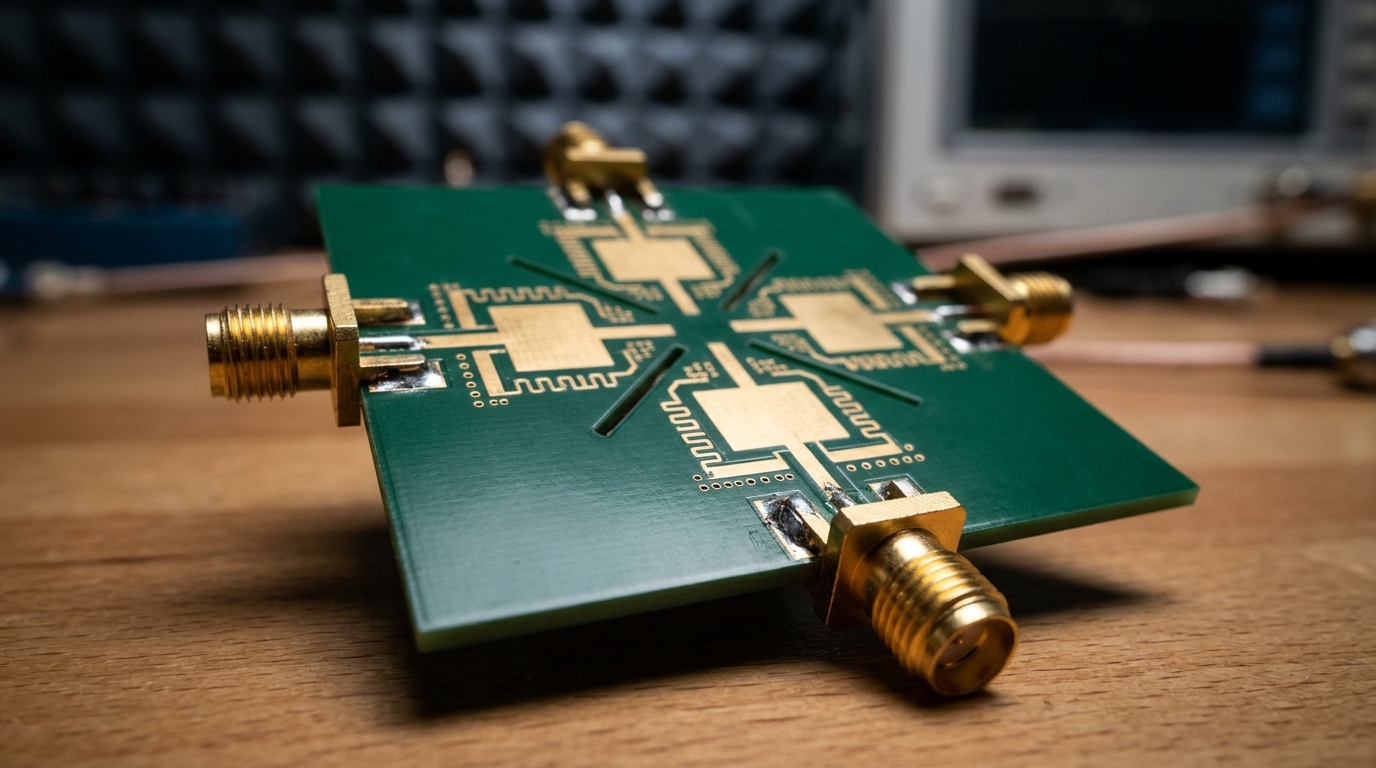
Researchers Laxmikant K. Shevada, Javed Sayyad, and Sumit Kumar have developed a miniature four-port ultra-wideband multiple-input multiple-output antenna array optimized through a machine learning framework, achieving inter-element isolation exceeding twenty decibels across its operational bandwidth. The initial single-element design occupies compact physical dimensions of sixteen millimeters by fourteen millimeters by 1.575 millimeters on a Rogers RT/Duroid 5880 dielectric substrate, incorporating two semicircular slots and a stepped ground structure to secure reflection coefficients below negative ten decibels. Extending this optimized base unit into a symmetrical four-port multiple-input multiple-output configuration produces an overall footprint of thirty-six millimeters by thirty-six millimeters by 1.575 millimeters. Operating from 5.9 gigahertz to 10.6 gigahertz, the assembly covers the X-band spectrum for military communications satellites, radar installations, weather monitoring, and air traffic control. By integrating an ensemble Random Forest algorithm into the design workflow, the team established an efficient methodology for rapidly predicting antenna parameters and optimizing physical dimensions without repetitive simulations.
Ultra-wideband wireless communication has attracted widespread attention because a single broadband antenna can accommodate diverse transmission frequencies, eliminating the requirement for multiple narrowband components while reducing system cost. Although the proposed configuration functions from 5.9 to 10.6 gigahertz rather than the entire commercial ultra-wideband allocation, its absolute impedance bandwidth of 4.7 gigahertz comfortably satisfies this definition, making it suitable for upper-band communications and sensing. However, packing several radiating elements into a miniaturized multiple-input multiple-output system introduces severe mutual coupling. Electromagnetic interactions between closely spaced radiators degrade antenna impedance matching and worsen diversity metrics such as the envelope correlation coefficient and diversity gain. Furthermore, at elevated frequencies where electromagnetic wavelengths shorten, surface currents propagating across shared ground planes severely limit the decoupling efficacy of conventional spatial separation methods.
To overcome mutual coupling barriers while keeping dimensions small, the investigation began with synthesizing a single-element radiator modeled in ANSYS High Frequency Structure Simulator. Fabricated on a Rogers RT/Duroid 5880 substrate featuring a dielectric constant of 2.2 and thickness of 1.575 millimeters, the radiator uses a quarter-wave square monopole patch fed by a three-millimeter fifty-ohm microstrip line. The layout evolved across four successive iterations, designated ANT 1 through ANT 4. Starting from a basic rectangular patch and continuous ground, the researchers etched two semicircular slots into the radiating element and modified the ground plane into a staircase geometry. Parametric analysis of the semicircular slot radius from 1.4 to 1.7 millimeters showed that slots alter surface current paths to widen impedance bandwidth. Concurrently, varying the stepped ground dimensions from 0.2 to 0.5 millimeters modified fringing fields near the feedline, reducing unwanted current concentrations along boundary margins and securing a reflection coefficient below negative ten decibels across seven to 10.6 gigahertz.
Building upon the optimized single element, the researchers structured a four-port multiple-input multiple-output array measuring thirty-six by thirty-six millimeters on the same substrate. To mitigate mutual coupling arising from adjacent radiating elements, the authors conducted parametric analyses on stub dimensions and inter-element spacing. Methodical adjustments of chopped stub dimensions between 1.2 and 1.5 millimeters demonstrated that stubs improve port isolation without compromising radiation characteristics or bandwidth. Concurrently, parametric sweeps identified an optimal inter-element spacing of twelve millimeters, achieving substantial isolation enhancement while maintaining a compact physical footprint. An equivalent circuit model developed for the decoupling structure elucidates the resonance and coupling behavior of the array. The semicircular slots lengthen effective surface current paths, introducing reactive loading that excites secondary resonant modes alongside the fundamental resonance. Meanwhile, the stepped ground structure alters radiator-to-ground capacitive coupling, and an inductive-capacitive branch captures residual inter-port electromagnetic interactions, ensuring broad impedance bandwidth and stable operating characteristics.
To evaluate the proposed isolation strategy, the authors performed a comparative analysis between orthogonal and non-orthogonal four-port array configurations. In the non-orthogonal arrangement, co-polarized elements placed in parallel alignment experience severe near-field electromagnetic interactions, causing considerable field overlap that perturbs input impedance and degrades return-loss characteristics. In contrast, the orthogonal configuration introduces polarization diversity and field orthogonality, substantially reducing electric and magnetic field overlap between adjacent units. Numerical results demonstrated that orthogonal placement suppresses induced currents on neighboring elements, thereby minimizing impedance perturbations and preserving reflection characteristics across the working spectrum. Furthermore, while the non-orthogonal model exhibited excessive mutual coupling, the orthogonal array maintained isolation values greater than twenty decibels across the operational band, with isolation increasing to forty to forty-five decibels at higher frequencies. Remarkably, this high isolation was attained without incorporating external decoupling mechanisms such as neutralization lines, electromagnetic bandgap structures, metamaterials, dielectric walls, or parasitic elements, simplifying fabrication on standard printed circuit boards.
Surface current distribution analyses carried out with port one excited and remaining ports terminated in fifty-ohm matched loads further clarified these decoupling mechanisms. In the non-orthogonal design, parallel polarization produces intense induced currents on adjacent radiating patches. In contrast, the orthogonal configuration dramatically attenuates induced currents by orienting neighboring patches perpendicularly, minimizing mutual electromagnetic field overlap. Furthermore, the antenna incorporates an isolated, non-common ground structure rather than a continuous reference plane. Because surface-current propagation across a shared ground severely worsens coupling at short ultra-wideband wavelengths, electrically separating ground regions removes the primary conductive path responsible for inter-port interaction. Complementing this isolated ground, the integrated high-impedance stubs function as reactive barriers against coupling currents. At operational frequencies, these stubs present high-impedance pathways that block and attenuate unwanted current flows between elements. This shifts surface current distributions to confine electromagnetic energy tightly around the excited patch, substantially reducing the energy that couples into adjacent terminals.
Experimental verification of the fabricated single-element and four-port antennas was performed using laboratory testing systems. Scattering parameters were measured with a calibrated Vector Network Analyzer across the operational band, applying standard short-open-load-thru two-port calibration to eliminate systematic measurement errors. Individual ports were excited sequentially while unexcited ports remained terminated in fifty-ohm matched loads, with measured data exported in Touchstone format for comparative analysis against simulation models. Far-field radiation patterns were measured inside a fully anechoic chamber measuring six by four by four meters lined with radio-frequency absorbers to eliminate reflections and external interference. The antenna under test was mounted on a computer-controlled positioner and evaluated against an ETS-Lindgren 3117 standard gain horn antenna operating linearly from one to eighteen gigahertz with ten to fifteen dBi nominal gain. Measurement distances complied with the Fraunhofer far-field criterion, with overall measurement uncertainties estimated within plus or minus 0.5 decibels for gain and plus or minus three percent for radiation efficiency.
Measured antenna characteristics showed close agreement with simulation findings across the 5.9 to 10.6 gigahertz operating range, covering X-band military communications satellite frequencies between 7.2 and 10.5 gigahertz. The four-port antenna demonstrated stable, nearly omnidirectional radiation patterns in both principal planes at eight, nine, and ten gigahertz, with peak realized gain reaching eight dBi and radiation efficiency ranging between seventy-five and ninety-seven percent. Crucial multiple-input multiple-output diversity parameters derived from measured scattering data further validated performance. The envelope correlation coefficient remained below 0.006 across the entire operational band, easily satisfying the strict practical threshold of 0.05 and the standard benchmark of 0.5. Diversity gain reached approximately 10 dB, maintaining values greater than 9.99 dB throughout the band. Additionally, total active reflection coefficient values remained below negative ten decibels, and channel capacity loss stayed under 0.2 bits per second per hertz, well beneath the acceptable limit of 0.4 bits per second per hertz.
To accelerate design synthesis without relying on repetitive full-wave solvers, the authors implemented a Random Forest machine learning framework to model antenna behavior. The training dataset was developed in ANSYS High Frequency Structure Simulator by systematically varying nine structural parameters across specified increments, generating 8,300 discrete simulation samples. The dataset was partitioned into 6,640 development samples and 1,660 independent test samples at an eighty-to-twenty ratio. Using one hundred decision trees, the Random Forest model was trained on the development partition with five-fold cross-validation before final evaluation on the unseen test dataset. The model accurately captured the nonlinear relationships between geometrical variables and high-frequency electromagnetic responses, achieving coefficients of determination exceeding 0.99 for reflection coefficient, isolation, and radiation efficiency. Consistency between cross-validation and independent test results, coupled with low mean squared error and mean absolute error values, confirmed the stability of the model. Furthermore, tree-to-tree variability analysis demonstrated low prediction uncertainty across test samples, with radiation efficiency exhibiting the highest predictive precision.
Performance comparisons with other optimization techniques underscored the computational efficiency of the Random Forest framework. While conventional metaheuristic algorithms—such as Genetic Algorithms, Particle Swarm Optimization, Differential Evolution, and Simulated Annealing—required between 680 and 920 full-wave evaluations, the Random Forest strategy converged upon optimal parameters with only 150 evaluations. This achieved a major reduction in computing cost while securing an optimal objective value of 0.98, yielding an optimized reflection coefficient of negative 28.2 decibels, isolation of 26.1 decibels, and radiation efficiency of 95.2 percent. The authors noted that achieving high isolation through element orientation and ground shaping avoids complex decoupling add-ons like neutralization lines or electromagnetic bandgap structures, allowing cost-effective single-layer printed circuit board manufacturing. Future work will focus on expanding operational bandwidth toward sub-6 gigahertz 5G bands and integrating advanced machine learning techniques to refine optimization accuracy, demonstrating how data-driven surrogates facilitate compact multi-antenna design for next-generation wireless communications.
Subject of Research: Miniature ultra-wideband MIMO antenna design and machine learning optimization
Article Title: Design and optimization of a miniature UWB MIMO antenna using machine learning for high-isolation wireless applications
Article References: Shevada, L. K., Sayyad, J., & Kumar, S. (2026). Design and optimization of a miniature UWB MIMO antenna using machine learning for high-isolation wireless applications. Discover Artificial Intelligence, 6(1), Article 1968. https://doi.org/10.1007/s44163-026-02867-9
Image Credits: AI Generated
DOI: 10.1007/s44163-026-02867-9
Keywords: ultra-wideband antenna, MIMO antenna, Random Forest algorithm, machine learning optimization, inter-element isolation, envelope correlation coefficient, diversity gain, total active reflection coefficient, channel capacity loss, X-band communications, high-impedance stubs, polarization diversity, stepped ground plane, vector network analyzer, anechoic chamber measurement, radiation efficiency, Rogers RT Duroid 5880
News Source: Teresa Odom. (November 26, 2026). Machine Learning Model Optimizes Miniature Four-Port Antenna for High-Isolation Wireless Systems. Scienmag.