Convective hot-air drying experiments coupled with machine learning algorithms have revealed how operating temperatures and airflow rates dictate the biochemical preservation, physical characteristics, and energy demands of dehydrated banana slices. Investigating banana processing within an insulated drying chamber, researchers determined that varying thermal levels between forty and sixty degrees Celsius and airflow velocities between one and two meters per second significantly alter moisture loss trajectories and phytochemical stability. While intense convective conditions accelerated drying rates and curtailed overall specific energy consumption, they simultaneously provoked non-enzymatic browning and accelerated the degradation of heat-sensitive bioactive compounds. To model these intricate non-linear relationships, the investigative team benchmarked three computational approaches consisting of artificial neural networks, support vector regression, and k-nearest neighbors. Across cross-validated evaluations, support vector regression models achieved superior predictive precision for key biochemical indices, demonstrating that data-driven algorithmic frameworks can accurately forecast rehydration capacity, phenolic retention, and flavonoid concentration to optimize industrial dehydration protocols.
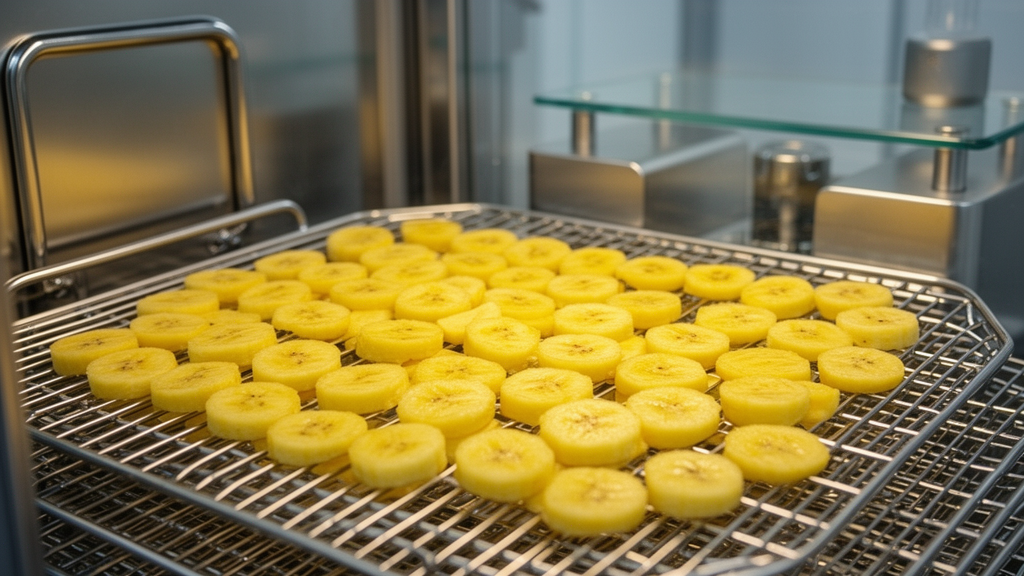
The empirical investigation utilized ripe Cavendish bananas selected at a standardized green tip ripeness stage, corresponding to USDA color index five, free from mechanical damage or insect infestation. Prior to thermal processing, the raw fruit was stabilized for four hours at twenty-five degrees Celsius, peeled, and sliced to a precise thickness of five millimeters verified through triplicate caliper measurements. Drying operations took place inside a custom stainless-steel drying chamber measuring forty by forty by fifty centimeters, insulated with five centimeters of external material and heated by controlled one-point-five kilowatt electric elements. A variable-speed fan generated regulated air velocities monitored by thermocouples and anemometers across an experimental matrix combining temperatures of forty, fifty, and sixty degrees Celsius with airflows of one, one-point-five, and two meters per second. For each test run, a three-hundred-gram thin layer of prepared slices rested on a wire mesh tray, where automated load-cell instrumentation recorded continuous mass reductions at ten-minute intervals until sample weight stabilized.
Analysis of drying kinetics indicated that moisture ratio values decreased continuously and non-linearly across all tested regimes, transitioning from initial hydration toward equilibrium through characteristic falling-rate behavior. Operating temperature exerted the dominant influence over moisture removal velocity, as elevated temperatures augmented internal water diffusion and heightened vapor pressure differentials at the fruit slice surface. At an airflow velocity of two meters per second, reaching near-equilibrium moisture required two hundred and twenty minutes at forty degrees Celsius, dropping to one hundred and sixty minutes at fifty degrees, and completing in approximately one hundred and twenty minutes at sixty degrees. Increasing air velocity from one to two meters per second further accelerated evaporation by reducing boundary layer resistance around the fruit slices, though this aerodynamic influence proved most pronounced during initial drying phases before internal diffusion became the primary rate-limiting mechanism. Final moisture determinations conducted via conventional oven desiccation at one hundred and five degrees confirmed residual moisture levels of approximately five percent on a wet basis.
Thermal and aerodynamic conditions significantly influenced surface coloration, causing noticeable darkening alongside an increase in redness and a decline in yellowness. Spectrophotometric colorimeter measurements recorded reductions in lightness and yellowness coordinates accompanied by increases in redness values and overall color difference metrics as drying temperatures climbed toward sixty degrees Celsius. These chromatic shifts were primarily driven by non-enzymatic Maillard browning reactions, in which reducing sugars such as glucose and fructose condensed with available amino acids under thermal acceleration to form intermediate Schiff bases and Amadori products. Subsequent polymerization yielded brown melanoidin pigments that altered tissue reflectance, while elevated airflow exacerbated color shifts by facilitating heat transfer and convective reactant mobility throughout the fruit matrix. Concurrently, thermal stress induced the degradation of residual chlorophyll and carotenoid pigments according to first-order kinetic pathways, generating dull pheophytin derivatives that further reduced product luminosity and visual brightness across aggressively dried batches.
Structural integrity and reconstitution potential, quantified through rehydration ratios, displayed a complex response to convective drying parameters. Rehydration values experienced an unexpected decline across all airflow velocities at fifty degrees Celsius before partially recovering at sixty degrees, with the highest overall rehydration performance achieved under the gentle thermal condition of forty degrees combined with an airflow of two meters per second. Researchers attributed the intermediate decline at fifty degrees to surface case hardening, which established a dense outer barrier that obstructed rehydration fluid penetration, whereas higher thermal stress at sixty degrees generated internal microfractures that enhanced matrix porosity. In parallel, water activity dropped systematically as temperatures rose from forty to fifty degrees, reaching an absolute minimum under fifty degrees Celsius and one-point-five meters per second of airflow. Minor water activity rebounds observed at sixty degrees reflected structural collapse and solute migration that liberated previously bound cellular water without compromising overall preservation safety.
Biochemical assessments revealed that the retention of bioactive secondary metabolites was highly sensitive to thermal exposure and convective air movement. Total phenolic content, quantified through Folin-Ciocalteu spectrophotometric assays using gallic acid standards at seven hundred and fifty nanometers, reached a maximum concentration of two hundred and twenty-six milligrams per gram at forty degrees Celsius and one meter per second. Conversely, exposure to sixty degrees Celsius and two meters per second degraded phenolic compounds to a minimum of one hundred and twelve milligrams per gram. Total flavonoid content, measured via aluminum chloride colorimetry at four hundred and fifteen nanometers against quercetin calibration curves, ranged from two hundred and eighty-nine down to two hundred and forty-five milligrams per gram, attaining its highest retention under identical low-temperature, low-velocity conditions. While prolonged exposure under low airflow extended drying duration, higher temperatures and rapid air streams accelerated oxidative and thermal degradation of fragile flavonoid skeletons and phenolic hydroxyl groups.
Evaluation of energetic requirements established specific energy consumption as an essential benchmark for processing efficiency, determined by dividing total electrical kilowatt-hours by the mass of evaporated water. Specific energy consumption varied widely across the nine experimental combinations, peaking at fifteen-point-ninety-seven kilowatt-hours per kilogram under forty degrees Celsius and one meter per second, where sluggish heat transfer prolonged drying durations and produced continuous chamber heat loss. Conversely, raising air velocity to two meters per second at sixty degrees Celsius minimized energy demand to seven-point-zero-six kilowatt-hours per kilogram, as rapid surface evaporation and accelerated moisture diffusion substantially shortened the total operational cycle. At an intermediate airflow rate of one-point-five meters per second, elevating the drying temperature from forty to sixty degrees reduced specific energy expenditure to eight-point-fifteen kilowatt-hours per kilogram. These findings illustrate that although higher temperature and airflow increase immediate electrical power draw, their ability to compress total drying time dramatically lowers net cumulative energy consumption per kilogram of removed water.
To untangle the intricate interactions governing physicochemical alterations, the investigators conducted principal component analysis across the experimental datasets. The first two principal components captured seventy-eight-point-forty-eight percent of the total cumulative variance, with the first component accounting for sixty-point-thirty-eight percent and the second representing eighteen-point-ten percent, satisfying standard thresholds for robust variance explanation. Total phenolic content, total flavonoid content, drying duration, and water activity clustered positively along the primary axes, demonstrating that extended drying times at moderate temperatures maintained favorable correlations with bioactive retention. In contrast, total color change exhibited a strong negative association with product quality metrics, while specific energy consumption displayed a pronounced positive correlation of zero-point-ninety-one with the first principal component. Correlation matrix evaluations confirmed that drying intensity directly governed cellular shrinkage and pigment darkening, demonstrating that intermediate operational parameters, particularly fifty degrees Celsius coupled with one-point-five meters per second, provided an optimal compromise among nutritional preservation, structural stability, and water activity reduction.
The research team systematically benchmarked artificial neural networks, support vector regression, and k-nearest neighbors to predict rehydration ratio, phenolic content, and flavonoid content from processing temperature, airflow velocity, and drying time. Utilizing twenty-seven experimental samples partitioned into seventy percent training, fifteen percent validation, and fifteen percent testing subsets alongside five-fold cross-validation, the algorithms demonstrated distinct predictive proficiencies across the biochemical targets. Within the neural network architectures, a three-eight-eight-one multilayer perceptron delivered the highest accuracy for phenolic retention, while a three-ten-one topology estimated rehydration ratios with a determination coefficient of zero-point-ninety-eight-forty-two and root mean square error of zero-point-zero-four-sixty-seven. For k-nearest neighbors, optimal performance occurred at neighborhood sizes of three for phenolics, eleven for flavonoids, and one for rehydration. However, support vector regression achieved overall superior performance; normalized Pearson universal kernels best predicted phenolic retention with a zero-point-ninety-eight-sixty coefficient of determination and rehydration ratio, while radial basis function kernels most effectively captured non-linear flavonoid degradation dynamics.
The resulting predictive models demonstrate significant utility as decision-support instruments for commercial fruit dehydration, allowing operators to simulate finished product quality without executing cost-prohibitive physical trials. Nevertheless, the authors identified several key methodological limitations within the study, including the omission of formal texture profile analysis, sensory evaluation panels, and volatile aromatic compound tracking, which represent critical parameters for consumer market acceptance. Furthermore, the absence of microstructural imaging restricted direct visualization of cellular pore formation and thermal collapse mechanisms, while the machine learning models relied upon a relatively compact twenty-seven-sample dataset derived exclusively from a single Cavendish cultivar. Future investigations should expand experimental parameters across diverse banana varieties, integrate advanced deep learning and ensemble modeling techniques, and explore microstructural dynamics to enhance algorithmic generalizability. Refining these data-driven methodologies will support automated, real-time supervision in commercial drying facilities, enabling manufacturers to balance energy efficiency with maximum nutritional retention.
Subject of Research: Convective hot-air drying kinetics, biochemical retention, and machine learning prediction in banana slices
Article Title: Combined Effects of Temperature and Airflow on Biochemical Properties and Energy Consumption of Banana Slices During Convective Hot Air Drying: Application of Machine Learning Approaches
Article References: El‐Mesery, H. S., Jibril, A. N., Mabusela, B., Hu, Z., Mahdi, A. A., & Abdel‐Fattah, A. N. (2026). Combined Effects of Temperature and Airflow on Biochemical Properties and Energy Consumption of Banana Slices During Convective Hot Air Drying: Application of Machine Learning Approaches. Food Science & Nutrition, 14(11), Article e72375. https://doi.org/10.1002/fsn3.72375
Image Credits: AI Generated
DOI: 10.1002/fsn3.72375
Keywords: convective hot-air drying, banana slices, Cavendish bananas, support vector regression, artificial neural networks, k-nearest neighbors, total phenolic content, total flavonoid content, rehydration ratio, water activity, specific energy consumption, principal component analysis, drying kinetics, Maillard reaction, moisture ratio, food engineering, Pearson universal kernel, radial basis function
News Source: Teresa Odom. (November 21, 2026). Machine Learning Identifies Optimal Temperature and Airflow for Drying Banana Slices. Scienmag.