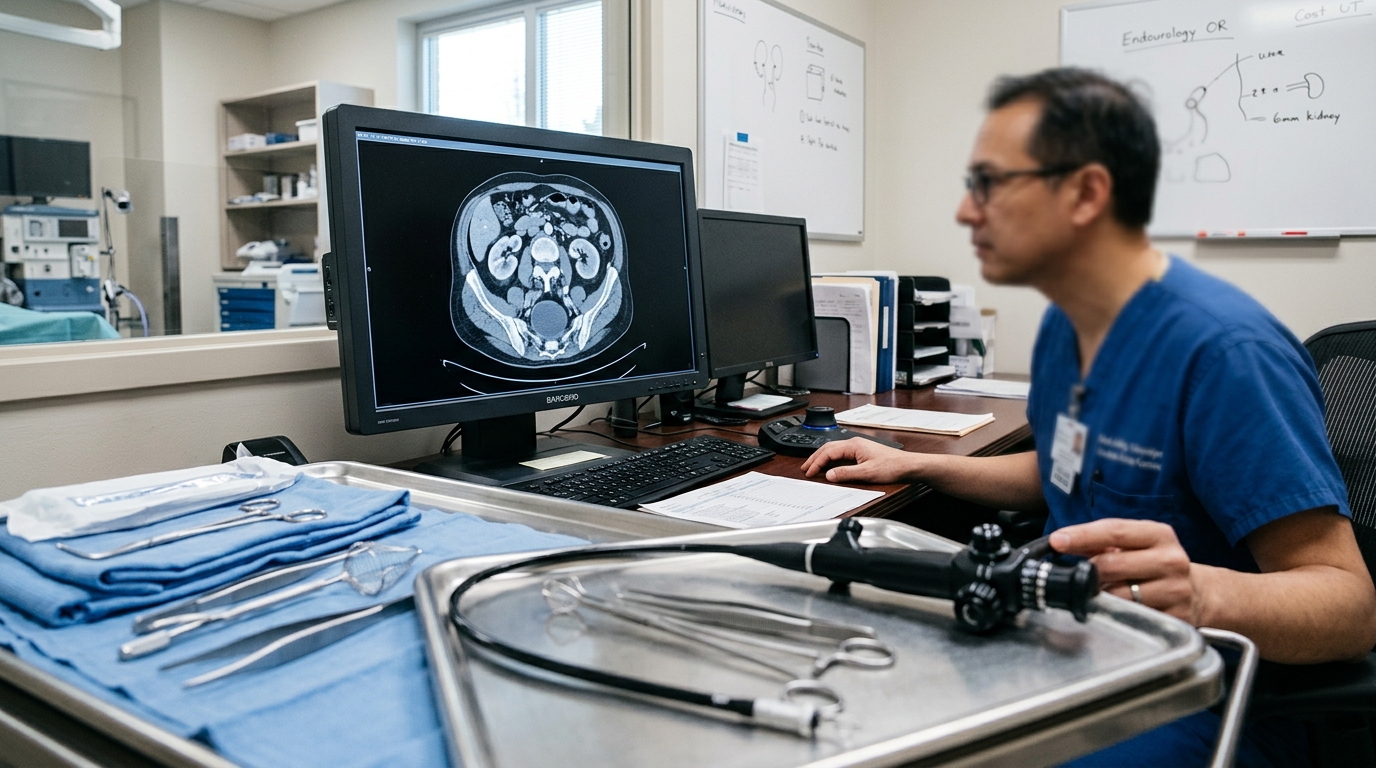
A machine-learning model developed using routine clinical and non-contrast computed tomography features accurately predicted impacted ureteral stones in patients undergoing ureteroscopic treatment, according to a retrospective two-centre study. Conducted by researchers across multiple institutions, the study evaluated algorithmic approaches to preoperatively identify stone impaction. The investigation demonstrated that a random forest model retained high diagnostic discrimination across internal validation and an independent external cohort, offering a potential tool for procedural planning in surgical urology.
Preoperative identification of impacted ureteral stones is clinically valuable because it may inform surgical strategies and procedural preparation. In this study, the research team examined whether readily available non-contrast computed tomography metrics and clinical variables could reliably predict stone impaction prior to intervention. The investigated clinical outcome was defined as intraoperative surgeon-reported stone impaction established according to a predefined operative criterion during ureteroscopy.
The study design involved a retrospective analysis of clinical, laboratory, operative, and preoperative non-contrast computed tomography data collected from two medical centres: the First Affiliated Hospital of Jinzhou Medical University and Huludao Central Hospital. The cohort comprised consecutive adult patients aged 18 to 80 years who underwent ureteroscopic stone treatment. All included individuals had complete diagnostic imaging, clinical records, and intraoperative outcome documentation to ensure data integrity during model development and validation.
To build and evaluate the predictive architecture, the investigators assessed nine machine-learning algorithms using a nested framework consisting of five-fold outer cross-validation repeated five times. All critical pipeline operations—including predictor variable selection, data preprocessing, hyperparameter tuning, and algorithm selection—were strictly restricted to the corresponding training partitions. A random forest algorithm emerged as the primary model, having been selected in 8 of the 25 outer-training resamples based on training-stage selection frequency.
Following selection, the final random forest model was refitted on the entire development cohort and then applied to the external validation cohort without any subsequent retraining or recalibration. Through this process, the model selected and retained six key preoperative predictive features: patient flank pain, stone attenuation, proximal ureteral width, ureteral wall thickness, stone length, and hydronephrosis area. Post-hoc model interpretability was evaluated using Shapley Additive exPlanations, which revealed that ureteral wall thickness provided the largest mean absolute attribution toward the model’s predictions.
In the primary study sample, stone impaction was identified in 209 patients within the development cohort, representing an incidence rate of 38.3 percent. In the external validation cohort, impaction occurred in 38 patients, accounting for 37.6 percent of the sample. The nested out-of-fold patient-level area under the receiver operating characteristic curve for the random forest model reached 0.917, with a 95 percent confidence interval of 0.893 to 0.941, outperforming standard logistic regression, which achieved an area under the curve of 0.909 with a 95 percent confidence interval of 0.883 to 0.935.
When evaluated on the independent external testing population, the random forest model demonstrated strong discrimination, achieving an area under the receiver operating characteristic curve of 0.970 with a 95 percent confidence interval ranging from 0.941 to 0.999. Diagnostic sensitivity in the external group was recorded at 0.921, with a 95 percent confidence interval of 0.786 to 0.983, while diagnostic specificity reached 0.873, with a 95 percent confidence interval of 0.765 to 0.944. Applying a predetermined fixed probability threshold of 0.50 resulted in eight false-positive classifications and three false-negative classifications within the external validation cohort.
The researchers also evaluated model calibration and predictive error metrics across both datasets. The analysis yielded an internal Brier score of 0.111, with a 95 percent confidence interval of 0.097 to 0.126, and an external Brier score of 0.081, with a 95 percent confidence interval of 0.057 to 0.109. Calibration slope assessments yielded values of 1.361 during internal cross-validation and 1.982 during external evaluation, reflecting differences between predicted probabilities and observed event rates across environments.
The study authors concluded that the six-predictor random forest framework demonstrated promising discrimination for the preoperative identification of impacted ureteral stones using routinely available clinical and imaging inputs. The findings suggest the model could facilitate surgical risk stratification prior to ureteroscopic intervention. However, the investigators noted that further multicenter validation, formal calibration assessment, and dedicated evaluations of clinical utility are necessary before the model can be deployed in routine healthcare workflows.
Subject of Research: Preoperative machine-learning prediction of impacted ureteral stones
Article Title: Development and external validation of a machine-learning model for preoperative prediction of impacted ureteral stones in patients undergoing ureteroscopy: a retrospective two-centre study
Article References: Lv, D.-S., Zhu, J.-B., Xue, S., Feng, K., Zhou, L.-P., Tian, H.-Y., Ma, J.-J., Bo, N., Xiao, L., Karim, A., Wang, C.-C., He, Y.-B., Song, D.-M., Jiang, H., & Jin, Y. (2026). Development and external validation of a machine-learning model for preoperative prediction of impacted ureteral stones in patients undergoing ureteroscopy: a retrospective two-centre study. BMC Medical Informatics and Decision Making. https://doi.org/10.1186/s12911-026-03965-5
Image Credits: AI Generated
DOI: 10.1186/s12911-026-03965-5
Keywords: ureteral stones, machine learning, random forest, ureteroscopy, stone impaction, computed tomography, ureteral wall thickness, hydronephrosis area, predictive modeling, external validation, urological surgery, Brier score, Shapley Additive exPlanations, diagnostic discrimination, preoperative planning, stone attenuation
News Source: Ophelia Keating. (November 13, 2026). Machine Learning Accurately Predicts Impacted Ureteral Stones Before Ureteroscopy. Scienmag.