• HOME
  • NEWS
  • EXPLORE
    • CAREER
      • Companies
      • Jobs
    • EVENTS
    • iGEM
      • News
      • Team
    • PHOTOS
    • VIDEO
    • WIKI
  • BLOG
  • COMMUNITY
    • FACEBOOK
    • INSTAGRAM
    • TWITTER
Sunday, February 8, 2026
BIOENGINEER.ORG
No Result
View All Result
  • Login
  • HOME
  • NEWS
  • EXPLORE
    • CAREER
      • Companies
      • Jobs
        • Lecturer
        • PhD Studentship
        • Postdoc
        • Research Assistant
    • EVENTS
    • iGEM
      • News
      • Team
    • PHOTOS
    • VIDEO
    • WIKI
  • BLOG
  • COMMUNITY
    • FACEBOOK
    • INSTAGRAM
    • TWITTER
  • HOME
  • NEWS
  • EXPLORE
    • CAREER
      • Companies
      • Jobs
        • Lecturer
        • PhD Studentship
        • Postdoc
        • Research Assistant
    • EVENTS
    • iGEM
      • News
      • Team
    • PHOTOS
    • VIDEO
    • WIKI
  • BLOG
  • COMMUNITY
    • FACEBOOK
    • INSTAGRAM
    • TWITTER
No Result
View All Result
Bioengineer.org
No Result
View All Result
Home NEWS Science News Chemistry

MA3Bi2I9 single-crystal enables X-ray detection down to nanograys per second

Bioengineer by Bioengineer
April 28, 2020
in Chemistry
Reading Time: 2 mins read
0
IMAGE
Share on FacebookShare on TwitterShare on LinkedinShare on RedditShare on Telegram

IMAGE

Credit: ©Science China Press

Sensitive X-ray detectors are essential for medical radiography, industrial inspection and security screening. However, commercially available X-ray instruments require high dosages for imaging. Further lowering the radiation dose will reduce health risks to patients; and will also increase the frequency with which X-ray images can safely be acquired, ultimately paving the way toward truly personalized patient care.

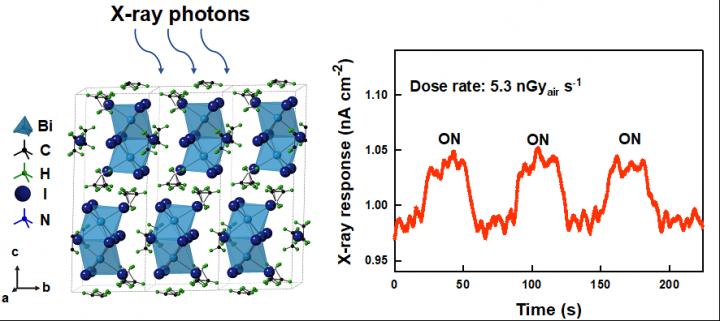
Researchers from China Academy of Engineering Physics, Nanjing University and University of Victoria demonstrated ultra-sensitive and stable X-ray detectors by using a new kind of 0D MA3Bi2I9 single-crystals. The disconnecting of the (Bi2I9)3- units in the lattice leads to a high activation energy (Ea) for ion migration (0.46 eV) and is also accompanied by a low dark carrier concentration (~ 10 6 cm-3). The suppressed ion migration and lowered dark carrier concentration enable the desirable combination of high sensitivity, low LoD, and stable operation. X-ray detectors with a low LoD of 0.62 nGyair s-1 was achieved with a 100 kVp tungsten-target X-ray tube, which approaches the background radiation on Earth (~0.1 nGyair s-1), and is significantly lower than the dose rate required for X-ray diagnostics (5.5 μGyair s-1). Additionally, the reported X-ray sensitivity of 10,620 μC Gyair-1 cm-2 is comparable to the values obtained in 3D perovskite detectors (1.1 × 10 4 μC Gyair-1 cm-2 for MAPbI3 and 2.1 × 10 4 μC Gyair-1 cm-2 for hybrid MAPbBr3/Si) and 2D perovskite detectors (8,400 μC Gyair-1 cm-2 for (NH4)3Bi2I9). It is worth noting that, unlike 2D hybrid Bi halide perovskites that cannot obtain low LoD and high sensitivity in the same direction, 0D MA3Bi2I9 X-ray detectors achieve simultaneously low LoD and high X-ray sensitivity in the out-of-plane transport mode. The 0D perovskite X-ray detectors exhibit stable operation even under high applied biases up to 120 V. No deterioration in detection performance was observed following an X-ray irradiation dose of ~23,800 mGyair, equivalent to > 200,000 times of the dose used in acquiring commercial X-ray chest radiographs.

The advance presented herein provides a promising X-ray detector candidate in X-ray imaging and medical applications. This work was published in Journal of Energy Chemistry.

###

See the article: https://www.sciencedirect.com/science/article/pii/S2095495620301121

This work is supported by the National Natural Science Foundation of China (Grant Nos. 21773218, 61974063), the Sichuan Province (Grant No. 2018JY0206) and the Presidential Foundation of CAEP (Grant No. YZJJLX2018007).

Media Contact
Yan Bei
[email protected]

Related Journal Article

http://dx.doi.org/10.1016/j.jechem.2020.02.049

Tags: Chemistry/Physics/Materials Sciences
Share12Tweet8Share2ShareShareShare2

Related Posts

blank

Breakthrough in Environmental Cleanup: Scientists Develop Solar-Activated Biochar for Faster Remediation

February 7, 2026
blank

Cutting Costs: Making Hydrogen Fuel Cells More Affordable

February 6, 2026

Scientists Develop Hand-Held “Levitating” Time Crystals

February 6, 2026

Observing a Key Green-Energy Catalyst Dissolve Atom by Atom

February 6, 2026
Please login to join discussion

POPULAR NEWS

  • Robotic Ureteral Reconstruction: A Novel Approach

    Robotic Ureteral Reconstruction: A Novel Approach

    82 shares
    Share 33 Tweet 21
  • Digital Privacy: Health Data Control in Incarceration

    63 shares
    Share 25 Tweet 16
  • Breakthrough in RNA Research Accelerates Medical Innovations Timeline

    53 shares
    Share 21 Tweet 13
  • Mapping Tertiary Lymphoid Structures for Kidney Cancer Biomarkers

    50 shares
    Share 20 Tweet 13

About

We bring you the latest biotechnology news from best research centers and universities around the world. Check our website.

Follow us

Recent News

Evaluating Biosimilar Trastuzumab for Breast Cancer in Thailand

Decoding Phantom Limb Movements via Intraneural Signals

Attitudes Toward Aging Impact Early Nursing Home Quality

Subscribe to Blog via Email

Enter your email address to subscribe to this blog and receive notifications of new posts by email.

Join 73 other subscribers
  • Contact Us

Bioengineer.org © Copyright 2023 All Rights Reserved.

Welcome Back!

Login to your account below

Forgotten Password?

Retrieve your password

Please enter your username or email address to reset your password.

Log In
No Result
View All Result
  • Homepages
    • Home Page 1
    • Home Page 2
  • News
  • National
  • Business
  • Health
  • Lifestyle
  • Science

Bioengineer.org © Copyright 2023 All Rights Reserved.