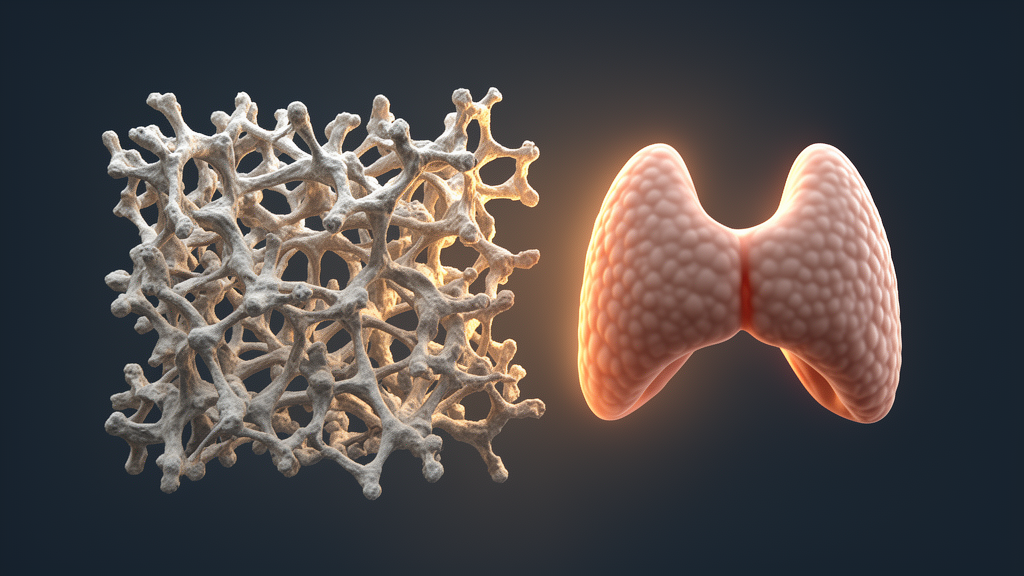
Men with thyroid-stimulating hormone levels in the lower range of normal face higher odds of osteoporosis and lower bone mineral density in the spine, according to an observational study evaluating Chinese adults with normal thyroid function. The investigation assessed whether circulating concentrations of thyroid-stimulating hormone, commonly known as TSH, relate to skeletal health even when values do not indicate clinical thyroid disease. While prior scientific literature has indicated that TSH plays a meaningful role in bone metabolism, previous results across diverse cohorts remained controversial and limited data existed concerning Chinese populations.
To examine this relationship, researchers enrolled a cross-sectional study cohort comprising 1,912 adult participants, consisting of 1,366 men and 546 women. All included individuals presented with thyroid function falling within standard reference limits. The investigators specifically sought to clarify whether subtle variations within normal physiological ranges of serum TSH correlate with objective radiological measurements of bone density or alter the documented prevalence of clinical osteoporosis.
Skeletal evaluation was carried out by measuring spinal bone mineral density using quantitative computed tomography. To evaluate potential associations, the research team implemented sex-specific multivariable logistic regression models designed to estimate odds ratios alongside 95 percent confidence intervals. The statistical analyses adjusted for several potential metabolic and cardiovascular confounding factors, specifically incorporating age, body mass index, systolic blood pressure, fasting plasma glucose, high-density lipoprotein cholesterol, and low-density lipoprotein cholesterol.
Upon analyzing the cohort by hormonal distribution, researchers observed a significant difference across quartile groupings among male participants. Men classified into lower TSH quartiles exhibited lower bone mineral density measurements than participants situated in higher quartile groups, demonstrating a statistically significant downward trend with a p-value of less than 0.05 across the distribution.
The study identified a substantially higher frequency of osteoporosis among male participants situated at the bottom of the normal hormonal spectrum. When compared directly with the fourth and highest quartile of serum TSH, men in the lowest quartile displayed significantly elevated odds of presenting with osteoporosis, yielding an adjusted odds ratio of 2.62 with a 95 percent confidence interval extending from 1.16 to 5.88.
Following adjustment for the full panel of metabolic and physiological covariates, the correlation between spinal bone mineral density and circulating hormone concentrations remained statistically robust. The multivariable models demonstrated a significant dose-response relationship across the quartiles of TSH in men, characterized by a trend p-value of 0.02. This graded relationship suggests that spinal bone density tracks progressively downward as normal TSH values decline toward the lower boundary.
In contrast to the findings observed in male subjects, the analysis showed no corresponding relationship among female participants. Within the female subcohort, investigators detected no statistically significant associations between serum TSH levels and spinal bone mineral density measurements or the diagnosed prevalence of osteoporosis, highlighting distinct sex-specific patterns in this population.
The authors concluded that lower serum concentrations of thyroid-stimulating hormone within normal clinical thresholds associate with poorer spinal bone mineral density and an increased prevalence of osteoporosis in men. Based on these observed associations, the researchers suggested that low-normal TSH concentrations could serve as an informative indicator during osteoporosis risk assessments in male patients, while noting the findings remain observational.
Subject of Research: Association between normal-range serum TSH levels and osteoporosis risk in men
Article Title: Low normal TSH levels are associated with increased osteoporosis risk and decreased BMD in Chinese men
Article References: Xu, Z., Yang, T., Yang, Y., Shen, L., & Li, Y. (2026). Low normal TSH levels are associated with increased osteoporosis risk and decreased BMD in Chinese men. BMC Musculoskeletal Disorders. https://doi.org/10.1186/s12891-026-10575-9
Image Credits: AI Generated
DOI: 10.1186/s12891-026-10575-9
Keywords: thyroid-stimulating hormone, TSH, bone mineral density, osteoporosis, quantitative computed tomography, spine, men's health, endocrinology, bone metabolism, Chinese population, multivariable logistic regression, cross-sectional study, metabolic health, thyroid function, musculoskeletal disorders, odds ratio
News Source: Daisy Hatcher. (November 13, 2026). Low Normal Thyroid Hormone Levels Linked to Lower Bone Density in Men. Scienmag.