In a groundbreaking study published in the prestigious journal Cell Death Discovery, researchers have uncovered a pivotal mechanism through which low-dose tumor necrosis factor-alpha (TNF-α) exacerbates the malignancy of glioblastoma, one of the most aggressive forms of brain cancer. The study elucidates the intricate biological interplay involving the TRAF2-FASN axis, linking inflammatory signaling to lipid metabolism—a powerful driver of cancer progression. This discovery not only challenges existing paradigms about TNF-α’s role in glioblastoma but also opens new avenues for targeted therapeutic interventions against this devastating disease.
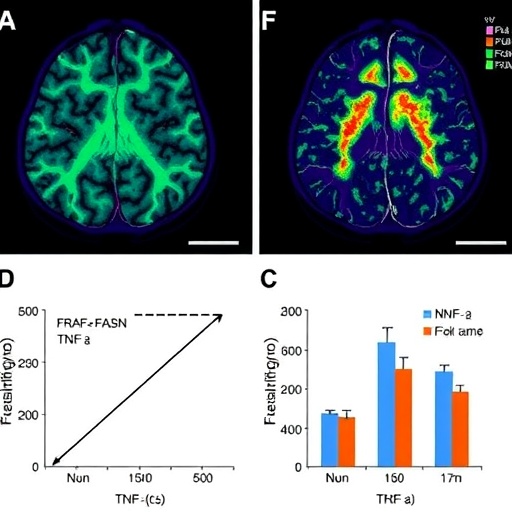
Tumor necrosis factor-alpha, a cytokine commonly associated with inflammation and immune responses, has long been a molecule of interest in cancer biology. Paradoxically, while high doses of TNF-α are frequently cytotoxic to tumor cells, this new research reveals that sub-lethal, low doses actually amplify tumor aggressiveness. Through sophisticated molecular experiments, the authors demonstrated that these low TNF-α levels specifically activate the TRAF2 (TNF receptor-associated factor 2) signaling pathway. This activation is intricately linked to enhanced fatty acid synthase (FASN) expression, a key enzyme driving the biosynthesis of lipids crucial for tumor cell growth and survival.
Glioblastoma, characterized by rapid proliferation and resistance to therapy, is notoriously difficult to treat, with current modalities offering limited survival benefits. Metabolic reprogramming—alterations in how tumor cells process nutrients—is an emerging hallmark of this cancer, enabling its relentless expansion. The study positions lipid metabolism at the heart of this reprogramming, connected directly to inflammatory cues mediated by TNF-α. This duality underscores a complex tumor microenvironment where inflammation not only fosters immune evasion but also fuels metabolic shifts, thereby promoting malignancy.
The researchers employed a variety of cutting-edge techniques ranging from gene silencing, lipidomics, to in vivo glioblastoma models to dissect the pathway’s dynamics. By knocking down TRAF2 expression, they observed a marked decrease in FASN activity and subsequent lipid accumulation, which correlated with impaired tumor growth and invasiveness. Conversely, administration of low-dose TNF-α enhanced TRAF2 signaling and lipid production, confirming the axis’s critical role in driving tumor progression.
This discovery holds significant therapeutic implications. Targeting the TRAF2-FASN axis could represent a novel strategy to halt tumor growth by cutting off the lipid supply essential for glioblastoma cells. Given FASN’s role in lipid biosynthesis, pharmacological inhibitors of this enzyme are already under clinical investigation in other cancer types. Coupling these inhibitors with agents modulating TNF-α signaling could potentiate the treatment’s efficacy, potentially overcoming the notorious resistance glioblastomas exhibit to conventional therapies.
Moreover, the study sheds light on the nuanced role of inflammation in cancer biology. While inflammation is classically seen as a double-edged sword in oncogenesis, this research intricately details how even minimal inflammatory stimuli can rewire tumor metabolism in a way that paradoxically promotes malignancy rather than inhibiting the tumor. This insight could recalibrate how scientists approach cytokine signaling in cancer treatment strategies, advocating for dose-specific modulation rather than blanket inhibition.
Significantly, the linkage of TRAF2, a central adapter protein in the TNF receptor signaling complex, to FASN establishes a molecular nexus that integrates signaling cascades with metabolic outputs. Such integrative mechanisms highlight the sophistication of tumor cell biology, where signaling pathways do not act in isolation but intersect with metabolic networks to orchestrate malignant behaviors.
The implications extend beyond glioblastoma. Given the ubiquitous presence of TNF-α and lipid metabolism across various cancers, this study raises the possibility that similar mechanisms may operate in other tumor types. Future research could explore these pathways across malignancies, potentially identifying a universal metabolic vulnerability exploitable by new therapeutics.
Importantly, the in vivo models used in this study reflect the human glioblastoma microenvironment with high fidelity, lending credibility to the translational potential of targeting the TRAF2-FASN axis. Their findings accentuate the microenvironment’s role, including immune and metabolic components, in influencing tumor trajectory.
The study also provokes questions about the impact of systemic inflammation or chronic low-grade inflammation in cancer patients and how such conditions might inadvertently propel tumor growth through metabolic reprogramming. This could influence clinical practices, prompting closer monitoring of inflammatory states in cancer patients as part of comprehensive disease management.
As the field looks forward, the possibility of combining metabolic interventions with immunotherapies becomes increasingly attractive. By restraining lipid metabolism, tumors might become more susceptible to immune-mediated clearance, thus harnessing the immune system’s full potential against glioblastoma.
This research ultimately represents a compelling example of how unraveling cellular metabolic pathways and their crosstalk with signaling molecules can unravel new cancer vulnerabilities. The detailed molecular characterization provided by these scientists serves as an invaluable resource for developing next-generation therapeutics aiming to disarm the molecular conduits of glioblastoma progression.
In the ever-evolving landscape of cancer research, such discoveries highlight the importance of multidisciplinary approaches, merging oncology, immunology, and metabolism to conquer some of the most intractable cancers. This study not only advances our understanding of glioblastoma pathophysiology but also inspires hope for more effective, personalized treatment strategies in the near future.
The nexus between low-dose TNF-α and lipid metabolic reprogramming via the TRAF2-FASN axis stands as a new hallmark of glioblastoma malignancy, redefining how inflammation and metabolism converge to drive cancer. This paradigm shift underscores the need for innovative research initiatives aiming to intercept these malignant circuits early on and with precision.
As therapeutic research marches forward, these insights prompt a reconsideration of cytokine biology in cancer—where timing, dosage, and context dictate divergent outcomes. By unveiling how seemingly subtle inflammatory cues wield profound influence over tumor metabolism and progression, this work sets a new frontier for intervention strategies in the battle against glioblastoma and potentially other cancers reliant on similar metabolic and inflammatory axes.
Subject of Research: Glioblastoma malignancy mechanisms involving low-dose TNF-α signaling and lipid metabolism reprogramming.
Article Title: Low-dose TNF-α drives malignant progression and lipid metabolism in glioblastoma through the TRAF2-FASN axis.
Article References:
Cai, M., Liu, Y., Mao, X. et al. Low-dose TNF-α drives malignant progression and lipid metabolism in glioblastoma through the TRAF2-FASN axis. Cell Death Discov. (2026). https://doi.org/10.1038/s41420-026-03087-x
Image Credits: AI Generated
DOI: https://doi.org/10.1038/s41420-026-03087-x
Tags: fatty acid synthase FASN role in tumorsglioblastoma tumor aggressiveness mechanismsinflammation-driven glioblastoma progressioninflammatory signaling and cancer progressionlipid biosynthesis enzymes in tumor growthlipid metabolism in glioblastomalow-dose TNF-alpha in glioblastomamolecular pathways in glioblastoma proliferationtargeted therapies for glioblastomaTNF receptor-associated factor 2 in cancerTNF-alpha paradox in cancer therapyTRAF2 signaling pathway in brain cancer