A computational study published in Results in Chemistry demonstrates that extending the hydrophobic acyl chain of N-acyl-L-homoserine lactones significantly enhances their binding affinity to cucurbit[7]uril (CB7). The research, conducted by Mostafa Sayed, Ahmed El-Rashedy, Awad I. Said, and Mostafa Ahmed, utilized molecular dynamics simulations and MM/GBSA free-energy calculations to investigate how chain length influences the stability of these supramolecular complexes. The findings indicate that the N-octanoyl derivative forms the most stable complex, driven primarily by efficient hydrophobic packing within the rigid cavity of the macrocyclic host.
The study focused on a homologous series of four signaling molecules known as N-acyl-L-homoserine lactones (AHLs), which play a critical role in bacterial quorum sensing. These molecules regulate collective microbial behaviors such as biofilm formation and virulence. The specific derivatives examined were N-pentanoyl (C5), N-hexanoyl (C6), N-heptanoyl (C7), and N-octanoyl (C8) L-homoserine lactones. Each molecule consists of a conserved homoserine lactone headgroup attached to an amide linkage and a variable hydrophobic acyl tail. The systematic variation in tail length provided a controlled framework for isolating the effects of hydrophobic surface area on host-guest recognition.
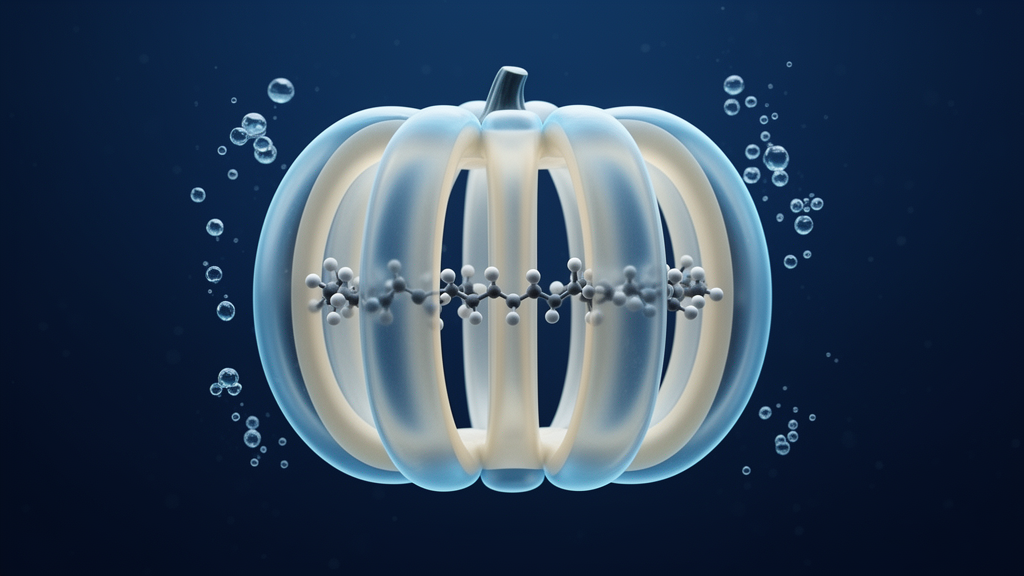
Cucurbit[7]uril is a pumpkin-shaped macrocyclic molecule composed of glycoluril units linked by methylene bridges. It features a hydrophobic internal cavity bordered by two carbonyl-rich portals, a structure that allows it to encapsulate various guest molecules with high selectivity in aqueous media. The researchers synthesized CB7 using a modified acid-catalyzed condensation procedure and constructed initial host-guest complexes by positioning the acyl chains of the AHLs inside the CB7 cavity. These systems were then solvated in orthorhombic TIP3P water boxes and subjected to energy minimization and equilibration before production simulations.
The computational methodology involved 200 nanoseconds of molecular dynamics simulations for each 1:1 host-guest complex. Force-field parameters were derived using the GAFF atom types and Espaloma machine-learned charges, ensuring chemically consistent representations of the macrocycle. Binding free energies were calculated using the MM/GBSA method, which decomposes the total binding energy into gas-phase, electrostatic, van der Waals, and solvation contributions. This approach allows for a detailed energetic analysis of the noncovalent interactions stabilizing the complexes, providing insights that experimental methods alone might not fully resolve.
The results revealed a clear trend in binding affinity correlated with acyl chain length. The N-octanoyl-CB7 complex exhibited the most favorable binding free energy at -29.53 ± 1.15 kcal/mol, followed by the N-heptanoyl complex at -28.00 ± 1.26 kcal/mol. The N-hexanoyl and N-pentanoyl complexes showed slightly weaker affinities of -27.22 ± 1.18 kcal/mol and -27.00 ± 1.24 kcal/mol, respectively. While the differences among the shorter-chain homologues fall within the statistical uncertainty of the calculations, the significantly stronger binding of the C8 derivative is robust and consistent across all analyzed trajectory windows.
Energy decomposition analysis identified van der Waals interactions as the principal driving force for complex formation. These interactions remained consistently strong across the series, ranging from approximately -28 to -30 kcal/mol. In contrast, electrostatic contributions were relatively small and showed minor variation among the complexes. A key factor in the enhanced affinity of longer chains was the progressive reduction in the unfavorable solvation penalty. The solvation contribution decreased from +2.37 ± 0.42 kcal/mol for the C5 derivative to +0.39 ± 0.35 kcal/mol for the C8 analogue, indicating that longer hydrophobic chains are more effectively shielded from the aqueous environment upon encapsulation.
Structural analysis provided direct evidence for the hydrophobic driving force behind these thermodynamic trends. Cavity occupancy analysis showed that the average number of acyl-chain carbon atoms residing inside the CB7 cavity increased monotonically with chain length. The C5 complex occupied the cavity with an average of 3.2 ± 0.4 carbon atoms, whereas the C8 complex achieved a much higher occupancy of 7.9 ± 0.2 carbon atoms. This progressive filling of the hydrophobic space correlates strongly with the decrease in solvation penalty and the increase in binding free energy, confirming that efficient packing is central to the recognition mechanism.
Dynamic stability metrics further supported the conclusion that longer chains form more rigid and stable assemblies. The root mean square deviation (RMSD) of the complexes decreased as chain length increased, with the C5 complex showing the highest flexibility at 4.68 ± 0.58 Å and the C8 complex exhibiting the lowest deviation at 1.27 ± 0.23 Å. Center-of-mass radial distribution function (COM-RDF) analysis revealed that the C5 complex had a broad, bimodal distribution, suggesting the guest could fluctuate between encapsulated and partially egressed states. In contrast, the C7 and C8 complexes displayed sharp, single peaks, indicating that the longer chains remained fully encapsulated throughout the simulation period.
The authors compared these computational findings with the natural quorum-sensing receptor LasR, which also recognizes AHLs through hydrophobic acyl chain encapsulation. While both systems exploit the hydrophobic effect for recognition, CB7 is a rigid synthetic macrocycle with a smaller, more symmetric cavity, leading to selectivity governed primarily by cavity occupancy. The study notes that while the computational trends are qualitatively consistent with experimental observations of CB7 binding AHLs, the MM/GBSA method provides relative rather than absolute thermodynamic quantities. The comparison with experimental data is limited to trend consistency, as the specific association constants for the C5-C8 series were not tabulated in the referenced experimental work.
Limitations of the study include the use of classical molecular dynamics and end-point free-energy calculations, which do not provide a full free-energy profile along the association coordinate. The simulations started from pre-formed inclusion complexes, and no umbrella-sampling or potential-of-mean-force calculations were performed to determine global free-energy minima or association barriers. The authors acknowledge that other binding configurations or dissociated states cannot be strictly ruled out without unbiased simulations from separated host and guest molecules. Future work could employ enhanced-sampling approaches to further characterize the free-energy landscape of these supramolecular systems.
This research provides a detailed molecular-level understanding of how hydrophobic chain length dictates the stability of cucurbituril-based host-guest complexes. By linking structural occupancy, dynamic stability, and energetic decomposition, the study highlights the potential of cucurbit[7]uril as a platform for the selective recognition and modulation of biologically relevant quorum-sensing molecules. The findings offer a mechanistic basis for the design of supramolecular systems aimed at interfering with bacterial communication pathways through precise molecular recognition.
The computational framework employed in this study relies on the Generalized Born surface area method, a widely used end-point approach for estimating host-guest binding affinities in supramolecular chemistry. Although Poisson-Boltzmann variants are sometimes considered more rigorous for polar solvation, systematic benchmarking studies indicate that the Generalized Born model often yields higher correlations with experimental binding affinities across diverse ligand sets. For cucurbituril systems specifically, this method offers a favorable balance between accuracy and computational efficiency, which is essential when averaging over thousands of snapshots extracted from long molecular dynamics trajectories. Consequently, the absolute binding free energy values reported here should be interpreted as relative affinities within the specific series of N-acyl-L-homoserine lactones rather than as quantitatively exact thermodynamic constants. This methodological choice ensures that the observed trends reflect genuine structural differences rather than artifacts of the simulation protocol.
To verify that the observed binding trends were not artifacts of the specific trajectory window selected for analysis, the researchers performed a convergence assessment by recalculating binding free energies across multiple overlapping time segments of the 200 nanosecond simulations. The absolute values of the binding free energies remained stable across all tested windows, with variations comparable to the statistical uncertainty estimated through block averaging. More importantly, the relative ranking of the complexes was preserved in every segment, from the early 0-50 nanosecond period to the late 150-200 nanosecond interval. This consistency demonstrates that the chain-length-dependent enhancement in binding affinity is a robust feature of the simulated systems and is not biased by the initial configuration or slow relaxation of the host-guest assembly. The window-resolved analysis confirms that the stronger binding of the octanoyl derivative is a genuine property of the complex rather than a consequence of insufficient sampling.
The structural insights gained from these simulations offer a direct comparison to the natural quorum-sensing receptor LasR, which also recognizes these signaling molecules through hydrophobic acyl chain encapsulation. In both the synthetic CB7 cavity and the protein binding pocket, the hydrophobic tail of the molecule is sequestered from the aqueous environment, while the polar lactone and amide headgroups engage in specific interactions at the binding interface. However, a key distinction lies in the nature of the host: LasR is a flexible protein with a deep, structured pocket that imposes specific steric and hydrogen-bonding constraints, whereas CB7 is a rigid, symmetric macrocycle. This rigidity means that CB7 selectivity is governed primarily by the efficiency of cavity filling and hydrophobic packing, rather than by the broader ligand promiscuity often seen in protein receptors. Understanding these mechanistic differences helps clarify how synthetic supramolecular systems can mimic or diverge from biological recognition pathways.
The study explicitly acknowledges that the simulations were limited to 1:1 host-guest stoichiometries, focusing on the primary recognition mode for these systems. While the CB7 cavity is theoretically large enough to accommodate two guest molecules, the current analysis did not explore 1:2 complexes or higher-order assemblies. At the dilute conditions modeled in the simulations, 1:1 binding is expected to dominate, but the potential formation of 1:2 species at higher concentrations or for longer-chain derivatives remains an open question. Future investigations could extend this analysis to compare the relative stabilities of different stoichiometries, providing a more comprehensive picture of how these molecules interact in concentrated environments. This limitation underscores the importance of considering concentration-dependent effects when translating computational findings to experimental applications.
Subject of Research: Molecular dynamics and free-energy analysis of N-acyl-L-homoserine lactone binding to cucurbit[7]uril
Article Title: Hydrophobic chain-length effects on the binding of N -acyl homoserine lactones with cucurbit[7]uril: Molecular dynamics and free-energy analysis
Article References: Sayed, M., El-Rashedy, A., Said, A. I., & Ahmed, M. (2026). Hydrophobic chain-length effects on the binding of N-acyl homoserine lactones with cucurbit[7]uril: Molecular dynamics and free-energy analysis. Results in Chemistry, 32, Article 104046. https://doi.org/10.1016/j.rechem.2026.104046
Image Credits: AI Generated
DOI: 10.1016/j.rechem.2026.104046
Keywords: cucurbit[7]uril, N-acyl-L-homoserine lactones, molecular dynamics, MM/GBSA, quorum sensing, supramolecular chemistry, host-guest binding, hydrophobic interactions, binding free energy, Results in Chemistry, Hydrophobic, chain-length
News Source: Bethany Barker. (November 9, 2026). Longer Hydrophobic Chains Strengthen Cucurbit[7]uril Binding. Scienmag.