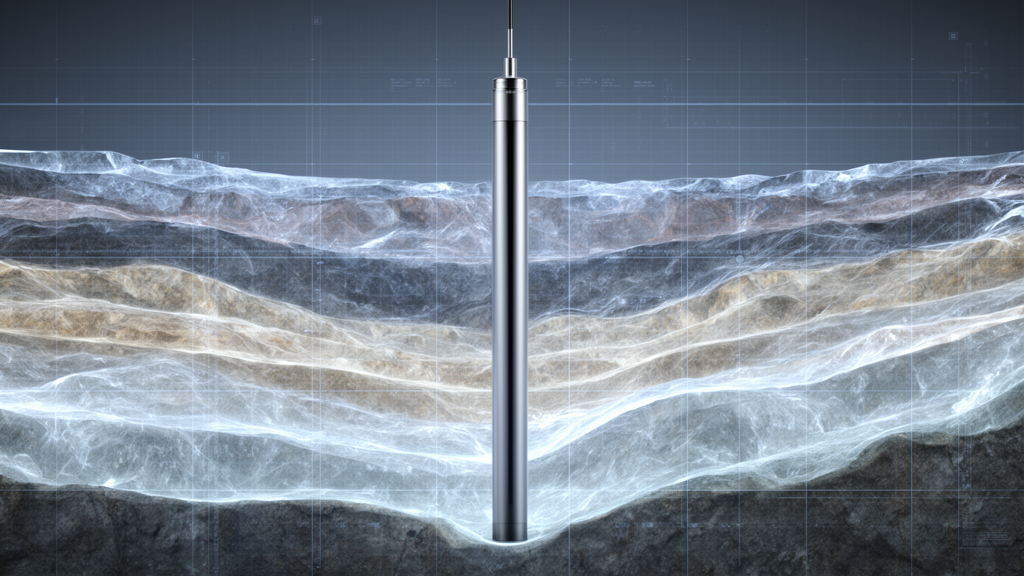
Geophysical researchers Daiming Hu, Jianhua Cai, and Weihua Luo have formulated a three-dimensional direct current electrical resistivity tomography forward modeling framework that incorporates finite borehole diameters and non-uniform surface current distributions through a long cylindrical electrode source model. In conventional electrical resistivity tomography, subsurface resistivity distributions are routinely reconstructed to evaluate geological structures for mineral prospecting, engineering geology, environmental surveys, and geological disaster prevention. Standard forward modeling algorithms typically approximate electrical current sources as idealized point electrodes. While the point source assumption remains mathematically tractable and practically valid when the spacing between observation electrodes far exceeds physical electrode dimensions, short surface-deployed electrodes suffer from rapid current density decay with depth. Consequently, traditional point electrode setups often yield weak signal responses from deeply buried targets, shallow effective investigation depths, and elevated vulnerability to environmental noise interference under realistic field exploration conditions.
To overcome the penetration depth limitations associated with surface point sources, geophysicists have increasingly explored long electrode excitation methods that repurpose existing conductive metal borehole casings as primary current injection structures. By channeling electrical currents directly into deep geological formations, long electrodes substantially boost electrical signal coupling with deep-seated targets. Early computational approaches frequently simplified these conductive casings as idealized, one-dimensional linear current sources, effectively neglecting the radial diameter of the borehole. However, actual mineral exploration drill holes typically exhibit casing diameters ranging from 75 millimeters to 150 millimeters, and occasionally larger. Omitting the physical radius of the casing can introduce notable near-source modeling deviations. Established three-dimensional numerical techniques, such as the finite difference method, face severe geometric mesh constraints when discretizing rounded borehole sources or complex irregular topographies, making the flexible local mesh refinement of the finite element method the preferred numerical architecture for intricate geological structures.
The newly developed long cylindrical electrode numerical framework solves the governing partial differential equations by converting them into an equivalent variational functional extremum problem discretized over unstructured tetrahedral grids generated with Gmsh software. Drawing conceptual analogy from finite fault source simulations in seismology, the formulation decomposes the distributed long cylindrical electrode into a continuum of discrete point current elements governed by the fundamental electric potential equation. To truncate the infinite subsurface computational domain without introducing artificial boundary reflections, the model couples Neumann boundary conditions at the ground surface with mixed Robin-type boundary conditions along artificial outer boundaries. Global system assemblies are subsequently solved using a conjugate gradient method accelerated by a symmetric successive over-relaxation preconditioner, enabling efficient three-dimensional potential calculations without requiring excessive computing clusters.
A central theoretical component of the proposed method is its source-term analytical formulation for surface current density across heterogeneous subsurface formations. In field resistivity surveys, metallic casings possess an electrical resistivity around 10 to the power of negative seven ohm-meters, which is six to eight orders of magnitude lower than typical host rocks that range between 1 and 1000 ohm-meters. Because the voltage drop along the metallic casing is negligible compared to potential gradients in surrounding geological media, the casing can be treated as an equipotential conductor. Rather than imposing computationally intensive Dirichlet boundary constraints or generating fine-scale discretization over the casing surface, the researchers analytically derived the relationship between surface current density, surrounding layer conductivity, and lateral cylindrical surface area. This formulation directly embeds the calculated non-uniform current injection into the right-hand side source vector of the global linear system.
Initial algorithm validation was conducted on a desktop computer powered by an Intel Core i5-5350U central processing unit operating at 1.80 gigahertz with eight gigabytes of random access memory. The research team modeled a 200-meter-long, 0.1-meter-diameter cylindrical electrode embedded within a homogeneous 100 ohm-meter half-space domain bounded by a 1000-meter radial extent. Comparisons between the finite-element numerical results and theoretical analytical solutions revealed that relative potential errors remained near zero across 98 percent of the surface and borehole observation electrodes. Only a small subset of observation points located within 5 meters of the casing exhibited elevated relative errors reaching 2 percent, a localized discrepancy caused by source singularities inherent to total-potential numerical formulations that dissipates rapidly with increasing observation offset.
To rigorously evaluate finite-diameter effects, the authors benchmarked the long cylindrical electrode model against the established Dirichlet constant-potential boundary approximation across three electrode diameters measuring 0.01 meters, 0.05 meters, and 0.10 meters in a 100 ohm-meter half-space. The comparative tests revealed substantial apparent resistivity discrepancies in the immediate near-electrode zone. At the closest observation point situated 0.1 meters from the casing wall, relative errors compared to the Dirichlet benchmark reached 76.2 percent for the 0.01-meter diameter, 64.0 percent for the 0.05-meter diameter, and 53.3 percent for the 0.10-meter diameter. This localized deviation stems from end-current concentration effects, wherein thinner electrodes concentrate elevated current densities at their extremities. Nevertheless, discrepancies dropped below 1 percent beyond approximately 3 meters and converged to 0.2 percent at 50 meters, confirming that finite-diameter representations are vital for near-borehole evaluation but converge with Dirichlet formulations in the far field.
The investigative team subsequently simulated surface exploration surveys over a synthetic conductive cubic ore body measuring 50 meters on each side with a resistivity of 5 ohm-meters embedded in a 100 ohm-meter background. Ten surface survey lines spaced 10 meters apart with 40 potential recording stations were deployed under a pole-pole configuration. When the ore body was placed at a shallow depth of 50 meters, both the 40-meter long cylindrical electrode and the conventional point electrode successfully delineated the horizontal boundaries of the deposit, producing maximum relative anomaly amplitudes of 29 percent and 20 percent, respectively. However, when the target depth was extended to 100 meters using an 80-meter casing, the point electrode response deteriorated to an 8 percent anomaly that was virtually indistinguishable from background terrain, whereas the long cylindrical electrode retained a distinct 18 percent anomaly peak that clearly localized the deposit.
To overcome vertical resolution limitations inherent to surface-only surveys, the researchers modeled a cross-hole borehole survey system comprising five observation wells to sense a 100-meter cubic ore body positioned at a depth of 150 meters. Utilizing a 100-meter-long casing supplied with 1 ampere of current, the numerical experiments compared pole-pole and pole-dipole recording arrays. Under the pole-pole array, the long cylindrical electrode generated a maximum relative anomaly amplitude of 5.68 percent compared to 3.07 percent for the point electrode. Under the pole-dipole configuration, the long cylindrical electrode delivered a 25.84 percent anomaly amplitude versus 13.68 percent for the point source. The pole-dipole array exhibited superior anomaly peak sharpening and vertical boundary positioning accuracy, whereas the pole-pole array demonstrated sensitive detection of broader electrical resistivity contrasts between the ore body and host rock.
The modeling strategy was further tested in complex engineering and environmental contexts, including time-lapse monitoring of karst caverns for pumped-storage hydroelectric reservoirs and natural gas hydrate-bearing permafrost zones. Simulating reservoir grouting stages across a 1000-meter deep karst structure modeled after engineering conditions in Hubei Province, China, a 900-meter casing captured clear transitions from low-resistivity water-filled voids at 10 ohm-meters to consolidated grouting zones at 500 ohm-meters. In the permafrost simulation, featuring a three-layer sequence of thawed active layer, ice-rich permafrost, and an underlying unfrozen talik aquifer, the long cylindrical electrode algorithm was benchmarked against a slender-column point electrode conductive pillar model. The proposed formulation reduced the total tetrahedral mesh count by more than 55 percent, declining from 1,684,427 to 751,461 elements. Furthermore, the required iterative solver steps fell from 760 to 167, cutting total computation time from 25.42 seconds down to 6.24 seconds, which represents a 75.4 percent reduction in overall computational expense.
Despite its computational and signal-coupling strengths, the authors emphasized several operational boundaries and physical simplifications governing their forward modeling algorithm. The core equipotential conductor assumption degrades if an electrode is encased in highly conductive surrounding media, such as specialized conductive drilling muds or molten slurries. Furthermore, when the electrode length is significantly shorter than the thickness of an overlying overburden layer, small-offset geometric factor calculations can produce apparent resistivity inaccuracies. The present mathematical formulation also omits electrode-rock contact impedance, which remains a limitation to be addressed in subsequent revisions. Finally, because the findings remain grounded entirely in synthetic numerical simulations, the authors highlighted that ongoing research must focus on integrating complex realistic geological media and conducting on-site drilling electrical surveys to validate the algorithm against physical field measurement data.
Subject of Research: Three-dimensional electrical resistivity tomography forward modeling using long cylindrical electrodes
Article Title: An innovative modelling method for sensing deep geological anomaly using long cylindrical electrode model
Article References: Hu, D., Cai, J., & Luo, W. (2026). An innovative modelling method for sensing deep geological anomaly using long cylindrical electrode model. Results in Engineering, 32, Article 114294. https://doi.org/10.1016/j.rineng.2026.114294
Image Credits: AI Generated
DOI: 10.1016/j.rineng.2026.114294
Keywords: Electrical resistivity tomography, Long cylindrical electrode, Deep geological exploration, Numerical forward modelling, Finite element method, Borehole geophysics, Surface current density, Apparent resistivity, Unstructured tetrahedral mesh, Pole-dipole configuration, Mineral resource prospecting, Karst monitoring, Permafrost geoelectrics, Computational geophysics, Equipotential conductor, Source-term formulation
News Source: Denise Maddox. (November 21, 2026). Long Cylindrical Electrode Modeling Improves Deep Resistivity Sensing in Synthetic Simulations. Scienmag.