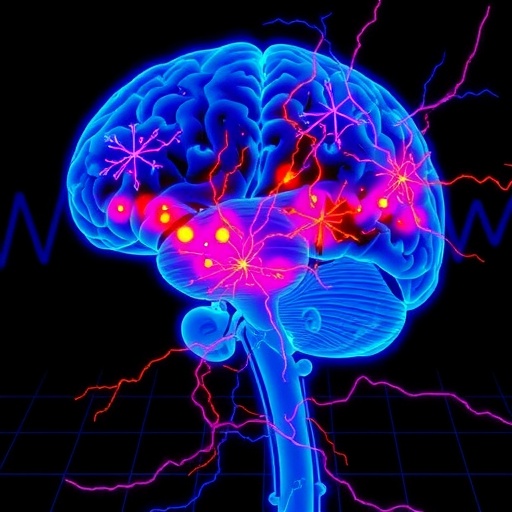
Epileptic seizures have long been a subject of fascination and concern within both medical and scientific communities. Understanding the underlying mechanisms responsible for these events is vital for advancing treatment modalities and improving patient outcomes. Recent research led by a team including Yin, Yu, and Liu delves into the biophysics of epileptic seizures, shedding light on the significant role that local voltage differences play in these neurological phenomena. Their work, titled “Epileptic seizure biophysics: the role of local voltage difference,” published in Military Medical Research, presents novel insights that could reshape our understanding of seizure dynamics and inform future therapeutic strategies.
Electrical activity in the brain, governed by excitatory and inhibitory neurons, is crucial for maintaining normal neurological function. When this balance is disrupted, it can lead to unwanted electrical discharges—seizures. The concept of local voltage differences emerges as a central theme in the investigation of these events. The research team aimed to quantify how these discrepancies in voltage contribute to seizure initiation and propagation, and their findings are both intriguing and practically significant.
Local voltage differences refer to the variations in electrical potential across small regions of brain tissue. These tiny but critical shifts can alter neuronal excitability, making certain areas more prone to experiencing seizures. By conducting a series of experiments that included advanced imaging techniques and computational modeling, the researchers were able to identify patterns associated with the onset of seizures under different conditions. This meticulous approach allowed them to draw well-founded conclusions regarding the mechanistic role of voltage in seizure activity.
One of the pivotal discoveries of this research highlighted how local voltage differences can influence synaptic transmission, which is fundamental for communication between neurons. The study found that when local voltage levels become aberrant, they not only impair communication but also facilitate a cascade effect that can lead to synchronized bursts of activity characteristic of seizures. This insight is crucial as it lays the groundwork for potential interventions aimed at normalizing voltage differences in affected brain regions.
Moreover, the researchers explored how these voltage discrepancies can vary by brain region. Their work revealed that particular areas, notably the hippocampus and cortex, exhibit more pronounced voltage variations during seizure episodes. This regional specificity is noteworthy; it suggests that therapeutic approaches may need to be tailored according to the specific characteristics of the brain region involved in the seizure activity. Additionally, understanding these regional dynamics opens the door to targeted therapies that could minimize side effects associated with broader neurological treatments.
Another fascinating aspect of Yin and colleagues’ study involves the neural circuits that become activated during seizures. By employing state-of-the-art techniques, they mapped these circuits and demonstrated how local voltage differences impact circuit function, further elucidating the relationship between structural dynamics and electrical behavior in the brain. This intricate interplay between voltage, structural integrity, and function underscores the complexity of epileptic phenomena and illustrates the range of potential therapeutic targets available for intervention.
The implications of this research extend beyond theoretical understanding; they have direct clinical relevance. By elucidating a mechanism that can be targeted, it opens avenues for developing advanced medical devices and pharmacological therapies aiming to stabilize local voltage levels. For instance, bioelectronic techniques—such as responsive neurostimulation—could be refined to address the specific patterns identified in this research, providing tailored therapies for patients suffering from refractory epilepsy.
Furthermore, the study encourages us to rethink current interpretations of seizure behavior. Previously, seizures were primarily viewed through the lens of global cerebral dysfunction or as resulting from large-scale network failures. However, the focus on local voltage differences challenges this paradigm, suggesting a more nuanced approach is needed to understand these complex conditions. This shift in perspective could catalyze further research into localized brain pathologies and their connection to more widespread seizure activity.
As researchers continue to dissect the intricate biophysics of seizure activity, the study serves as an important stepping stone towards a more comprehensive and actionable understanding. This work not only provides clarity regarding specific physiological mechanisms but also highlights the need for multidisciplinary approaches that integrate biophysics, neurology, and engineering to devise more effective interventions.
In terms of future applications, the research lays a framework upon which new advancements in epilepsy management can be built. The insights acquired regarding local voltage differences could serve as a basis for developing novel biomarkers, enabling clinicians to predict seizure susceptibility more accurately. Such predictive capabilities would undoubtedly enhance the ability to implement preemptive interventions, potentially decreasing the frequency and severity of seizure events in susceptible patients.
In summary, the study conducted by Yin, Yu, and Liu constitutes a significant advancement in understanding the role of local voltage differences in epileptic seizures. As the research landscape evolves, it will be vital for scientists and clinicians to keep abreast of these findings and incorporate them into ongoing clinical practices. This evolving field promises not only to improve our understanding of epilepsy but also to transform the quality of care provided to those affected by this challenging condition.
This landmark study is more than a singular research endeavor; it signifies a movement towards an integrated understanding of brain function and pathology, inviting further exploration into the potential interrelations of electrical activity, anatomy, and treatment modalities. The future holds promise for a new era in epilepsy research, one where tailored therapies derived from robust scientific insights lead to meaningful improvements in patient care and quality of life.
As we reflect on the implications of this research, it is clear that continuing to investigate the biophysical aspects of seizures will yield further insights and breakthroughs. The collaboration of experts across multiple disciplines will be essential in enhancing our understanding of epilepsy, ultimately leading to innovative solutions that will benefit countless individuals worldwide.
Subject of Research: The Role of Local Voltage Differences in Epileptic Seizures
Article Title: Epileptic seizure biophysics: the role of local voltage difference
Article References:
Yin, KY., Yu, T., Liu, C. et al. Epileptic seizure biophysics: the role of local voltage difference.
Military Med Res 12, 35 (2025). https://doi.org/10.1186/s40779-025-00620-4
Image Credits: AI Generated
DOI: https://doi.org/10.1186/s40779-025-00620-4
Keywords: Epileptic seizures, biophysics, local voltage difference, neural circuits, seizure dynamics, epilepsy treatment, electrical activity in the brain, synaptic transmission, neurological function, predictive biomarkers, tailored therapies.
Tags: advances in epilepsy treatmentbiophysics of seizuresbrain tissue electrical potentialelectrical activity in the brainepileptic seizure mechanismsexcitatory and inhibitory neuronslocal voltage differences in epilepsyneuronal excitability and seizuresresearch on epilepsy and seizuresseizure initiation and propagationtherapeutic strategies for epilepsyunderstanding seizure dynamics