• HOME
  • NEWS
  • EXPLORE
    • CAREER
      • Companies
      • Jobs
    • EVENTS
    • iGEM
      • News
      • Team
    • PHOTOS
    • VIDEO
    • WIKI
  • BLOG
  • COMMUNITY
    • FACEBOOK
    • INSTAGRAM
    • TWITTER
Friday, December 19, 2025
BIOENGINEER.ORG
No Result
View All Result
  • Login
  • HOME
  • NEWS
  • EXPLORE
    • CAREER
      • Companies
      • Jobs
        • Lecturer
        • PhD Studentship
        • Postdoc
        • Research Assistant
    • EVENTS
    • iGEM
      • News
      • Team
    • PHOTOS
    • VIDEO
    • WIKI
  • BLOG
  • COMMUNITY
    • FACEBOOK
    • INSTAGRAM
    • TWITTER
  • HOME
  • NEWS
  • EXPLORE
    • CAREER
      • Companies
      • Jobs
        • Lecturer
        • PhD Studentship
        • Postdoc
        • Research Assistant
    • EVENTS
    • iGEM
      • News
      • Team
    • PHOTOS
    • VIDEO
    • WIKI
  • BLOG
  • COMMUNITY
    • FACEBOOK
    • INSTAGRAM
    • TWITTER
No Result
View All Result
Bioengineer.org
No Result
View All Result
Home NEWS Science News Biology

Local emissions amplify regional haze and particle growth

Bioengineer by Bioengineer
January 29, 2021
in Biology
Reading Time: 2 mins read
0
IMAGE
Share on FacebookShare on TwitterShare on LinkedinShare on RedditShare on Telegram

IMAGE

Credit: Yele Sun

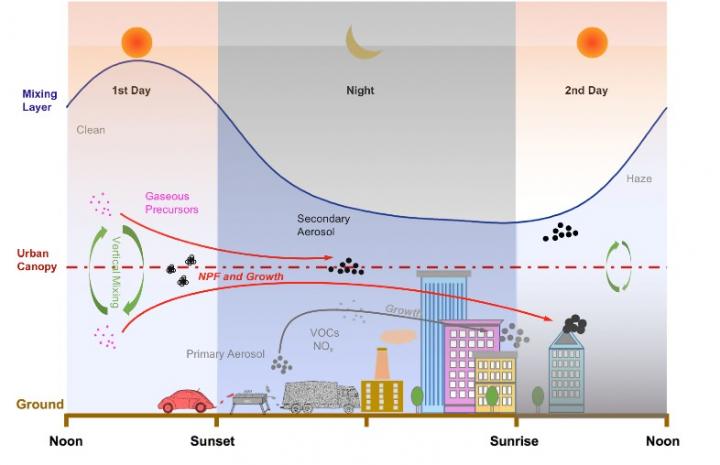
New particle formation (NPF) is a major source of aerosol particles in the global atmosphere. In polluted megacities, such as Beijing, the role of new particle formation events and their contribution to haze formation through subsequent growth is still unclear.

To improve the understanding of the sources, meteorological conditions, and chemistry behind air pollution, the research teams led by Prof. Yele Sun with the Institute of Atmospheric Physics at the Chinese Academy of Sciences and Prof. Markku Kulmala with the University of Helsinki performed simultaneous measurements of aerosol composition and particle number size distributions at ground level and at 260 m in central Beijing, China, during a total of 4 months in 2015-2017. Their study was recently published in npj Climate and Atmospheric Science.

“The haze formation is initiated by the growth of freshly formed particles at both ground level and city aloft. However, the haze was more severe at ground level because of higher particle growth rates due to the impacts of local primary particles and gaseous precursors.” said Prof. Sun.

According to Prof. Sun, the particle growth creates a feedback loop, in which a further development of haze increases the atmospheric stability. It in turn strengthens the persisting apparent decoupling between the two heights and increases the severity of haze at ground level.

The team further complemented the field observations with NAQPMS+APM model analyses, and found that the haze associated with NPF and growth was formed on a regional scale in Beijing-Tianjin-Hebei area. Prof. Sun said, “The growth of NPF-originated particles accounts for up to ?60% of the accumulation mode particles, and drives the haze formation in the Beijing-Tianjin-Hebei area.”

The team also performed simulations on how emission reductions would affect haze development. “Concentration of both primary and secondary particles in the accumulation mode would decrease drastically, and the haze formation would be reduced if the emission cuts are higher than 30%.” Concluded Prof. Sun. “Our results show that a reduction in anthropogenic gaseous precursors can suppress particle growth, and therefore is a critical step for haze alleviation.”

###

Media Contact
Ms. Zheng Lin
[email protected]

Original Source

http://english.iap.cas.cn/home/News/202101/t20210127_262271.html

Related Journal Article

http://dx.doi.org/10.1038/s41612-020-00156-5

Tags: Atmospheric ScienceEarth SciencePollution/Remediation
Share12Tweet8Share2ShareShareShare2

Related Posts

blank

Redefining Sex in Science: Three Rigid Frameworks

December 19, 2025
Pneumococcal S Protein Drives Cell Wall Defense

Pneumococcal S Protein Drives Cell Wall Defense

December 19, 2025

RNA-Seq Unveils Gene Expression Differences in Pea Subspp.

December 19, 2025

MHC Gene Variation Drives Lovebird Evolution

December 19, 2025
Please login to join discussion

POPULAR NEWS

  • Nurses’ Views on Online Learning: Effects on Performance

    Nurses’ Views on Online Learning: Effects on Performance

    70 shares
    Share 28 Tweet 18
  • NSF funds machine-learning research at UNO and UNL to study energy requirements of walking in older adults

    70 shares
    Share 28 Tweet 18
  • Unraveling Levofloxacin’s Impact on Brain Function

    53 shares
    Share 21 Tweet 13
  • MoCK2 Kinase Shapes Mitochondrial Dynamics in Rice Fungal Pathogen

    72 shares
    Share 29 Tweet 18

About

We bring you the latest biotechnology news from best research centers and universities around the world. Check our website.

Follow us

Recent News

Togo Nears Onchocerciasis Elimination: Vector Control, Ivermectin

Revolutionizing Computing: Innovative Analogue In-Memory Tiles

CRISPR Screens Revolutionize Human Neural Organoids Research

Subscribe to Blog via Email

Enter your email address to subscribe to this blog and receive notifications of new posts by email.

Join 70 other subscribers
  • Contact Us

Bioengineer.org © Copyright 2023 All Rights Reserved.

Welcome Back!

Login to your account below

Forgotten Password?

Retrieve your password

Please enter your username or email address to reset your password.

Log In
No Result
View All Result
  • Homepages
    • Home Page 1
    • Home Page 2
  • News
  • National
  • Business
  • Health
  • Lifestyle
  • Science

Bioengineer.org © Copyright 2023 All Rights Reserved.