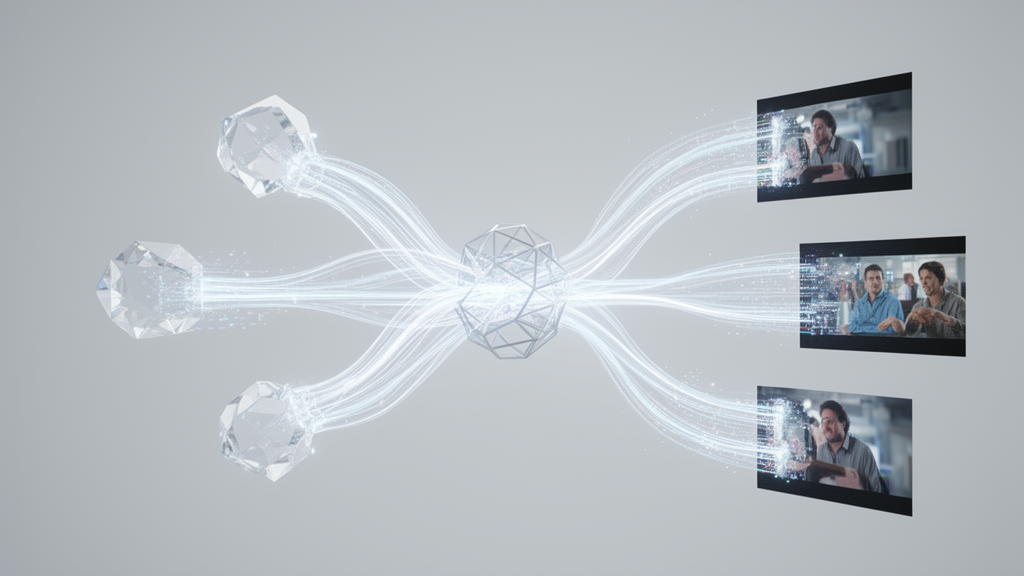
Researchers have developed LiteInterp-NeRV, a lightweight framework designed to reduce the computational demands of neural video representation decoders by substituting selected learned upsampling blocks with non-parametric interpolation operators. Neural Representations for Videos, known as NeRV, encode video sequences by fitting neural networks to map frame indices directly to RGB frames. While effective for video compression and representation, conventional NeRV architectures rely on convolutional upsampling decoders that become computationally intensive when processing high spatial resolutions.
To overcome this computational bottleneck, the study investigated three non-parametric interpolation strategies within the decoder pipeline. These strategies comprised feature-domain bicubic interpolation, discrete cosine transform interpolation with zero high-frequency coefficients, and temporal discrete cosine transform interpolation that reuses high-frequency coefficients from the previously reconstructed frame. The framework pairs these non-parametric operations with an optional refinement module to preserve visual fidelity after upsampling.
Evaluations conducted across multiple video sequences and five distinct quantization levels demonstrated that replacing the final decoder stage yielded the most favorable performance balance. Specifically, adopting feature-domain bicubic interpolation followed by a C32 L2 refinement module reduced overall computational complexity from 201.9 GFLOPs to 67.4 GFLOPs. This architectural modification simultaneously lowered network parameter count from 3.20 million to approximately 2.89 million.
Rate-distortion measurements revealed that the final-stage bicubic configuration achieved approximately a 10 percent reduction in bits per pixel alongside a minor peak signal-to-noise ratio loss of roughly 0.30 dB. Further Bjøntegaard delta rate analysis focused on final-stage replacement indicated average PSNR-based bitrate savings of -5.34 percent for bicubic interpolation, -5.53 percent for discrete cosine transform interpolation with previous high-frequency reuse, and -3.53 percent for discrete cosine transform interpolation with zero high frequencies.
The investigation also evaluated video quality stability through temporal flicker analysis. Across all three interpolation variants, temporal stability remained consistent, yielding average temporal structural similarity values between 0.908 and 0.909. Furthermore, temporal Learned Perceptual Image Patch Similarity ratios remained below 1, confirming that replacing convolutional upsamplers with interpolation operators avoided introducing excessive temporal flicker between consecutive frames.
As an additional architectural extension, the researchers applied low-rank factorization to the fully connected stem network. This factorization reduced the total parameter count down to approximately 2.0 million while substantially decreasing bits per pixel in an 8-bit quantized model without compromising reconstruction quality.
Subject of Research: Lightweight decoder simplification for neural video representations using non-parametric interpolation and low-rank stem factorization
Article Title: LiteInterp-NeRV: lightweight interpolation-based decoder simplification with low-rank stem factorization
Article References: Shanableh, T. (2026). LiteInterp-NeRV: lightweight interpolation-based decoder simplification with low-rank stem factorization. Multimedia Tools and Applications, 85(12), Article 859. https://doi.org/10.1007/s11042-026-22022-x
Image Credits: AI Generated
DOI: 10.1007/s11042-026-22022-x
Keywords: LiteInterp-NeRV, Neural Representations for Videos, Video Compression, Decoder Simplification, Bicubic Interpolation, Discrete Cosine Transform, Non-parametric Upsampling, Computational Complexity, GFLOPs Reduction, Low-Rank Factorization, Bits Per Pixel, Peak Signal-to-Noise Ratio, BD-Rate Analysis, Temporal Flicker, Temporal SSIM, Temporal LPIPS, Model Quantization
News Source: Denise Maddox. (November 21, 2026). LiteInterp-NeRV Cuts Decoder Complexity and Bitrate Using Interpolation Operators. Scienmag.