A research team led by Professor YANG Weishen and Professor ZHU Xuefeng from the Dalian Institute of Chemical Physics of the Chinese Academy of Sciences has developed a liquid-phase growth strategy that densifies ceramic films at substantially lower temperatures. The peer-reviewed study, detailing an alternative fabrication route for functional ceramics, was published in the journal Nature Synthesis.
Ceramic films are widely used in solid-state batteries, energy conversion devices, and advanced electronic systems. Their fabrication, however, has traditionally required high-temperature sintering processes. These elevated temperatures can cause severe processing complications, including elemental volatilization, compositional segregation, and undesirable interfacial reactions between adjacent materials, creating significant barriers to manufacturing high-quality functional devices.
Because of these persistent processing complications, achieving dense and compositionally uniform ceramic films at lower temperatures has remained an ongoing challenge in materials science. Conventional ceramic processing methods rely on high temperatures that often compromise material composition and interface quality, underscoring the necessity for alternative manufacturing strategies that avoid excessive thermal exposure.
To address this challenge, the researchers selected yttrium-doped barium zirconate, commonly designated as BZY, to serve as a representative model material for their investigation. BZY is a proton-conducting ceramic with an exceptionally high melting point of about 2,700 °C, presenting a rigorous test case for low-temperature densification methods.
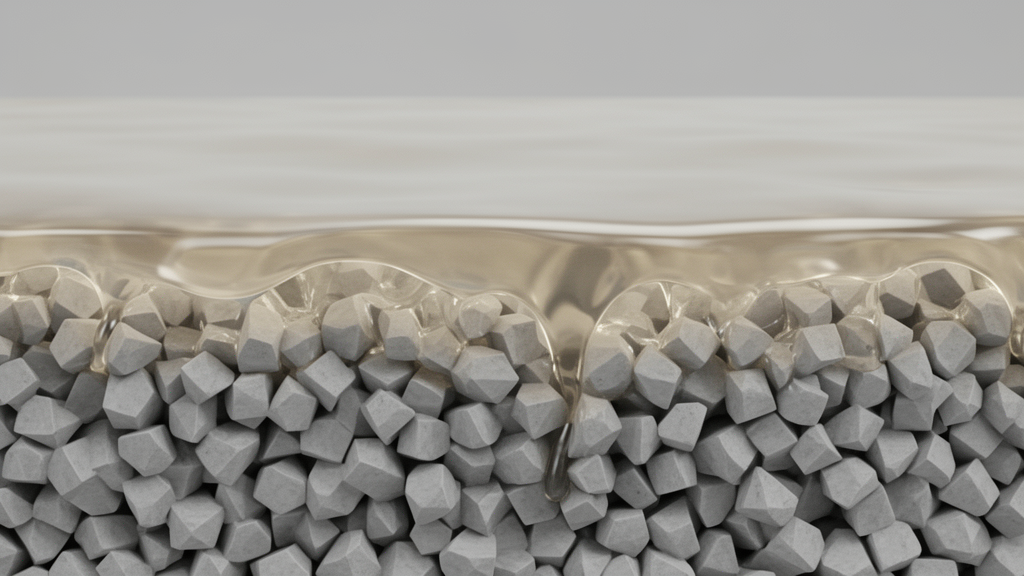
In the team’s liquid-phase growth setup, molten carbonate served as the liquid growth medium, and a seed layer was introduced to guide crystal nucleation and subsequent film growth. Operating at 800 °C under ambient pressure, this approach yielded dense BZY electrolyte films approximately 10 micrometers thick, demonstrating successful densification well below the material’s melting point.
Structural examinations confirmed that the resulting BZY films exhibited uniform chemical composition, minimal secondary-phase formation, and limited interfacial interdiffusion of elements. The research team also utilized in situ characterization to track the entire growth process, monitoring stages from molten carbonate formation and precursor dissolution to crystal nucleation and film growth.
Subsequent fuel-cell tests confirmed the favorable electrochemical performance of the dense BZY electrolyte films. Beyond this initial model system, the researchers showed that the liquid-phase growth strategy can be successfully applied to large-area fabrication, metal substrates, and other ceramic materials, pointing to its broader potential for low-temperature ceramic manufacturing.
According to Professor ZHU, conventional ceramic processing often relies on high temperatures, which can compromise material composition and interface quality. Professor ZHU explained that their liquid-phase growth strategy offers an alternative route to fabricating dense ceramic films at lower temperatures and can be adapted to different ceramic materials and substrates, opening up new possibilities for processing and application.
Subject of Research: Low-temperature liquid-phase growth of dense ceramic films
Article Title: Liquid-phase growth strategy densifies ceramic films at low temperature
Article References: Liquid-phase growth strategy densifies ceramic films at low temperature. Original publication (Bibliographic details unavailable.)
Image Credits: AI Generated
DOI: Not provided
Keywords: ceramic films, liquid-phase growth, low-temperature sintering, densification, yttrium-doped barium zirconate, BZY, proton-conducting ceramic, molten carbonate, seed layer, crystal nucleation, in situ characterization, fuel-cell tests, electrochemical performance, solid-state batteries, energy conversion devices, Dalian Institute of Chemical Physics, Chinese Academy of Sciences, Nature Synthesis
News Source: Bethany Barker. (November 21, 2026). Liquid-Phase Growth Strategy Densifies Ceramic Films at Lower Temperatures. Scienmag.