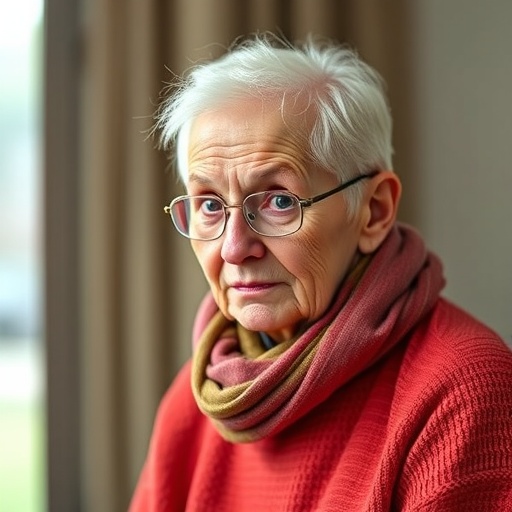
In a groundbreaking exploration of aging and health technology, researchers have unveiled new insights into the nuanced relationship between older adults’ self-perceived frailty and the objectively measured electronic frailty index (eFI). This complex intersection, illuminated by a recently published cross-sectional study, provides critical evidence for enhancing individualized healthcare for the elderly, ushering in a new era of precision health management tailored specifically to aging populations residing independently in their communities.
Frailty, a multidimensional syndrome characterized by decreased physiological reserve and increased vulnerability to adverse health outcomes, has long been recognized as a crucial factor in elderly care. Traditionally assessed through clinical observation and patient history, frailty assessment has now embraced the digital age through the development of electronic frailty indexes. These indexes aggregate large sets of health data to objectively quantify frailty, offering a standardized metric that can be integrated into electronic health records and facilitate more streamlined risk stratification in clinical practice.
The study meticulously compared self-assessments of frailty by community-dwelling older adults with their corresponding eFI scores, revealing a complex and often discordant relationship. Participants’ self-perceptions of their frailty status were gathered using validated subjective questionnaires, while electronic health records were mined to generate comprehensive eFI scores based on accumulated deficits spanning diagnoses, symptoms, and clinical outcomes. By juxtaposing these two data points, the researchers aimed to parse out the degree to which subjective experiences align with data-derived assessments, a question pivotal for designing interventions that resonate with patients’ own health perceptions.
One of the most compelling findings was the variability in concordance between self-perceived frailty and eFI scores across different demographic and psychosocial strata. While some older adults demonstrated remarkable acumen in accurately gauging their health vulnerabilities, others either underestimated or overestimated their frailty relative to the electronic index. This discrepancy has profound implications for healthcare providers, as it suggests that relying solely on either patient-reported outcomes or electronic metrics may result in misclassification and inappropriate allocation of resources.
The study delved into potential contributing factors for these disparities, highlighting the role of cognitive function, emotional well-being, and health literacy. Those with diminished cognitive capacities or lower levels of education were more prone to underreporting frailty symptoms, potentially due to decreased insight or denial, whereas individuals experiencing anxiety or depressive symptoms occasionally overreported frailty. These psychological dimensions underscore the importance of comprehensive geriatric assessments that integrate mental health evaluation alongside physical health monitoring.
From a technical standpoint, the electronic frailty index leveraged in this study represents an advanced application of big data analytics in medicine. By employing algorithms capable of parsing through voluminous and heterogeneous electronic health record data, the eFI quantifies frailty through a cumulative deficit model. This model includes a wide array of clinical parameters ranging from chronic disease diagnoses and laboratory values to functional impairments and medication use. The automated nature of the eFI not only facilitates rapid risk stratification but also allows for longitudinal monitoring at scale, a feat that traditional assessments cannot easily accomplish.
Importantly, the study’s cross-sectional design enables a snapshot view of the interplay between subjective and objective frailty measures, though it invites future longitudinal research to explore dynamics over time. Understanding how self-perception evolves in tandem with objective health decline could be instrumental in early detection and prevention strategies. The data-driven approach used here paves the way for integrating patient-reported outcomes with digital health metrics, promoting a more holistic and patient-centered paradigm in geriatric care.
The public health implications of these findings are vast. As the global population ages, health systems worldwide grapple with increasing demands for efficient, personalized care models. The study advocates for incorporating both self-perceived and electronically measured frailty into routine assessments, thus enabling tailored interventions that reflect individual needs and empower older adults in managing their health proactively. Such dual assessment strategies could improve resource allocation, reduce hospitalizations, and enhance quality of life by addressing both clinical and psychosocial drivers of frailty.
From a clinical implementation perspective, incorporating electronic frailty indexes into primary care workflows offers promising advantages but also poses challenges. Integration requires robust infrastructure, interoperability between diverse health information systems, and clinician training to interpret and act upon eFI data appropriately. Furthermore, engaging older adults in understanding and utilizing their eFI score alongside their own health perceptions necessitates clear communication strategies to avoid confusion and foster shared decision-making.
The research also throws light on the potential for personalized digital health interventions tailored to individual frailty profiles. For instance, mobile health applications and telemonitoring platforms could incorporate eFI algorithms alongside patient input to deliver bespoke recommendations on exercise, nutrition, medication management, and social support. By bridging subjective experiences with objective data, technology-enabled care pathways could enhance adherence and motivation among older adults, addressing the multifactorial nature of frailty.
Ethical considerations emerge as electronic health data becomes more central in frailty assessment. Ensuring data privacy, securing informed consent, and maintaining transparency on how eFI scores influence clinical decisions are paramount. The study highlights the necessity for governance frameworks that balance technological innovation with respect for patient autonomy and equity in access to digital health tools, especially considering the varying levels of digital literacy among older adults.
Methodologically, this study exemplifies rigorous cross-sectional research design with robust statistical analyses employed to dissect correlations and discrepancies between subjective and objective frailty indicators. Sensitivity analyses and subgroup stratifications enhance confidence in the generalizability of findings across diverse community-dwelling elderly populations. Such methodological robustness lays a strong foundation for future research to validate and refine these assessment tools.
Looking ahead, the integration of emerging technologies such as artificial intelligence (AI) and machine learning (ML) with electronic frailty indexes holds exciting possibilities. AI-driven models could enhance the predictive power of eFI by continuously learning from new data streams, including wearable sensors and patient-generated health data, thereby creating dynamic, real-time frailty assessments. This evolution would mark a significant leap towards preventative geriatrics, catching early signs of decline before overt clinical deterioration.
Moreover, the interplay between subjective frailty perception and electronic data can inform behavioral health research. Understanding how self-awareness influences help-seeking behaviors, compliance with medical advice, and psychosocial resilience could guide interventions that not only address physical frailty but also empower mental and emotional well-being in aging populations. Such integrative strategies are critical for holistic health promotion among the elderly.
In summary, the study advances the science of frailty assessment by bridging subjective and objective domains, underscoring the complexity of aging as a biopsychosocial process. It calls for healthcare systems to embrace sophisticated digital tools while maintaining a human-centered approach that honors individual experiences. As the demographic tide shifts towards longer lifespans, innovations like the electronic frailty index, complemented by patient self-reporting, will be instrumental in crafting sustainable, effective care models for older adults.
This pioneering work sets a precedent for future interdisciplinary research, combining geriatrics, informatics, psychology, and public health. It offers a compelling vision of aging well supported by technology and empathy, a vision that resonates powerfully in the quest to demystify frailty and champion dignity in late life. The integration of these dual perspectives on frailty signifies a critical step forward in enabling older adults to thrive within their communities, supported by precision health insights and personalized care.
Subject of Research: The relationship between self-perceived frailty and the electronic frailty index in community-dwelling older adults.
Article Title: A cross-sectional study of the relationship between community dwelling older adults’ self-perceived frailty and their electronic frailty index score.
Article References: Barber-Fleming, V., Anand, A., Wilkinson, H. et al. A cross-sectional study of the relationship between community dwelling older adults’ self-perceived frailty and their electronic frailty index score. BMC Geriatr (2026). https://doi.org/10.1186/s12877-026-07386-x
Image Credits: AI Generated
Tags: community-dwelling elderly health studiescross-sectional frailty researchdigital health records in frailty evaluationelectronic frailty index (eFI) assessmentindividualized healthcare for aging populationsintegration of eFI in clinical practicemultidimensional frailty syndrome in agingolder adults frailty perceptionsprecision health management for elderlyrisk stratification in elderly careself-assessed frailty vs objective measuressubjective vs objective frailty measurement