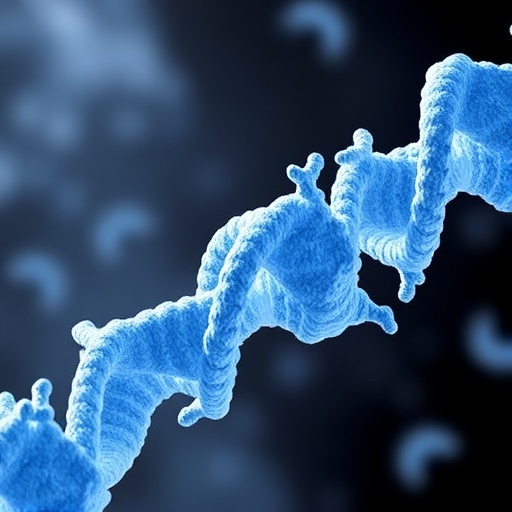
For decades, the compact organization of DNA within the human cell nucleus has been conceptualized as a rigid and highly ordered structure facilitated by the linker histone H1. Traditional molecular biology frameworks depict H1 as a static clamp, binding stably to nucleosomes—the fundamental units of chromatin—and orchestrating the formation of well-defined higher-order chromatin fibers, often illustrated as 30-nm thick fibers. This classical model has been a cornerstone for understanding chromatin architecture and its role in genome regulation. However, recent research challenges this perspective, unveiling a more dynamic and fluid nature of chromatin organization mediated by H1, fundamentally reshaping our comprehension of genome packaging and accessibility.
The human genome encapsulates a vast length of DNA—if stretched end to end, the 46 chromosomes span nearly two meters—yet this extensive polymer fits within the confined space of the nucleus, approximately 10 micrometers in diameter. Chromatin organization achieves this by wrapping DNA around histone proteins to form nucleosomes, which then fold and compact into higher-order structures. The role of histone H1, the linker histone, has long been thought to stabilize and condense these nucleosomal arrays into rigid fibers, thereby playing a pivotal part in chromatin’s physical architecture. However, this conventional image is increasingly contradicted by experimental evidence from living cells, where such ordered fibers appear rarely, if at all.
A multidisciplinary team of researchers led by Professor Kazuhiro Maeshima at the National Institute of Genetics (Japan) and the University of Cambridge (UK) has employed cutting-edge imaging techniques combined with advanced computational modeling to elucidate the true nature of H1’s involvement in chromatin architecture inside living human cells. Their findings, recently published in Science Advances, radically depart from the “static clamp” model. Instead, they propose that H1 operates as a liquid-like “glue,” dynamically binding and releasing nucleosomes, allowing chromatin to fold into a highly condensed yet fluid and adaptable structure.
Utilizing super-resolution fluorescence microscopy capable of single-nucleosome resolution, the researchers sparsely labeled nucleosomes within living cells to track their real-time dynamics. This novel approach provided unprecedented insights into chromatin behavior at the nanoscale, revealing that nucleosomes exhibit mobility inconsistent with a rigid, static fiber. Instead, chromatin behaves as a condensed but fluid entity, where nucleosomes transiently associate with histone H1, which dynamically mediates chromatin folding without locking it into a fixed configuration.
The dynamic binding of H1 contrasts starkly with previous models, suggesting a paradigm shift in understanding chromatin compaction. Rather than enforcing a stiff structure, H1 forms transient multivalent interactions bridging multiple nucleosomes. These interactions generate a flexible network, comparable to a liquid-like condensate, which compacts chromatin while maintaining accessibility. Such a mechanism has profound implications for genomic functionality, as it enables essential molecular processes—including transcription, replication, and DNA repair—to occur within a densely packed yet permeable chromatin environment.
To complement and interpret their experimental findings, the team developed coarse-grained computational models that simulate chromatin behavior with near-atomic detail through molecular dynamics (MD) simulations. These simulations revealed the underlying physical mechanisms by which H1 fosters chromatin compaction dynamically. By engaging in multiple interaction sites across nucleosomes, H1 forms a versatile organizational scaffold that supports dynamic chromatin condensation and fluidity simultaneously.
Professor Maeshima emphasized that understanding chromatin as a dynamic fluid network held together by histone H1 recasts longstanding assumptions about genome organization. This model explains how chromatin can be densely packed yet remain sufficiently adaptable and accessible to the molecular machinery necessary for proper genome function. It also illuminates how varied H1 interactions can influence chromatin’s large-scale structure and thereby impact gene expression regulation and genome maintenance.
The implications extend to disease pathology as well. Aberrations in H1 function or dynamics could disrupt chromatin fluidity, potentially leading to genome dysregulation involved in cancer, developmental disorders, or aging-related diseases. This study thus not only advances fundamental biology but also opens new avenues for medical research targeting chromatin architecture and histone dynamics.
Co-investigator Dr. Rosana Collepardo-Guevara highlighted the power of combining experimental single-molecule observations with computational modeling. This integrative approach allowed the team to visualize and quantify the microscopic and mesoscale chromatin interactions critical for cellular function, going beyond static images to reveal chromatin’s emergent properties as a dynamic material.
The study also leverages state-of-the-art fluorescence tracking methodologies, which enable visualization of nucleosome motions within intact, living human cells with unprecedented resolution and minimal perturbation. This technique bridges the gap between in vitro structural biology and the complex, dynamic nuclear environment, providing critical insights into the real-time behavior of chromatin.
In conclusion, this research redefines the role of histone H1 from a rigid chromatin clamp to a dynamic, multivalent organizer that mediates chromatin as a fluid, adaptable, and compacted network. This liquid-like chromatin model reconciles past conflicting observations and paves the way for novel understandings of genome regulation, organization, and dysfunction. As we absorb the dynamic choreography of nucleosomes and histone H1 within the nucleus, the picture of the genome emerges not as a static blueprint encased in chromatin, but as a living, breathing landscape sculpted by molecular interactions that balance stability with flexibility.
Subject of Research: Chromatin architecture and dynamics mediated by linker histone H1 in living human cells.
Article Title: Revising the model of H1 binding and chromatin compaction.
News Publication Date: April 8, 2026.
Web References:
National Institute of Genetics: https://www.nig.ac.jp/nig/
Research Organization of Information and Systems (ROIS): https://www.rois.ac.jp/en/index.html
DOI to article: 10.1126/sciadv.aec9801
References:
Maeshima, K., Shimazoe, M. A., Tamura, S., Collepardo-Guevara, R., Huertas, J., Phillips, C., Farr, S., Ashwin, S. S., Sasai, M. (2026). Dynamic and liquid-like binding of histone H1 mediates chromatin compaction while maintaining genome function. Science Advances. DOI: 10.1126/sciadv.aec9801.
Image Credits: Masa A. Shimazoe, Sachiko Tamura & Kazuhiro Maeshima, National Institute of Genetics, ROIS.
Keywords
Chromatin, histone H1, nucleosome dynamics, genome compaction, liquid-like chromatin, super-resolution microscopy, molecular dynamics simulation, epigenetics, genome organization, nuclear architecture, molecular biology, chromatin fluidity.
Tags: chromatin fluidity and genome regulationchromatin organization dynamicsDNA condensation in nucleusdynamic chromatin architecturegenome packaging and accessibilityhigher-order chromatin structurehistone H1 as chromatin gluehistone H1 role in chromatin compactionlinker histone H1 functionsliquid-like chromatin bindingnucleosome interaction mechanismsrethinking chromatin models