A mathematical modeling study conducted in the Spercheios River basin of Central Greece demonstrates how linear programming can be deployed as an agricultural policy tool to optimize crop distribution while safeguarding vulnerable surface water bodies. Published by researchers Konstantinos Fytilis and Ioannis Karaouzas in Agricultural Research, the investigation examines how the primary agricultural sector can reconcile production goals with rigorous environmental standards. Agricultural runoff driven by intensive cultivation, fertilizer application, and irrigation demand represents a leading source of surface water and groundwater degradation throughout Mediterranean catchments. By formulating an optimization model centered on the ELKE sub-basin, the authors simulated five distinct environmental vulnerability scenarios defined by nutrient water quality classifications ranging from high to bad. The mathematical analysis revealed that only four of the five scenarios yielded feasible agricultural production plans, demonstrating that strict ecological thresholds require radical shifts in regional crop composition to maintain economic productivity while cutting agrochemical pollution.
The study addresses deep-seated environmental challenges governed by European regulatory frameworks, notably the Water Framework Directive EC/2000/60 and the Common Agricultural Policy spanning the 2023 to 2027 programming period. The Water Framework Directive established binding obligations for European Union member states to achieve good ecological status across all surface water bodies, evaluating biological, hydromorphological, chemical, and physicochemical quality elements. However, meeting these statutory ecological targets has proven exceptionally difficult in basins characterized by intensive farming and concentrated human activity. Concurrently, the reformed Common Agricultural Policy aligns with the European Green Deal by prioritizing climate mitigation, environmental sustainability, food safety, and biodiversity conservation over unfettered yield maximization. The research authors highlight that conventional farm management frequently prioritizes immediate financial returns through high agrochemical inputs and unregulated water extraction without internalizing downstream ecological costs, producing widespread nitrate and phosphate pollution across river systems and underlying aquifers.
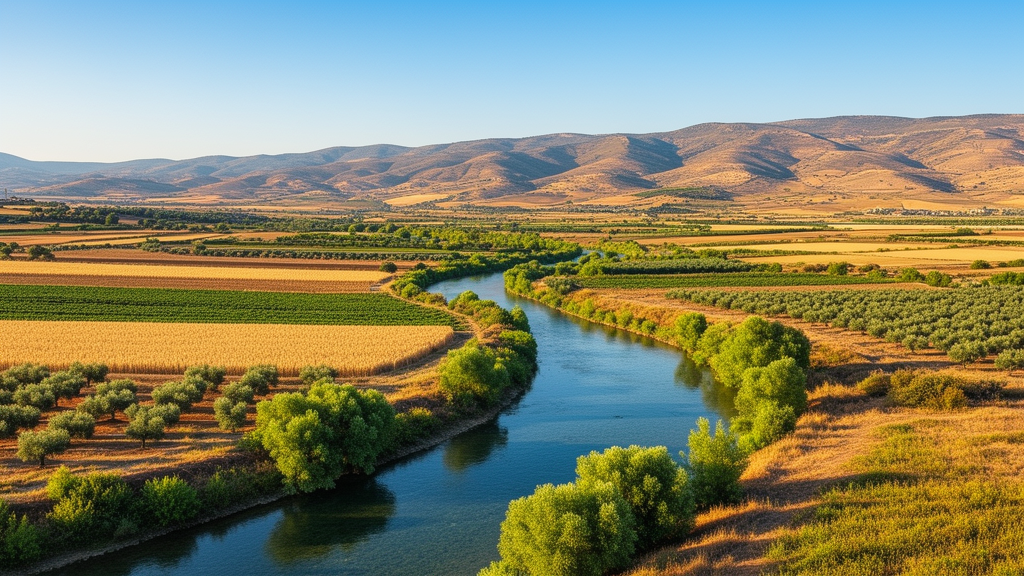
Geographically and hydrologically, the study centers on the Spercheios River catchment in the Phthiotida regional unit of Central Greece. The main river originates on Mount Timfristos, gathers discharge from tributaries originating across the Vardousia, Othrys, Oiti, and Kallidromo mountain ranges, and travels approximately eighty-five kilometers before discharging into the Maliakos Gulf. The drainage basin encompasses an area of 1,793.5 square kilometers with a steep average basin slope of thirty-three percent, terminating in a delta extending over 196 square kilometers southeast of Lamia and east of Anthili village. The region exhibits a sub-tropical Mediterranean climate marked by warm, dry summers and mild, wet winters. Greece exhibits substantial temporal and spatial precipitation imbalances, with approximately eighty-five percent of annual rainfall occurring during the winter months, and with significantly higher water availability west of the Pindos mountain range than in the eastern territory, leaving areas such as Thessaly, Attica, the Cyclades, and the eastern Peloponnese persistently water-deficient.
The mathematical optimization focused specifically on the ELKE sub-basin, which spans 1,392.60 square kilometers and concentrates nearly all major anthropogenic pressures across the Spercheios catchment. The ELKE monitoring station sits at an altitude of thirteen meters above sea level with a localized terrain slope of 0.05 percent. Across the wider basin, total available arable land encompasses 512,366.58 acres, of which 405,072.07 acres are under active cultivation, while the specific study zone encompasses 320,818.076 available agricultural acres, with 301,774.78 acres utilized for cultivation and associated activities. Pasturelands represent 131,036.96 acres, stables occupy 302.47 acres, and renewable energy facilities cover 140.49 acres. Baseline physicochemical sampling conducted in August 2020 under the National Water Quality Monitoring Program established baseline concentrations of 0.816 milligrams per liter for nitrate nitrogen and 127 micrograms per liter for phosphate phosphorus, corresponding to estimated seasonal fertilization inputs of 4,470.910 tons of nitrogen and 1,734.737 tons of phosphate formulations.
To solve the complex land and water allocation problem, the researchers formulated a multicriteria linear programming model that establishes an optimal production plan under competing environmental, social, and agronomic constraints. The objective function maximizes total net crop returns across the cultivated holdings, where total production volume serves as the primary optimization variable. The mathematical model subjected the cropping patterns to explicit constraints: total nitrogen fertilizer application, total phosphate fertilizer application, total irrigation water consumption in cubic meters per acre, total agricultural land use in acres, and total labor requirements expressed in working hours, alongside non-negativity parameters. Historical baseline conditions in the study zone encompassed twenty-two distinct crop holdings generating a cumulative baseline production mass of 240,230.84 tons. By adjusting the allowable nitrogen and phosphate thresholds across five distinct vulnerability scenarios, the linear programming algorithm evaluated how land allocation would systematically reconfigure among nineteen to twenty-two potential crops.
The first vulnerability scenario evaluated the agricultural adjustments necessary to achieve high surface water quality under the established nutrient classification scheme. Under these highly restrictive nutrient boundaries, the linear programming solver eliminated twenty of the existing twenty-two crop holdings, directing all agricultural activity exclusively into the intensive cultivation of tomatoes and peppers. Despite this dramatic concentration of cropping types, the model calculated an overall crop yield increase of 33.90 percent, reaching 321,658.55 tons of total agricultural mass. Concurrently, environmental pressures dropped precipitously compared to baseline practices: total nitrogen fertilizer application decreased by 73.05 percent, phosphate fertilizer application declined by 44.89 percent, and total irrigation water volume dropped by 52.65 percent. Cultivated land requirements fell by 75.58 percent, while total labor requirements decreased by 10.27 percent, proving that high water quality is technically compatible with aggregate yield gains if production shifts into specific high-yielding, resource-efficient horticultural crops.
In the second vulnerability scenario, which modeled conditions required to attain good water quality, the linear programming algorithm selected an optimal crop portfolio consisting of three crops: peanuts, tomatoes, and peppers. All other historical crop holdings were completely phased out in the mathematical solution. Under this second scenario, total crop yields reached 498,752.23 tons, representing a 107.61 percent increase relative to the baseline agricultural output. The environmental constraints associated with good ecological status resulted in a 26.47 percent reduction in nitrogen fertilizer usage and a 17.32 percent reduction in phosphate fertilizer usage. Total irrigation water requirements decreased moderately by 5.00 percent, while overall agricultural land use dropped by 44.40 percent. Notably, total labor requirements measured in working hours remained completely unchanged from baseline levels, demonstrating that good surface water quality could be pursued without causing an immediate contraction in agricultural employment across the rural basin.
The third vulnerability scenario examined the parameters associated with moderate water quality, which permits higher nutrient thresholds in receiving river channels. Under the optimal solution generated for this scenario, the model selected three crops: alfalfa, tomatoes, and peanuts, while zeroing out all remaining agricultural holdings. Total crop yields expanded substantially to 740,318.34 tons, representing an increase of 208.17 percent above baseline production levels. Because alfalfa constitutes a water-demanding forage crop, total irrigation requirements increased by 15.60 percent above baseline consumption. Fertilizer dynamics diverged significantly: nitrogen fertilizer application decreased by 25.25 percent, whereas total phosphate fertilizer application increased by 29.92 percent to satisfy crop physiological requirements. Total land use declined by 40.26 percent, while total agricultural labor requirements dropped sharply by 67.95 percent, underscoring that moderate water quality scenarios allow substantial biomass generation but alter resource and labor demands across the catchment.
The fourth and fifth scenarios explored the lower boundaries of water resource management, revealing clear mathematical and physical limits to agricultural adaptation. In the fourth vulnerability scenario, representing poor surface water quality, the optimal solution identified a production plan composed of alfalfa, tomatoes, and peaches. Total crop yields rose by 83.79 percent to reach 441,516.66 tons, accompanied by a 15.60 percent rise in irrigation demand, while working hours and land use decreased by 38.02 percent and 47.85 percent, respectively. However, agrochemical pollution increased dramatically: total nitrogen application rose by 60.54 percent and phosphate application rose by 30.71 percent. In sharp contrast, the fifth vulnerability scenario, designed to reflect bad water quality conditions, failed to produce any feasible mathematical solution. The linear programming solver returned an explicit error indicating that the accumulated environmental and physical constraints could not be mutually satisfied, proving that deteriorating water quality conditions ultimately undermine the systemic feasibility of regional agricultural planning.
Long-term physicochemical monitoring data from the Spercheios River between 2013 and 2023 validated these mathematical findings, showing that the river’s water quality consistently oscillated between good, moderate, and poor depending on seasonal discharge and fertilizer leaching, while never recording high or bad classifications. To translate these mathematical insights into practical administration, the authors recommend developing dedicated digital decision-support applications for mobile devices and computers, enabling local farmers and regional authorities to input specific field constraints and receive optimized cropping recommendations in real time. The authors emphasize that public authorities, including regional units and municipal governments, must combine mathematical optimization tools with targeted incentives, structured training seminars, and best management practices such as cover cropping and riparian buffer zones mandated by the 2023 to 2027 Common Agricultural Policy to protect Mediterranean aquatic ecosystems.
Subject of Research: Optimization of agricultural crop distribution and water resources management in the Spercheios River basin
Article Title: Water Resources Management as An Agricultural Policy Tool for Crop Restructuring: Implementation in a Rural Area of the Spercheios River Basin
Article References: Fytilis, K., & Karaouzas, I. (2026). Water Resources Management as An Agricultural Policy Tool for Crop Restructuring: Implementation in a Rural Area of the Spercheios River Basin. Agricultural Research, 15(1), 499-509. https://doi.org/10.1007/s40003-025-00861-8
Image Credits: AI Generated
DOI: 10.1007/s40003-025-00861-8
Keywords: Spercheios River basin, ELKE sub-basin, crop restructuring, linear programming, agricultural water management, nitrate pollution, phosphate fertilizers, irrigation management, Water Framework Directive, Common Agricultural Policy, vulnerability scenarios, surface water quality, mathematical programming, agricultural runoff, best management practices, Central Greece
News Source: Alan Morgan. (November 24, 2026). Linear Programming Model Restructures Spercheios Basin Crops to Protect River Water Quality. Scienmag.