A scientific investigation into dark fermentative biohydrogen production has revealed that combining two common organic inhibitors, limonene and phenol, produces an antagonistic toxicological interaction that unexpectedly enhances hydrogen yields compared to uninhibited controls and individual inhibitor exposures. Researchers examining anaerobic biochemical pathways demonstrated that rather than compounding cellular damage, specific binary mixtures of these antimicrobial agents attenuated overall toxicity toward fermentative bacteria. Operating batch bioreactors supplied with a standard glucose feedstock, the investigation identified that a combination containing forty percent limonene and sixty percent phenol relative to their respective inhibitory thresholds generated a cumulative volume of 296.6 ± 7.9 milliliters of hydrogen gas, representing an increase of thirty percent over inhibitor-free baseline fermentations. This discovery challenges the conventional assumption that citrus processing residues are fundamentally unsuited for biological energy recovery due to their dual burden of volatile terpenes and polyphenols. The findings show that dark fermentation remains feasible despite the presence of these inhibitory compounds.
Organic residues generated during the industrial processing of citrus fruits have historically presented formidable obstacles for biological biogas technologies because their chemical composition contains potent microbial inhibitors that disrupt anaerobic digestion. Essential oils concentrated within citrus peels, most notably the monoterpene limonene, alongside minor constituents such as alpha-terpineol and para-cymene, have repeatedly been shown to inhibit anaerobic digestion by disrupting cell membranes and interfering with upstream hydrolysis and acidogenic conversion stages. Compounding this challenge, the hydrolysis of citrus biomass releases substantial concentrations of phenolic secondary plant metabolites, which typically constitute over fifty percent of dry peel mass. Structurally containing aromatic rings attached to hydroxyl groups, phenolic compounds exhibit severe antimicrobial toxicity between 0.7 and 1.5 grams per liter by causing enzymatic inhibition, nucleic acid damage, and cell membrane disruption. While earlier anaerobic research focused largely on methanogenesis, their combined mechanistic impacts on dark fermentative hydrogen production had remained poorly understood until this controlled investigation.
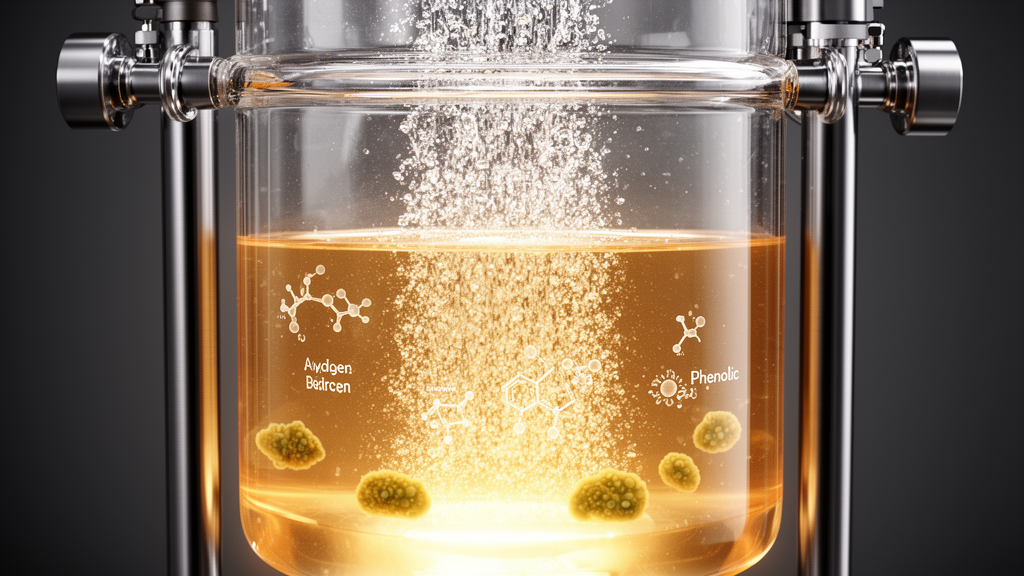
To isolate the exact biochemical interactions between limonene and phenol without interference from complex real matrices, the experimental design utilized a defined medium containing five grams per liter of glucose as the carbon substrate. Fermentation trials were conducted in automated batch bioreactors within an AMPTS II platform, utilizing reaction vessels with a total volume of 600 milliliters and a working volume of 360 milliliters. Granular anaerobic sludge acquired from a flour mill served as the inoculum, which was thermally treated at 105 degrees Celsius for twelve hours to eliminate methanogenic activity. Following heat conditioning, total solids and total volatile solids were measured at 994.2 and 829.8 grams per kilogram, establishing a maintained substrate-to-inoculum ratio of 2.7. The reaction medium received a micronutrient solution comprising ammonium chloride, MES buffer, and vital mineral salts, with initial pH adjusted to 7.5 and internal reactor temperature maintained at 37 degrees Celsius with intermittent mechanical stirring at 110 revolutions per minute.
The research team employed the classical isobologram methodology to rigorously assess synergistic and antagonistic interactions occurring between the two inhibitory compounds during dark fermentation. Benchmark concentrations were selected according to published minimum inhibitory concentrations, setting the upper boundaries at 2000 milligrams per liter for limonene and 1000 milligrams per liter for phenol. Six binary proportions were established across these baseline thresholds: 100:0, 80:20, 60:40, 40:60, 20:80, and 0:100, alongside an inhibitor-free control. In isobologram analysis, experimental mixture coordinates plotting along a straight diagonal line indicate additive toxicity, where individual components contribute proportionally to biological suppression. Points falling below this line indicate synergy, whereas coordinates positioned above the additive line denote antagonism, where the combined inhibitory effect is less than that of the individual substances acting alone. By evaluating proportional hydrogen production against this theoretical boundary, the researchers demonstrated that binary mixtures of limonene and phenol consistently attenuated their expected individual toxicities.
Experimental cumulative hydrogen generation tracked across all batch trials conformed closely to the modified Gompertz model, displaying mathematical fits exceeding 98.99 percent across every evaluated combination. Statistical evaluation using one-way ANOVA and Dunnett’s test revealed that binary mixtures of limonene and phenol produced significant enhancements in cumulative hydrogen volume compared to the control. The 40:60 and 20:80 combinations yielded the greatest accumulated gas volumes, reaching 296.6 ± 7.9 milliliters and 294.6 ± 6.9 milliliters of hydrogen, respectively, both corresponding to a thirty percent increase over the baseline control. The 60:40 and 80:20 combinations produced 282.5 ± 17.2 milliliters and 270.8 ± 7.9 milliliters, reflecting respective volume increases of twenty-three percent and eighteen percent. In contrast, trials evaluating the inhibitors individually showed substantially smaller increases, with the 100:0 limonene and 0:100 phenol assays generating 250.4 ± 3.3 milliliters and 254.0 ± 5.5 milliliters of hydrogen, representing modest gains of only nine percent and eleven percent over the control.
Despite superior cumulative production volumes, the kinetic parameters revealed that phenol imposed a substantial inhibitory constraint on microbial adaptation and production rates. Experimental lag time expanded systematically as the proportion of phenol increased, reaching a maximum adaptation delay of 16.0 ± 0.2 hours in the 0:100 phenol treatment compared to only 7.2 ± 0.1 hours in the 100:0 limonene condition. Volumetric hydrogen productivity was similarly suppressed in phenol-dominated systems, decreasing significantly to 28.3 ± 1.7 milliliters per liter per hour in the 0:100 combination and 39.6 ± 1.9 milliliters per liter per hour in the 20:80 mixture, representing forty-two percent and nineteen percent reductions relative to the control. Limonene alone produced a smaller productivity reduction of 12.7 percent, while balanced intermediate mixtures maintained productivity within 6.7 percent of control values. These observations confirm that phenol acts as a more severe kinetic inhibitor than limonene by extending adaptation latency and reducing instantaneous hourly gas synthesis.
Evaluation of substrate conversion efficiency demonstrated that antagonistic inhibitor interactions actively stimulated metabolic hydrogen yields per unit of glucose consumed. The 40:60 limonene-to-phenol combination attained the highest substrate yield of 164.8 ± 4.4 milliliters of hydrogen per gram of glucose, surpassing the uninhibited control yield of 126.69 ± 1.36 milliliters, the limonene-only trial at 139.13 ± 2.18 milliliters, and the phenol-only condition at 141.13 ± 3.03 milliliters. When calculated on a molar basis, the 40:60 mixture generated an exceptional yield of 1.13 moles of hydrogen per mole of glucose, outperforming the control value of 0.87 moles and the single-compound additions of 0.95 moles for limonene and 0.97 moles for phenol. Standard biochemical stoichiometry dictates potential yields of four moles of hydrogen per mole of glucose through acetic acid pathways and two moles through butyric acid pathways. The experimental yield of 1.13 moles demonstrates that antagonistic compound interactions effectively favored catabolic routes driving hydrogen synthesis.
Analysis of soluble fermentation metabolites demonstrated that inhibitor composition heavily influenced acidogenic and solventogenic metabolic branching. In the optimal 40:60 combination, lactic acid was the predominant metabolite at 829 milligrams per liter, accompanied by 728 milligrams per liter of acetic acid, 285 milligrams per liter of propionic acid, 98 milligrams per liter of succinic acid, and 5.7 milligrams per liter of formic acid, while butyric acid was absent. Conversely, the 100:0 limonene trial triggered a marked metabolic shift toward solventogenesis, accumulating ethanol as the primary end product at 1195.9 milligrams per liter alongside 946.8 milligrams per liter of propionic acid. In the 0:100 phenol assay, acetic acid predominated at 824 milligrams per liter with 339 milligrams per liter of propionic acid, and ethanol remained undetectable. Mixtures containing higher proportions of limonene exhibited greater diversity of volatile fatty acids, producing detectable amounts of butanol alongside formic, valeric, and isovaleric acids, confirming limonene’s role in promoting solventogenesis under microbial stress.
Chromatographic monitoring showed that the fermentative microbial consortia actively degraded both limonene and phenol throughout the operational cycle. Phenol removal efficiencies ranged between thirteen and twenty-seven percent across all treatments, with the highest removal observed in the 60:40 and 40:60 combinations, which reduced final phenol concentrations to 275.9 and 400.5 milligrams per liter, while the 0:100 trial achieved only 13.4 percent removal. Limonene degradation was even more complete, declining from initial concentrations of 800 and 400 milligrams per liter to undetectable levels by the end of fermentation in the 40:60 and 20:80 mixtures. Residual concentrations of 475.1, 195.3, and 72.4 milligrams per liter were detected in the 100:0, 80:20, and 60:40 trials. Gas chromatography-mass spectrometry revealed the formation of aromatic and cyclic degradation by-products, predominantly 1-ethyl-3-methylbenzene alongside indane and ortho-cymene. These biotransformation dynamics indicate that fermentative bacteria actively metabolized and transformed the inhibitory compounds, mitigating their antimicrobial pressure over time.
High-throughput 16S rRNA gene sequencing revealed significant taxonomic restructuring from the initial inoculum to the final fermentative community. While the original unheated granular sludge was dominated by methanogenic archaea including Methanosaeta at 43 percent and Methanobacterium at 14.6 percent with a Shannon diversity index of 6.6, the heat-treated systems shifted entirely toward bacterial dominance. Members of the family Enterobacteriaceae dominated across all treatments, comprising between 47 and 75 percent of the microbial community. In the high-yielding 40:60 combination, unclassified Enterobacteriaceae represented 38.7 percent and Enterobacter accounted for 26.2 percent, demonstrating that these bacteria grew successfully despite initial concentrations of 800 milligrams per liter of limonene and 600 milligrams per liter of phenol. Residual methanogens were present in negligible proportions without producing methane. The tolerance of Enterobacteriaceae is linked to their Gram-negative outer membrane, which acts as a protective barrier against lipophilic compounds. These results confirm the feasibility of dark fermentation for biohydrogen production from citrus processing wastes without complete inhibitor removal.
Subject of Research: Interactive effects of limonene and phenol on dark fermentative hydrogen production
Article Title: Interactive Effects of Limonene and Phenol on Dark Fermentative Hydrogen Production: Metabolic and Microbial Insights
Article References: Sánchez-Valeriano, N., & Moreno-Andrade, I. (2026). Interactive Effects of Limonene and Phenol on Dark Fermentative Hydrogen Production: Metabolic and Microbial Insights. Applied Biochemistry and Biotechnology, 198(8), 6011-6028. https://doi.org/10.1007/s12010-026-05732-8
Image Credits: AI Generated
DOI: 10.1007/s12010-026-05732-8
Keywords: biohydrogen production, dark fermentation, limonene, phenol, citrus waste, isobologram analysis, antagonistic interaction, Enterobacteriaceae, Enterobacter, anaerobic digestion, glucose fermentation, volatile fatty acids, lactic acid, solventogenesis, Gompertz model, lag time, 1-ethyl-3-methylbenzene
News Source: Drew Townsend. (November 24, 2026). Limonene and Phenol Mixtures Boost Dark Fermentation Hydrogen Production. Scienmag.