• HOME
  • NEWS
  • EXPLORE
    • CAREER
      • Companies
      • Jobs
    • EVENTS
    • iGEM
      • News
      • Team
    • PHOTOS
    • VIDEO
    • WIKI
  • BLOG
  • COMMUNITY
    • FACEBOOK
    • INSTAGRAM
    • TWITTER
Monday, November 16, 2026
BIOENGINEER.ORG
No Result
View All Result
  • Login
  • HOME
  • NEWS
  • EXPLORE
    • CAREER
      • Companies
      • Jobs
        • Lecturer
        • PhD Studentship
        • Postdoc
        • Research Assistant
    • EVENTS
    • iGEM
      • News
      • Team
    • PHOTOS
    • VIDEO
    • WIKI
  • BLOG
  • COMMUNITY
    • FACEBOOK
    • INSTAGRAM
    • TWITTER
No Result
View All Result
Bioengineer.org
No Result
View All Result
Home NEWS Science News Technology

Lightweight Vision Model Improves Underground Coal and Gangue Detection Accuracy

by
November 10, 2026
in Technology
Reading Time: 2 mins read
0
Lightweight Vision Model Improves Underground Coal and Gangue Detection Accuracy

Lightweight Vision Model Improves Underground Coal and Gangue Detection Accuracy

Share on FacebookShare on TwitterShare on LinkedinShare on RedditShare on Telegram

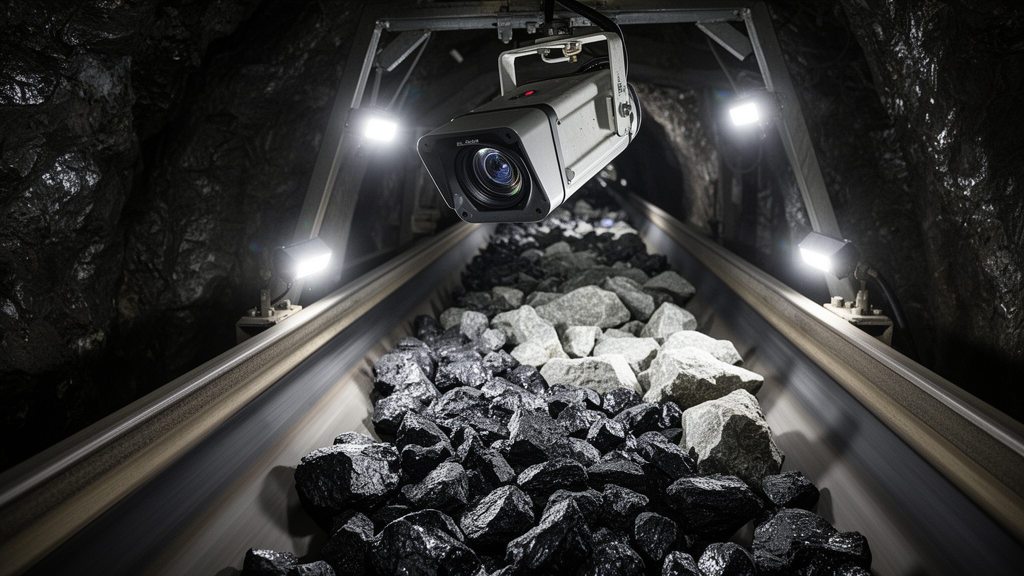
A research team has developed a lightweight, structure-aware computer vision detector called LCGA-YOLO11 that accurately identifies coal and gangue under harsh underground mining conditions. Built upon the YOLO11 object detection framework, the proposed model is engineered to provide reliable online perception during automated coal handling on conveyor belt systems. In validation experiments, the detector achieved a mean average precision of 95.94 percent at an intersection-over-union threshold of 0.5.

The detector was designed to address degraded imaging, dense stacking, adhesion, and occlusion in underground coal handling.

Crucially, the engineering design preserved the underlying end-to-end detection paradigm and the established multi-scale output mechanism of the original network. Rather than altering the complete detection pipeline, the authors introduced PP-LCNet to carry out lightweight feature extraction.

The study introduced CoalGangueAM to enhance structural and boundary representation. Structure-aware features improve boundary detection under stacking, adhesion, and occlusion. Furthermore, the researchers adopted imWIoU to improve localization stability.

The dataset was constructed from Sima Coal Mine of Lu’an Group. After augmentation, the dataset comprised 7,500 coal-gangue images. The research team partitioned this collection into 6,000 images designated for model training and 1,500 images reserved exclusively for objective validation testing.

Performance evaluations confirmed that LCGA-YOLO11 achieved substantial improvements in detection accuracy while lowering computational overhead compared to the baseline network. Alongside the 95.94 percent mAP at an intersection-over-union threshold of 0.5, the model recorded a precision of 93.46 percent and a recall rate of 90.36 percent. Concurrently, the total parameter count decreased from 2.59 million down to 2.33 million. Computational demands dropped correspondingly, with floating-point operations falling from 6.44 to 5.28 giga floating-point operations, confirming significant gains in structural efficiency.

The experimental outcomes indicate that the combination of lightweight feature extraction, boundary-focused attention, and stabilized localization provides a viable technical approach for underground coal handling. By achieving higher accuracy alongside reduced parameter counts and lower computational demands, LCGA-YOLO11 supports real-time monitoring in harsh belt transport environments. The authors note that the architecture delivers an effective balance between detection accuracy and computational efficiency, offering an operational method to maintain reliable online perception despite degraded imaging, stacking, and visual occlusion in underground mines.

Subject of Research: Lightweight computer vision detection of coal and gangue in underground mining environments

Article Title: Lightweight structure-aware detection of coal and gangue under complex operating conditions

Article References: Yue, X., Zhao, Z., Zhang, P., Chen, X., Hui, Z., & Shang, W. (2026). Lightweight structure-aware detection of coal and gangue under complex operating conditions. Geomechanics and Geophysics for Geo-Energy and Geo-Resources. https://doi.org/10.1007/s40948-026-01222-7

Image Credits: AI Generated

DOI: 10.1007/s40948-026-01222-7

Keywords: coal mining, gangue detection, YOLO11, computer vision, object detection, deep learning, mine automation, real-time monitoring, Lightweight, structure-aware, detection, coal

News Source: Blake Davidson. (November 10, 2026). Lightweight Vision Model Improves Underground Coal and Gangue Detection Accuracy. Scienmag.


Tags: coalcoal miningComputer Visiondeep learningdetectiongangue detectionlightweightmine automationobject detectionReal-time monitoringstructure-awareYOLO11
Share12Tweet7Share2ShareShareShare1

Related Posts

Rethinking Faculty Development for Teaching in the Generative AI Era

Rethinking Faculty Development for Teaching in the Generative AI Era

November 15, 2026
AI Frameworks Advance Predictive Resistome Surveillance and AMR Risk Assessment

AI Frameworks Advance Predictive Resistome Surveillance and AMR Risk Assessment

November 15, 2026

Manure Redistribution Could Slash Norway’s Agricultural Mineral Phosphorus Imports by 78 Percent

November 15, 2026

Rising Faculty Development Participation in Japan Masks Declines in Collegial Formats

November 15, 2026

POPULAR NEWS

  • White Analytical Chemistry Framework Unifies Quality and Sustainability in Liquid Chromatography

    White Analytical Chemistry Framework Unifies Quality and Sustainability in Liquid Chromatography

    29 shares
    Share 12 Tweet 7
  • Palliate Carer Training Demonstrates High Acceptability and Usability in Simulation

    29 shares
    Share 12 Tweet 7
  • Hepatocyte Hedgehog Activation Protects Mice From Acetaminophen Liver Injury Through Vegfa

    29 shares
    Share 12 Tweet 7
  • Refrigerated Storage and Matrix Compactness Lower Starch Digestibility in Maize Foods

    29 shares
    Share 12 Tweet 7

About

We bring you the latest biotechnology news from best research centers and universities around the world. Check our website.

Follow us

Recent News

Royal Jelly Acid Alleviates Hyperlipidemia via Gut-Liver Axis in Rat Study

Medical Students With High AI Trust More Often Miss Anatomical Errors

Temporal Deep Learning Models Predict Flavor Formation in Fengxiang Taibai Baijiu

Subscribe to Blog via Email

Enter your email address to subscribe to this blog and receive notifications of new posts by email.

Join 88 other subscribers
  • Contact Us

Bioengineer.org © Copyright 2023 All Rights Reserved.

Welcome Back!

Login to your account below

Forgotten Password?

Retrieve your password

Please enter your username or email address to reset your password.

Log In
No Result
View All Result
  • Homepages
    • Home Page 1
    • Home Page 2
  • News
  • National
  • Business
  • Health
  • Lifestyle
  • Science

Bioengineer.org © Copyright 2023 All Rights Reserved.