• HOME
  • NEWS
  • EXPLORE
    • CAREER
      • Companies
      • Jobs
    • EVENTS
    • iGEM
      • News
      • Team
    • PHOTOS
    • VIDEO
    • WIKI
  • BLOG
  • COMMUNITY
    • FACEBOOK
    • INSTAGRAM
    • TWITTER
Saturday, November 7, 2026
BIOENGINEER.ORG
No Result
View All Result
  • Login
  • HOME
  • NEWS
  • EXPLORE
    • CAREER
      • Companies
      • Jobs
        • Lecturer
        • PhD Studentship
        • Postdoc
        • Research Assistant
    • EVENTS
    • iGEM
      • News
      • Team
    • PHOTOS
    • VIDEO
    • WIKI
  • BLOG
  • COMMUNITY
    • FACEBOOK
    • INSTAGRAM
    • TWITTER
No Result
View All Result
Bioengineer.org
No Result
View All Result
Home NEWS Science News Technology

Lightweight Knowledge Distillation Framework Improves Coronary Artery Vessel Segmentation

by
November 7, 2026
in Technology
Reading Time: 2 mins read
0
Lightweight Knowledge Distillation Framework Improves Coronary Artery Vessel Segmentation

Lightweight Knowledge Distillation Framework Improves Coronary Artery Vessel Segmentation

Share on FacebookShare on TwitterShare on LinkedinShare on RedditShare on Telegram

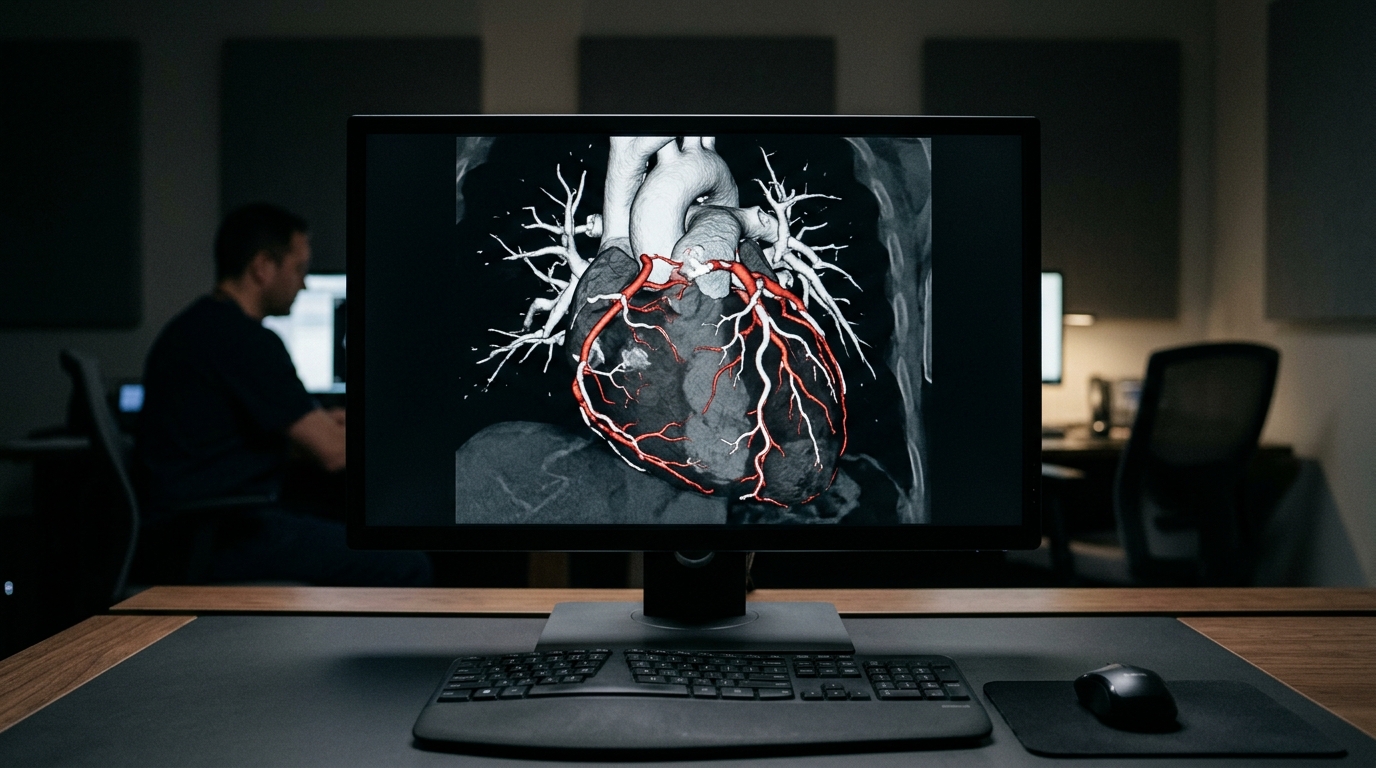
Researchers have developed a lightweight knowledge distillation framework named KDLight that incorporates adversarial training to improve coronary artery vessel segmentation while addressing computational costs. In experimental evaluations conducted across two datasets, the architecture outperformed existing state-of-the-art approaches in coronary vessel segmentation tasks, with performance improvements statistically confirmed by consistent p-values of less than 0.05.

Accurate vessel segmentation plays a significant role in diagnosing coronary atherosclerotic heart disease. While deep learning techniques have progressed in segmenting coronary vessels, existing deep learning-based approaches face substantial practical challenges. These limitations include high computational demands, a tendency toward overfitting when operating in small sample scenarios, and traditional loss functions that struggle to balance class imbalance alongside vascular topological continuity.

To overcome these computational and training obstacles, the investigators structured KDLight around three core components: an adversarial attacker module, a generator, and a knowledge distillation module. The system embeds an adversarial attack module featuring a black-box attacker upstream of the generator. Throughout the training process, this black-box attacker generates meaningful perturbations and adversarial examples, which strengthens the model’s generalization capacity and mitigates overfitting.

The distillation framework incorporates teacher and student refinement sub-networks utilizing two dedicated pathways: a feature-level similarity distillation module for feature extraction and a pixel-level similarity distillation module for vessel segmentation. Departing from conventional knowledge distillation setups, the teacher module operates as a segmentation network that ingests additional inputs to capture noise distributions and refine predictions during training. This accumulated knowledge is then transferred to the student module through feature-level distillation, enabling the student network to yield enhanced segmentation outputs.

Evaluation of the framework on Dataset 1 and Dataset 2 demonstrated superior generalization capabilities across varied coronary vessel segmentation tasks compared to benchmark methods. The authors confirmed these gains with consistent p-values below 0.05, establishing statistically verified segmentation improvements within the evaluated experimental datasets.

Subject of Research: Coronary artery vessel segmentation using lightweight knowledge distillation

Article Title: Exploring lightweight knowledge distillation with adversarial attack for efficient coronary artery vessel segmentation

Article References: Dang, H., Nie, X., Jing, S., & Li, P. (2026). Exploring lightweight knowledge distillation with adversarial attack for efficient coronary artery vessel segmentation. Frontiers in Artificial Intelligence, 9, Article 1891993. https://doi.org/10.3389/frai.2026.1891993

Image Credits: AI Generated

DOI: 10.3389/frai.2026.1891993

Keywords: coronary artery segmentation, knowledge distillation, adversarial attack, deep learning, vessel segmentation, medical image processing, atherosclerotic heart disease, Exploring, lightweight, knowledge, distillation, adversarial

News Source: Denise Maddox. (November 7, 2026). Lightweight Knowledge Distillation Framework Improves Coronary Artery Vessel Segmentation. Scienmag.


Tags: adversarialadversarial attackatherosclerotic heart diseasecoronary artery segmentationdeep learningdistillationExploringknowledgeknowledge distillationlightweightmedical image processingvessel segmentation
Share12Tweet7Share2ShareShareShare1

Related Posts

Fine-Grained Language Model Extracts Medication Data from Hungarian Clinical Narratives

Fine-Grained Language Model Extracts Medication Data from Hungarian Clinical Narratives

November 7, 2026
New Model Predicts Higher Fatigue Loads in Parked Wind Turbines

New Model Predicts Higher Fatigue Loads in Parked Wind Turbines

November 7, 2026

Synergistic Post-Processing Enhances Vacuum-Evaporated Blue Perovskite Light-Emitting Diodes

November 7, 2026

European Social Good Projects Reveal Crucial Machine Learning and Statistics Balance

November 7, 2026

POPULAR NEWS

  • Recycled Plastic Cladding Reinforced With Steel Fibers Withstands Intense Heat

    Recycled Plastic Cladding Reinforced With Steel Fibers Withstands Intense Heat

    29 shares
    Share 12 Tweet 7
  • Fungal Lys1 Enzymes Show Conserved Folds but Divergent Catalytic Kinetics

    29 shares
    Share 12 Tweet 7
  • Paediatric Asthma Emergency Acuity and Hospitalizations Surged in Alberta After Pandemic

    29 shares
    Share 12 Tweet 7
  • New Algorithm Accelerates Polarization and Direction-of-Arrival Estimation for Curved Sensor Arrays

    29 shares
    Share 12 Tweet 7

About

We bring you the latest biotechnology news from best research centers and universities around the world. Check our website.

Follow us

Recent News

UC Riverside Finds Sex-Specific Immune Roles in Fat

Polish Pig Farm Study Links Producer Groups to Higher Efficiency

Captivity Reduces Gut Microbial Diversity in Bengal Tigers

Subscribe to Blog via Email

Enter your email address to subscribe to this blog and receive notifications of new posts by email.

Join 86 other subscribers
  • Contact Us

Bioengineer.org © Copyright 2023 All Rights Reserved.

Welcome Back!

Login to your account below

Forgotten Password?

Retrieve your password

Please enter your username or email address to reset your password.

Log In
No Result
View All Result
  • Homepages
    • Home Page 1
    • Home Page 2
  • News
  • National
  • Business
  • Health
  • Lifestyle
  • Science

Bioengineer.org © Copyright 2023 All Rights Reserved.